Context
India is preparing for wider adoption of Sustainable Aviation Fuel (SAF) as the mandatory phase of ICAO’s CORSIA begins from 1 January 2027. India has announced indicative SAF blending targets of 1% in 2027, 2% in 2028 and 5% in 2030, initially for international flights.
What is Sustainable Aviation Fuel?
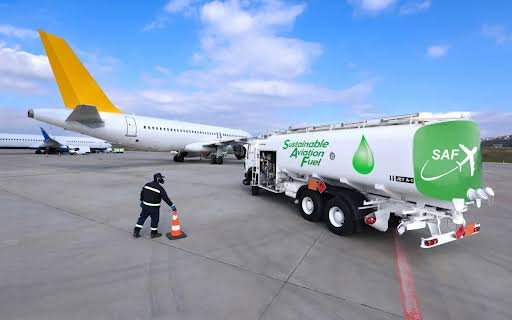
- SAF is an aviation fuel produced from renewable or alternative feedstocks such as used cooking oil, agricultural residues, biomass and other waste materials.
- Certified SAF is designed to meet aviation-fuel standards and can be blended with conventional Aviation Turbine Fuel (ATF) for use in existing aircraft.
- Its main advantage is lower lifecycle greenhouse-gas emissions, because emissions are assessed from feedstock production to final fuel use.
- India amended the ATF Control Order in 2026 to formally recognise SAF-blended and co-processed aviation fuel within the regulatory framework.
CORSIA and India’s SAF Roadmap
- CORSIA, developed by the International Civil Aviation Organization (ICAO), is the global framework for addressing emissions from international aviation.
- Its pilot phase covered 2021–23, followed by the first phase during 2024–26; the second phase runs from 2027–35.
- From 2027, India comes under mandatory CORSIA participation for covered international aviation activities.
- CORSIA uses 85% of 2019 international aviation emissions as the applicable baseline for the 2024–35 period.
- Airlines can reduce their offsetting requirement by using CORSIA-eligible fuels such as SAF, while approved carbon offsets remain another compliance route.
India’s Emerging SAF Ecosystem
- Feedstock advantage: Used cooking oil, crop residues and other wastes can be converted into SAF, linking aviation decarbonisation with waste management and the circular economy.
- Panipat facility: Indian Oil’s Panipat Refinery became the first Indian facility to receive ISCC CORSIA certification for SAF production.
- Policy preparation: India has completed an ICAO-supported SAF feasibility study covering feedstocks, production pathways, infrastructure and market readiness.
- Domestic opportunity: A strong agricultural and waste-resource base gives India potential to develop a domestic SAF supply chain if collection, processing and certification systems are scaled up.
Significance
- Aviation decarbonization: SAF lowers lifecycle emissions while allowing continued use of existing aircraft and fuel infrastructure.
- Waste-to-value: Waste oils and agricultural residues can become useful energy inputs instead of disposal burdens.
- Energy diversification: Domestic SAF production can gradually reduce dependence on conventional petroleum-based aviation fuel.
- Green industry: SAF can create new opportunities in bio-refining, waste collection, fuel certification and clean-energy supply chains.
Key Challenges
- High cost: SAF is generally more expensive than conventional ATF, creating a need for market support and scale.
- Feedstock supply: Reliable collection of used oils, biomass and agricultural residues is necessary for sustained production.
- Certification and traceability: Fuel must meet strict sustainability and aviation-safety standards before commercial use.
- Policy certainty: India is still developing a comprehensive SAF framework covering incentives, pricing, blending, certification and long-term market development.
FAQs
Q1. What is SAF?
A lower-carbon aviation fuel produced from renewable or alternative feedstocks.
Q2. What are India’s SAF blending targets?
1% in 2027, 2% in 2028 and 5% in 2030, initially for international flights.
Q3. What is CORSIA?
ICAO’s Carbon Offsetting and Reduction Scheme for International Aviation.
Q4. Which Indian facility first received ISCC CORSIA certification for SAF production?
Indian Oil’s Panipat Refinery.
Q5. Is SAF the only way to comply with CORSIA?
No. Airlines can use eligible fuels such as SAF and may also use approved carbon offsets.