Context
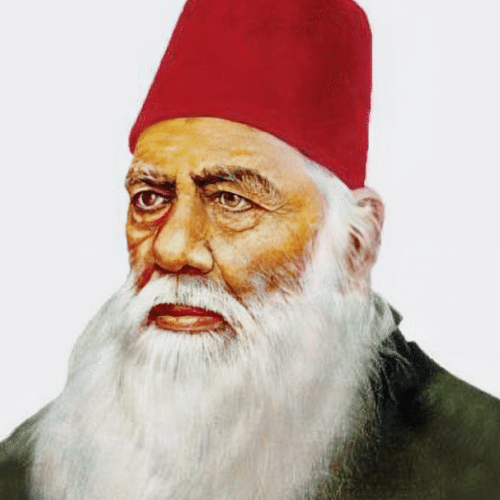
Sir Syed Ahmad Khan (1817–1898) was a major 19th-century reformer associated with the Aligarh Movement, modern education and socio-religious reform among Indian Muslims. His ideas evolved in response to the decline of Mughal authority, the Revolt of 1857, colonial rule and the emergence of representative politics.
Educational and Social Reform
- Sir Syed believed that social advancement required access to modern scientific and Western education.
- He promoted reason, scientific temper and reinterpretation of tradition, arguing that modern knowledge and cultural identity need not be treated as opposites.
- In 1864, he founded the Scientific Society at Ghazipur to translate and circulate works on science and modern knowledge in Indian languages.
- The Aligarh Institute Gazette, launched in 1866, helped disseminate educational, scientific and reformist ideas.
- In 1870, he started Tahzib-ul-Akhlaq, which focused on social reform, ethical conduct and intellectual renewal among Indian Muslims.
Aligarh Movement and Institutional Legacy
- In 1875, Sir Syed established the Muhammadan Anglo-Oriental School at Aligarh, which developed into the Muhammadan Anglo-Oriental College, formally inaugurated in 1877.
- The institution combined English and modern education with an Indian-Muslim cultural setting, making it the principal centre of the Aligarh Movement.
- He also promoted the Muhammadan Educational Conference, which helped spread modern education beyond Aligarh.
- The MAO College was later transformed into Aligarh Muslim University in 1920, after Sir Syed’s death.
Writings and Response to 1857
- In Asbab-e-Baghawat-e-Hind (The Causes of the Indian Revolt), Sir Syed argued that British administrative failures and inadequate understanding of Indian grievances contributed to the Revolt of 1857.
- He criticised the distance between the rulers and the ruled and favoured greater Indian participation in governance and legislative consultation.
- In The Loyal Mohammedans of India, he sought to challenge the colonial assumption that Indian Muslims as a whole had been disloyal during the revolt.
- His writings therefore combined criticism of colonial governance with an attempt to rebuild trust and protect Muslim interests after 1857.
Political Thought and Its Evolution
- Sir Syed initially prioritised education and social reform over organized political mobilization, arguing that educational advancement should precede political competition.
- He later opposed the Indian National Congress, fearing that representative politics in a socially and educationally unequal society could produce unequal political outcomes.
- In 1888, he helped establish the United Indian Patriotic Association, which opposed Congress politics and questioned its claim to represent all Indians.
- His political thinking was also influenced by the Hindi–Urdu controversy and wider debates over language, representation and political safeguards.
- His views on Hindu-Muslim relations therefore evolved over time and should not be reduced to a single fixed political position.
Historical Significance
- Educational modernization: He made modern and scientific education central to Muslim social advancement.
- Institution-building: His societies, journals, college and educational conference created a durable reform network.
- Intellectual reform: He encouraged engagement between reason, religion and modern knowledge.
- Political legacy: His later views contributed to debates on minority representation and representative politics in colonial India.
FAQs
Q1. Which movement is Sir Syed Ahmad Khan associated with?
The Aligarh Movement.
Q2. When and where was the Scientific Society founded?
At Ghazipur in 1864.
Q3. Which institution developed into Aligarh Muslim University?
The Muhammadan Anglo-Oriental College.
Q4. Which work analysed the causes of the Revolt of 1857?
Asbab-e-Baghawat-e-Hind.
Q5. Why did Sir Syed later oppose the Indian National Congress?
He feared that representative politics in an unequal society could disadvantage less educationally and politically advanced groups.