Context
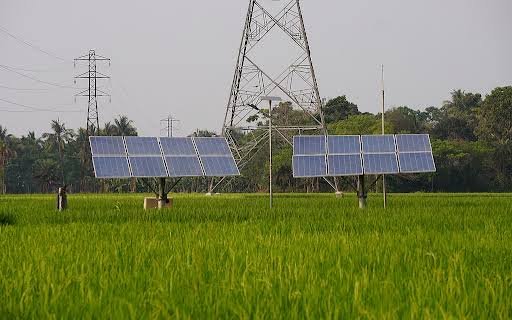
India is hosting the 7th World Agrivoltaics Conference in New Delhi from 21–23 October 2026, focusing on combining agriculture with solar power generation.
About PM-KUSUM: Objectives and Key Features
- Objective: The Pradhan Mantri Kisan Urja Suraksha evam Utthaan Mahabhiyan (PM-KUSUM) promotes solar energy in agriculture, reduces dependence on diesel pumps and enables farmers to earn additional income by selling surplus solar electricity.
- Nodal Ministry: The Ministry of New and Renewable Energy (MNRE).
- Key Features:
| Component | Key features |
| Component A | Promotes 10,000 MW of decentralised, grid-connected solar power plants, generally ranging from 500 kW to 2 MW. These can be established by farmers, Farmer Producer Organisations (FPOs), cooperatives and panchayats. |
| Component B | Supports the installation of 14 lakh standalone solar agricultural pumps, particularly to replace diesel pumps in areas without grid electricity. |
| Component C | Supports the solarisation of 35 lakh grid-connected agricultural pumps, allowing farmers to use solar energy for irrigation and sell surplus electricity to distribution companies, subject to applicable arrangements. |
- Solar Capacity Target: The scheme aimed to achieve 34,800 MW of total solar capacity by March 2026.
- Subsidy Pattern: Generally, the Central Government provides 30%, the State Government provides 30%, and the farmer contributes 40% of the eligible cost. Different funding provisions apply in certain regions.
Agrivoltaics (AgriPV)
- Definition: A dual land-use system that integrates agricultural production and solar power generation on the same land parcel by raising panels on elevated, stilt-mounted structures.
- Core Benefits: Maximizes land-use efficiency, lowers irrigation operating costs, generates additional non-farm income through grid power sales, and expands decentralized clean energy.
- Policy Relevance: Addresses the structural limitation highlighted in the Agriculture Census (2015–16)—where 86.07% of operational landholdings are below two hectares (small and marginal farmers)—by avoiding total land loss for solar deployment.
- Latest Policy Push: The proposed next phase of the PM-KUSUM Scheme introduces a dedicated Agri-PV component, targeting small/marginal farmers, Farmer Producer Organisations (FPOs), cooperatives, and panchayats.
Significance of PM-KUSUM
- Energy Security: Supplies reliable daytime solar power for agricultural irrigation, replacing diesel pumps and easing strain on conventional electricity grids.
- Additional Income: Enables farmers to transition from Annadata to Urjadata by selling surplus solar power back to DISCOMs via feed-in tariffs / net metering.
- Climate Benefits: Decarbonizes agricultural operations by curbing diesel consumption and lowering sectoral greenhouse gas emissions.
- Decentralized Power: Establishes distributed solar power plants (Component A) on barren/uncultivable land, strengthening rural grid resilience.
Challenges
- Groundwater Over-extraction: Near-zero marginal operating costs of solar pumps create perverse incentives for unregulated, continuous pumping.
- Weak Regulation: Inadequate monitoring by Central Ground Water Board (CGWB) and local authorities accelerates aquifer depletion in critical blocks.
- Monsoon Dependence: Over 60% of India’s annual groundwater recharge relies on monsoon rainfall, creating high climate vulnerability in rainfed zones.
- Unequal Access: High upfront capital costs (even post-subsidy) and limited credit lines favor affluent farmers over small and marginal landholders.
- Implementation Gaps: Financial stress in state DISCOMs, delayed subsidy disbursements, and lack of feeder-level metering hinder smooth rollout.
Way Forward
- Water-Efficient Irrigation: Promote drip and sprinkler irrigation under Per Drop More Crop.
- Groundwater Management: Ensure water budgeting, aquifer monitoring and community-based regulation of groundwater extraction.
- Sustainable Agrivoltaics: Develop crop-specific models that balance farming with solar power generation.
- Crop Diversification: Encourage less water-intensive crops through suitable incentives and market support.
- Case Study – Ralegan Siddhi (Maharashtra): Demonstrates community-led watershed management through check dams, percolation tanks, contour bunding, afforestation and gully plugging, supported by crop diversification.
FAQs
Q1. What is the primary objective of PM-KUSUM?
Ans. To promote solar energy in agriculture, reduce diesel dependence and increase farmers’ income.
Q2. Which ministry implements PM-KUSUM?
Ans. The Ministry of New and Renewable Energy (MNRE) is the nodal ministry.
Q3. What is agrivoltaics?
Ans. Agrivoltaics combines agricultural cultivation and solar electricity generation on the same land.
Q4. How can solar pumps worsen groundwater depletion?
Ans. Low operating costs may encourage excessive groundwater extraction, especially in poorly regulated areas.