Context
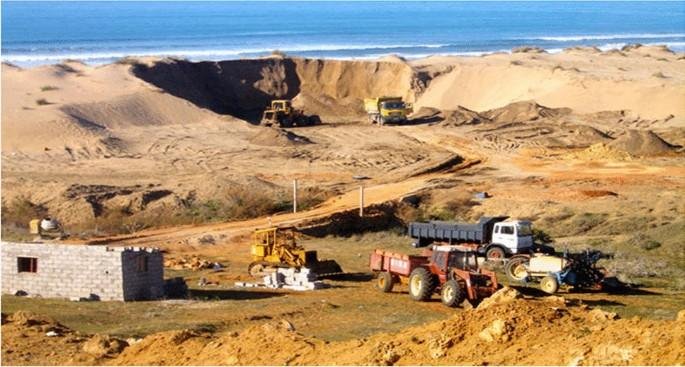
The National Green Tribunal (NGT) has sought a ground-level report on alleged collusion between an expert committee and illegal sand-mining operators in Madhya Pradesh.
About Sand Mining
- Legal Sand Mining: Extraction conducted under valid mining leases/permits and environmental clearance (EC), strictly following prescribed depth and replenishment limits.
- Illegal Sand Mining: Extraction or transportation that violates the Mines and Minerals (Development and Regulation) Act, 1957 (MMDR Act), environmental conditions, or state mining rules.
- Legal Framework: Sand is classified as a minor mineral under Section 3(e) of the MMDR Act, 1957. State Governments regulate minor-mineral mining, frame rules, and grant leases, while the Central Government lays down the broader legal framework and environmental clearance standards
Regulatory Framework
- MMDR Act, 1957: Primary legislation regulating mineral extraction; the 2015 amendment significantly strengthened penalties and strict enforcement mechanisms against illegal mining.
- Sustainable Sand Mining Management Guidelines, 2016: Formulated by the MoEFCC to promote scientific extraction, riverbed protection, and sustainable mining practices.
- Enforcement and Monitoring Guidelines, 2020: Introduced advanced tracking frameworks, including drones, satellite surveillance, and digital transit passes, to strengthen real-time monitoring and resource assessment.
- Environmental Clearance (EC): Mandated by the Supreme Court in Deepak Kumar v. State of Haryana (2012), making prior EC compulsory for minor-mineral mining irrespective of lease area size.
- District Survey Report (DSR): Serves as a mandatory prerequisite to identify suitable mining zones, estimate sand availability and annual replenishment rates, and map ecologically sensitive areas; requires mandatory updates every five years.
Penalties for Illegal Sand Mining
- Penalties: The 2015 amendment to the MMDR Act, 1957 provides for a fine of up to ₹5 lakh per hectare and imprisonment of up to five years for specified violations.
- Enforcement: State mining departments, district administrations and police are responsible for preventing illegal mineral extraction, transportation and storage.
Environmental and Governance Concerns
- Ecological Damage: Excessive, unscientific extraction alters river hydrology and sediment transport, causes riverbed deepening, erodes riverbanks, and degrades aquatic ecosystems.
- Revenue Loss: Unregulated extraction and illegal transportation cause substantial exchequer losses by evading state mining royalties and regulatory fees.
- Weak Enforcement & Collusion: National Green Tribunal (NGT) proceedings on the Sindh River (Madhya Pradesh) exposed severe regulatory oversight failures and administrative-mafia collusion in illegal sand extraction.
Way Forward
- Strengthen Enforcement: Conduct independent inspections, fix administrative accountability, and enforce strict action against corrupt monitoring officials.
- Deploy Technology: Utilize satellite imagery, remote sensing, GIS mapping, drones, and the Mining Surveillance System (MSS) to detect unauthorized extraction in real time.
- Improve Planning: Ensure regular updates of District Survey Reports (DSRs) based on rigorous, scientific sand-replenishment studies.
- Ensure Compliance: Enforce Environmental Clearance (EC) conditions, establish responsive grievance redressal, and impose strict financial penalties to safeguard river ecosystems and public revenue.
Additional Note: National Green Tribunal (NGT)
- Establishment: The NGT was established under the National Green Tribunal Act, 2010 for speedy disposal of environmental cases.
- Jurisdiction: Under Section 14, it handles civil cases involving a substantial question relating to the environment and can award relief and compensation for environmental damage.
- Covered Laws: Its jurisdiction includes laws on water pollution, forests, air pollution, environment protection, public liability insurance and biological diversity.
- Procedure: The NGT is not bound by the Code of Civil Procedure, 1908 or the Indian Evidence Act, 1872 and follows principles of natural justice. It aims to dispose of cases within 6 months.
- Key Principles: It applies sustainable development, precautionary principle and polluter pays principle while deciding cases.
- Benches: Its principal bench is in New Delhi, with zonal benches at Bhopal, Pune, Kolkata and Chennai.
- Appeal: NGT orders can be appealed before the Supreme Court within 90 days.
FAQs
Q1. Why is sand mining regulated by state governments?
Ans. Sand is a minor mineral under the MMDR Act, 1957, placing its regulation primarily under state governments.
Q2. What is a District Survey Report (DSR)?
Ans. A DSR identifies suitable mining zones, assesses sand availability and ecological constraints, and must be updated every five years.
Q3. What are the major environmental impacts of illegal sand mining?
Ans. It destabilises riverbeds, alters river flow, increases erosion and damages aquatic habitats.