Context
India had 7.43 GW of operational pumped storage capacity across 10 projects as of August 2026.
About Pumped Storage Hydropower
- Meaning: Pumped Storage Hydropower (PSH) is a hydroelectric energy storage technology designed to store surplus electricity during off-peak hours for later utilization during peak demand.
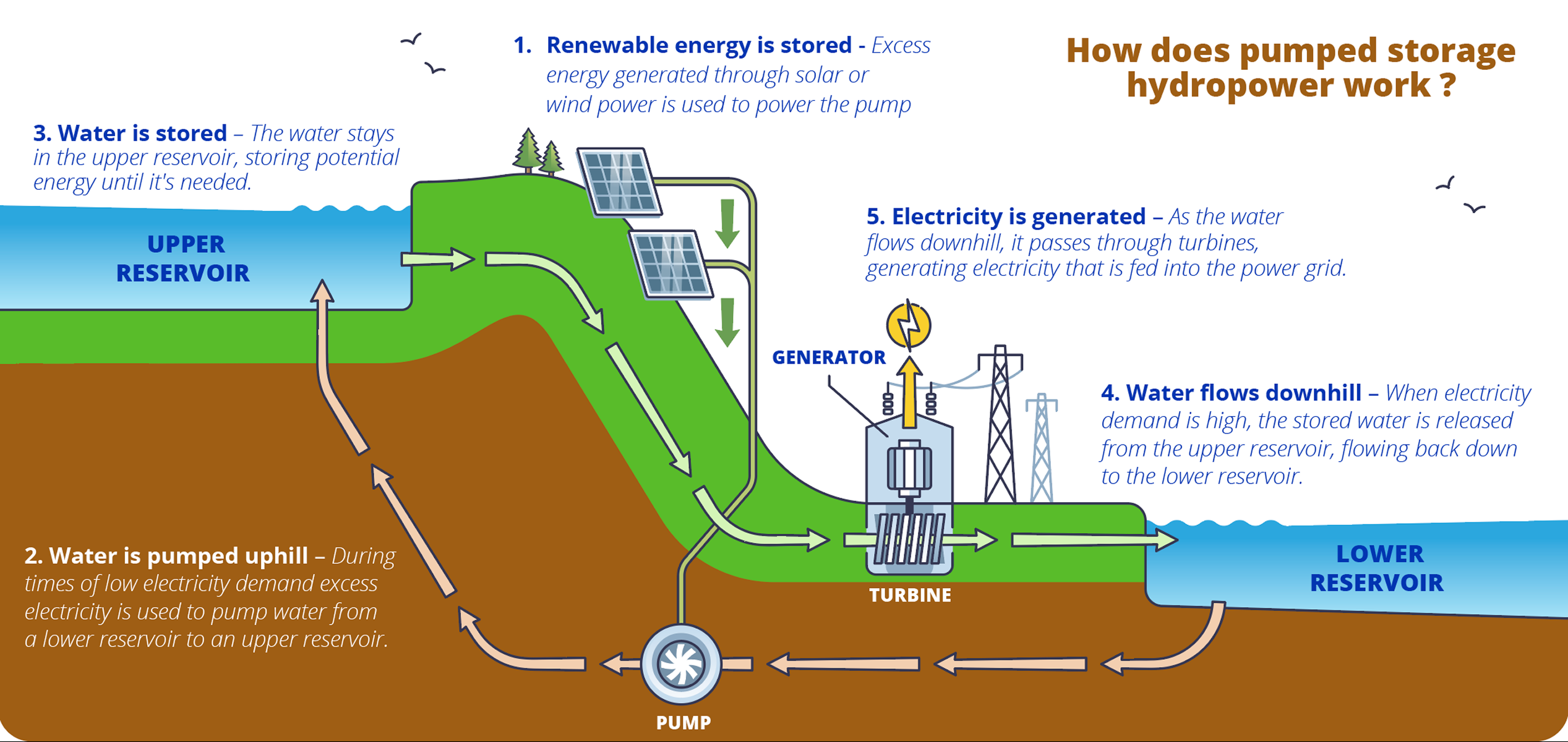
- Working Principle: Operates using two reservoirs at different elevations. Surplus power drives reversible pump-turbines to lift water to the upper reservoir; during peak demand, released water flows downward through turbines to generate electricity.
- Classification Types: Categorized based on their hydrological linkage to natural watercourses:
- On-stream: Both upper and lower reservoirs are built directly on a river, stream, or natural watercourse.
- Off-stream Open-Loop: One reservoir is connected to a natural watercourse, while the second is situated away from the river body.
- Off-stream Closed-Loop: Neither reservoir is located on a perennial river or stream; both reservoirs operate completely isolated from natural watercourses.
Significance
- Renewable Energy Integration: Stores surplus solar and wind power and supplies it when generation is low.
- Grid Stability: Balances electricity supply and demand and helps maintain grid frequency.
- Peak Demand Management: Provides power during sudden increases in electricity demand.
- Energy Security and Decarbonisation: Improves power supply reliability, reduces dependence on fossil-fuel-based thermal plants and supports the clean energy transition.
FAQs
Q1. What is Pumped Storage Hydropower?
Ans. It stores surplus electricity by pumping water to an upper reservoir and generates power by releasing it through turbines.
Q2. What are the main components of a PSH system?
Ans. Two reservoirs at different elevations, pumps, turbines and connecting water passages.
Q3. What are the three types of pumped storage projects?
Ans. On-stream, off-stream open-loop and off-stream closed-loop projects.