Context
- The Black Sea remains strategically important amid the Russia–Ukraine conflict, with continuing concerns over commercial shipping, grain exports, maritime security and access through the Turkish Straits.
Location and Surrounding Countries
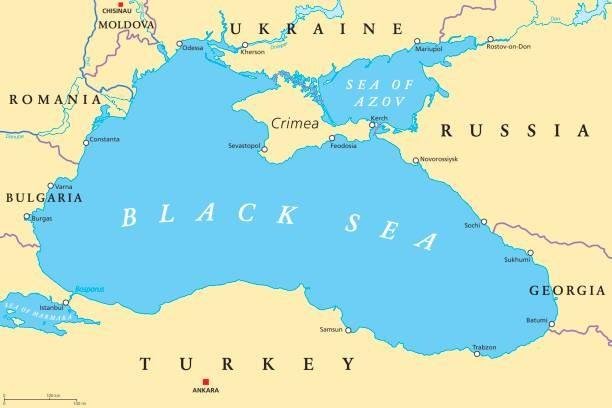
- The Black Sea lies between Eastern Europe and Western Asia.
- It is bordered by six countries: Bulgaria, Romania, Ukraine, Russia, Georgia and Türkiye.
- The Crimean Peninsula extends into the northern Black Sea.
- To the northeast, the Black Sea connects with the Sea of Azov through the Kerch Strait.
- It is linked to the Mediterranean maritime system through the Turkish Straits.
Physical Characteristics
- The Black Sea is a semi-enclosed inland sea with restricted exchange with the Mediterranean.
- Large river inflows, especially from the Danube, Dnieper and Dniester, lower the salinity of its upper waters.
- Its waters are strongly stratified, with limited vertical mixing between surface and deep layers.
- Much of the deeper Black Sea is anoxic, meaning it contains very little or no dissolved oxygen.
- These features make it one of the world’s best-known examples of a permanently stratified marine basin.
Rivers and Drainage
- Several major European rivers drain into the Black Sea.
- The most important are the:
- Danube
- Dnieper (Dnipro)
- Dniester
- The Danube reaches the sea through the Danube Delta near the Romania–Ukraine border.
- These river systems make the Black Sea important for the physical and economic geography of eastern and southeastern Europe.
Straits and Maritime Connectivity
- The Bosporus Strait connects the Black Sea with the Sea of Marmara.
- The Dardanelles Strait connects the Sea of Marmara with the Aegean Sea.
- The Aegean Sea opens into the Mediterranean Sea.
- Thus, the maritime sequence is:
Black Sea → Bosporus → Sea of Marmara → Dardanelles → Aegean Sea → Mediterranean Sea
- The Montreux Convention of 1936 regulates the passage of warships through the Turkish Straits and gives Türkiye an important strategic role in Black Sea security.
Strategic and Economic Significance
- Maritime gateway: The Turkish Straits provide Black Sea states access to the Mediterranean and global oceans.
- Food security: Black Sea ports are major outlets for grain and agricultural exports, especially from Ukraine and Russia.
- Energy importance: The region contains major ports, pipelines and maritime energy infrastructure.
- Geopolitical significance: It links Russia, Eastern Europe, the Caucasus and Türkiye and is central to wider Russia–Ukraine and Euro-Atlantic security tensions.
- Navigation risk: Conflict-related attacks and military activity can disrupt commercial shipping and regional trade.
FAQs
Q1. Which countries border the Black Sea?
Bulgaria, Romania, Ukraine, Russia, Georgia and Türkiye.
Q2. Which three major rivers drain into the Black Sea?
The Danube, Dnieper and Dniester.
Q3. Which strait connects the Black Sea with the Sea of Marmara?
The Bosporus Strait.
Q4. Which strait connects the Sea of Marmara with the Aegean Sea?
The Dardanelles Strait.
Q5. Why are the deeper waters of the Black Sea anoxic?
Because strong water-column stratification limits vertical mixing and oxygen supply to deeper layers.