Context
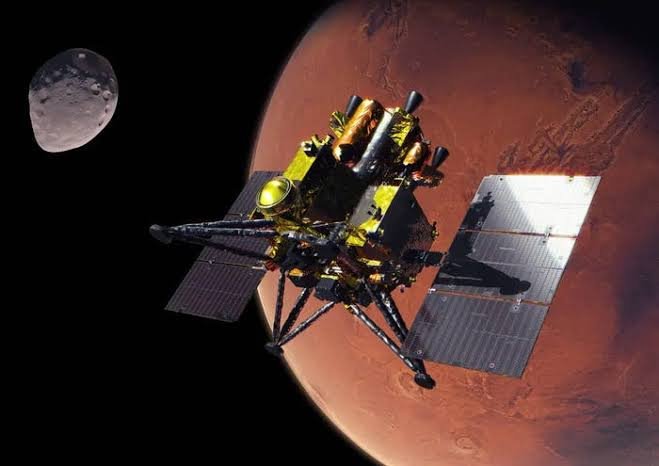
Japan’s Martian Moons eXploration (MMX) spacecraft was launched on 20 October 2026 aboard an H3 rocket from Tanegashima Space Center, beginning a mission to study Mars’ moons and return samples from Phobos to Earth.
Mission and Scientific Objectives
- MMX is a sample-return mission led by the Japan Aerospace Exploration Agency (JAXA), with Phobos as its primary target.
- It will study the topography, internal structure, composition and gravity of Phobos and also observe Mars’ second moon, Deimos.
- The mission aims to collect at least 10 grams of surface material from Phobos and return it to Earth in 2031.
- A major objective is to determine whether Phobos and Deimos are captured asteroids or formed from debris generated by a major impact involving Mars.
- Returned samples may also provide clues about the movement of water and organic-rich material in the early Solar System.
Mission Profile
- MMX is expected to reach the Martian system in 2027 and operate in a quasi-satellite orbit around Phobos for detailed observations.
- The spacecraft will conduct close surveys, identify suitable sampling sites and perform two soft-landing operations on Phobos for sample collection.
- Surface material will be collected using a JAXA-developed pneumatic sampling system, which uses pressurised gas to lift loose particles into the collection mechanism.
- After completing its Phobos operations, MMX will also observe Deimos through flybys.
- The sample-return capsule is planned to reach Earth in 2031, with recovery in Australia.
International Contributions
- France’s CNES and Germany’s DLR have jointly developed the Idefix rover, which will explore the surface of Phobos.
- The rover will study the moon’s surface properties, mineralogy and mechanical characteristics and provide surface data to support and calibrate the mother spacecraft’s landing preparations.
- NASA contributes MEGANE, a gamma-ray and neutron spectrometer designed to determine the elemental composition of Phobos.
- The mission combines Japanese leadership with international scientific instruments and surface-exploration capabilities.
Significance of the Mission
- Origin of Martian moons: Returned samples can help distinguish between competing theories about the formation of Phobos and Deimos.
- Mars system evolution: The moons may preserve evidence about the early history of Mars and material exchanged within the Martian system.
- Sample-return science: Laboratory analysis on Earth can provide far greater precision than remote sensing alone.
- Exploration technology: MMX advances capabilities in small-body landing, robotic surface operations, sampling and sample return.
FAQs
Q1. Which organisation leads the MMX mission?
The mission is led by the Japan Aerospace Exploration Agency (JAXA).
Q2. What is the primary target of MMX?
Its primary target is Phobos, one of Mars’ two moons.
Q3. How much material will MMX collect from Phobos?
It aims to return at least 10 grams of surface material.
Q4. Which instrument has NASA contributed to MMX?
NASA contributes MEGANE, a gamma-ray and neutron spectrometer.
Q5. When is the Phobos sample expected to return to Earth?
The sample-return capsule is targeted to reach Earth in 2031.