Context
Scientists have recently observed an unusual Hall effect, showing that it can occur even when the magnetic field is not perpendicular to the material.
About Hall Effect
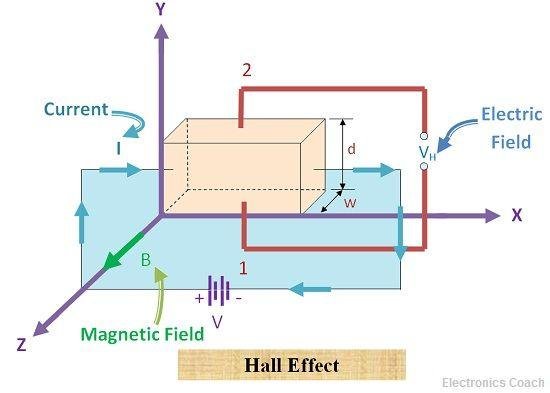
- Hall Effect is the production of a voltage across a conductor or semiconductor when electric current flows through it in the presence of a magnetic field.
- It was discovered by American physicist Edwin H. Hall in 1879.
- How does it work?
- Electric current causes charged particles to move through a material.
- When a magnetic field is applied, the moving charges experience a sideways Lorentz force.
- Lorentz force is the force experienced by a charged particle when it moves through an electric or magnetic field.
- This force pushes the charges towards opposite sides of the material, creating a voltage called Hall voltage.
- This voltage can be measured to detect the magnetic field.
- Semiconductors such as silicon and germanium generally produce a stronger Hall voltage, making them useful for accurate sensing.
- Applications: Hall-effect sensors are used for:
- Magnetic field measurement
- Proximity and position sensing
- Speed detection
- Current measurement
- Switches and joysticks
Recent Findings
- Earlier, scientists believed that the Hall effect mainly occurred when the magnetic field was perpendicular to the material.
- New research shows that a Hall response related to magnetisation can also occur in other directions.
- This could help scientists better understand complex magnetic and topological structures and aid the development of advanced electronic and magnetic devices.
FAQs
Q1. What is the Hall Effect?
It is the production of a voltage across a conductor/semiconductor when current flows in the presence of a magnetic field.
Q2. Who discovered the Hall Effect?
American physicist Edwin H. Hall in 1879.
Q3. How does the Hall Effect work?
Moving charges in a current experience a sideways Lorentz force under a magnetic field, creating a measurable Hall voltage.
Q4. What is the Lorentz force?
It is the force on a charged particle moving through an electric or magnetic field, deflecting it sideways.
Q5. Why does Hall voltage form?
Charges accumulate on opposite sides of the material due to Lorentz force, generating a transverse voltage.