Context
Germany has recently carried out a successful LORA missile test in the North Atlantic.
About LORA missile
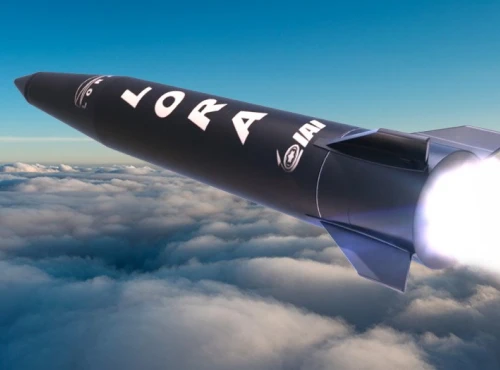
- Long Range Artillery (LORA) is a short-range ballistic missile associated with Israel, which developed and operates the system.
- It is meant for engaging high-value targets located deep within enemy territory.
- The system supports both land and maritime launches. Its land-based configuration is road-mobile.
- The missile is believed to have entered Israeli service in 2007.
Technical Characteristics
- LORA employs a single-stage solid-propellant propulsion system.
- At launch, it weighs approximately 1,600 kg and measures 5.2 m in length with a 0.624 m diameter.
- Its payload capacity is up to 600 kg and may include a high-explosive (HE) warhead or submunitions.
- The missile can reportedly cover around 280 km.
- For navigation and target approach, it uses INS (Inertial Navigation System) and GPS (Global Positioning System), supported by TV-based terminal guidance. The system may also permit manoeuvring during flight.
LORA Missile FAQs
Q1. What is the principal operational purpose of LORA?
Ans: The missile is intended to engage high-value targets deep inside enemy territory.
Q2. What does the mobility of LORA refer to?
Ans: Its land-based configuration is road-mobile, while the missile can also be operated from sea-based launch platforms.
Q3. What are the payload options available for LORA?
Ans: It can accommodate a payload of up to 600 kg, including an HE warhead or submunitions.
Q4. What propulsion technology is used in LORA?
Ans: LORA uses a single-stage solid-propellant propulsion system.
Q5. Which guidance technologies are incorporated in the missile?
Ans: It combines INS and GPS for navigation with TV guidance for the terminal phase and may have an in-flight manoeuvring capability.
Q6. What is the reported range of the missile?
Ans: LORA has a reported range of approximately 280 km.