Context
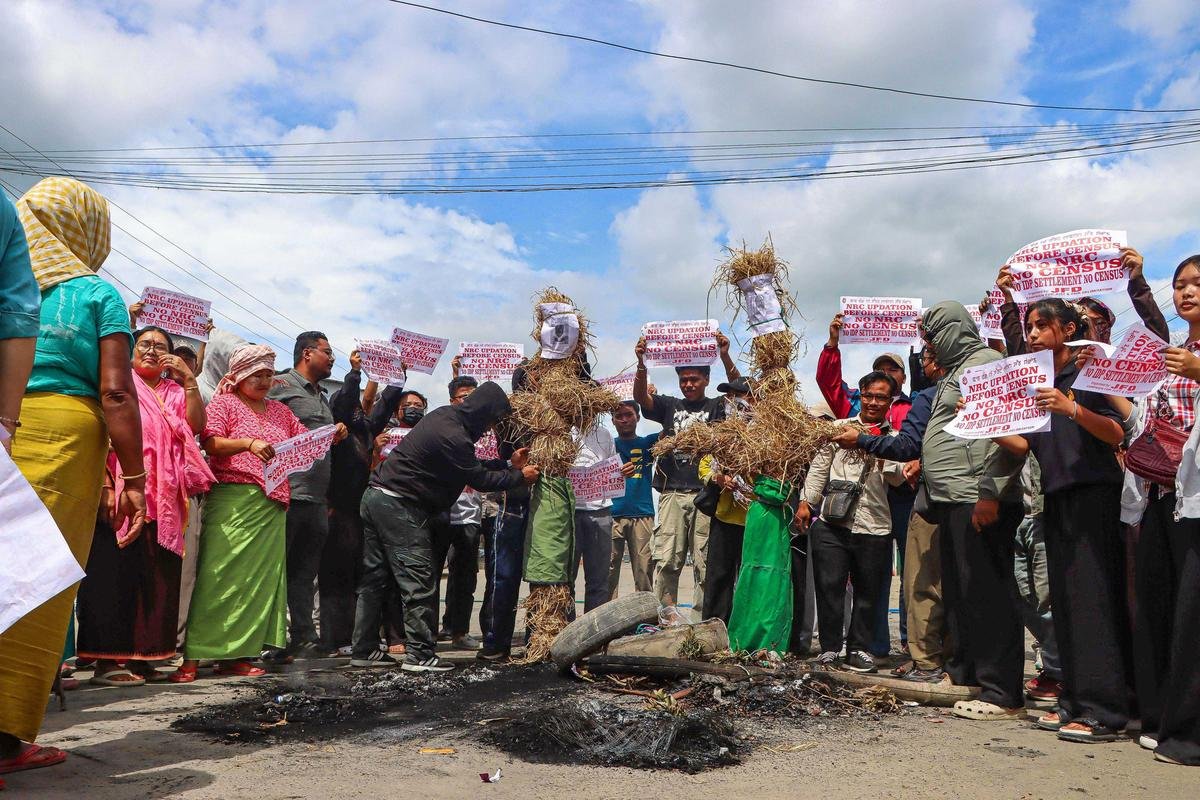
The Centre has deferred the house-listing operations of Census 2027 in Manipur until further declaration. The decision came amid demands from several civil society groups for updating the National Register of Citizens (NRC) before the Census. The Manipur High Court had also directed that the house-listing exercise remains in abeyance until the next hearing.
The issue has brought three concerns together:
- Citizenship: Identification of Indian citizens and alleged illegal immigrants.
- Demography: Changes in population patterns amid migration and displacement.
- Representation: The possible impact of updated population data on future delimitation.
Why the Census Has Become Controversial
- Concerns over demographic change:
- Civil society organisations have alleged that migration from Myanmar has altered the demographic composition of parts of Manipur. They argue that citizenship verification should precede population enumeration.
- However, population growth alone cannot establish illegal immigration. Demographic changes can have several causes and require independent verification through legal and documentary evidence.
- Displacement after the 2023 conflict
- The ethnic conflict that began in May 2023 displaced large numbers of people from their homes.
- Some Meitei organisations argue that conducting the Census while displacement continues could produce a population distribution that does not reflect the normal residential pattern. They have therefore sought greater clarity on the treatment of displaced persons before enumeration.
- Link with political representation
- Census figures are important for demographic assessment and can become relevant to future delimitation.
- This makes the timing of the Census politically sensitive because changes in officially recorded population could eventually affect the territorial distribution of electoral constituencies.
Background to the NRC Demand
The demand for an NRC in Manipur has been formally raised for several years.
- In June 2022, the Coordinating Committee on Manipur Integrity (COCOMI) and the United Naga Council (UNC) demanded an NRC and a State Population Commission.
- The Manipur Legislative Assembly passed a resolution supporting the demand on 5th August 2022 and reaffirmed it on 1st March 2024. The Assembly again urged the Centre to update the NRC before the Census in September 2026.
- A State Population Commission was constituted in February 2023 to examine demographic changes and the issue of illegal immigrants.
Supporters have pointed to differences in population growth between the hills and valley as evidence of demographic concerns. Such differences, however, do not by themselves establish illegal immigration.
The Myanmar Dimension
- The 2021 military coup in Myanmar intensified conflict in the country’s Chin State and contributed to cross-border movement into India’s Northeast.
- The issue is particularly sensitive in Manipur because of ethnic and familial links across the India–Myanmar border.
- The State government has raised concerns regarding:
- New settlements
- Encroachment
- Poppy cultivation
- Pressure on land and resources
- Kuki-Zo organisations, however, have opposed treating recent migrants and Indian citizens as a single category.
- The Centre also ended the Free Movement Regime (FMR) in 2024, citing security and demographic concerns.
Kuki-Zo Position
- The Kuki-Zo community and its representative organisations have opposed the demand to make an NRC a precondition for the Census.
- Their principal concerns are:
- NRC is governed by the Central legal framework and cannot simply be implemented as an independent State exercise.
- Allegations of illegal immigration should be established through credible evidence rather than demographic assumptions.
- An old citizenship cutoff could affect families with long-standing links across the international border.
- Future delimitation should be based on verified demographic data.
- The disagreement therefore extends beyond the timing of the Census to the method used for establishing citizenship and determining population-based representation.
Delimitation and Manipur
- Manipur has 60 Assembly constituencies:
-
- 40 in the valley
- 20 in the hills
- The existing constituency arrangement largely dates to the 1973 delimitation, which was based on the 1971 Census.
- Manipur was excluded from the 2002–2008 national delimitation exercise, along with Assam, Arunachal Pradesh and Nagaland, because of security-related concerns and questions regarding the reliability of Census data.
- The 2001 Census had also generated controversy because some hill subdivisions recorded exceptionally high population growth.
- Thus, a fresh Census has significance not only for demographic statistics but also for the future debate over electoral boundaries and political representation.
Legal Position on NRC
- The Citizenship Act, 1955, particularly Section 14A, provides the statutory basis for maintaining the National Register of Indian Citizens (NRIC).
- However:
-
- The NRC operates within the Central legal and administrative framework.
- A State government cannot independently establish an NRC outside that framework.
- The timing, methodology and scope of an NRC therefore require appropriate action under the central legal framework.
- The National Population Register (NPR) and NRC are related to population and citizenship documentation but are distinct exercises.
Other Measures Underway
- The Centre constituted a High-Level Committee on Demographic Change in May 2026 to examine demographic changes arising from illegal immigration and other abnormal factors and recommend appropriate policy, legal and administrative measures.
- Manipur has also undergone a Special Intensive Revision (SIR) of electoral rolls. The final electoral roll published on 6 September 2026 contained 19,60,620 electors. The revision involved deletion of 1,89,327 names and addition of 56,871 names.
- The SIR is an electoral-roll exercise and should not be confused with either the Census or an NRC.
Way Forward
- A credible resolution requires accurate data, lawful procedures and confidence among different communities.
-
- Conduct population enumeration through a transparent and verifiable process.
- Examine citizenship claims using established legal and documentary procedures.
- Distinguish between Indian citizens, displaced persons and recent migrants through appropriate verification mechanisms.
- Keep citizenship determination and electoral delimitation institutionally distinct.
- Base future delimitation on officially verified population data.
- Consult all major communities, including valley, hill and tribal groups, before taking decisions with long-term demographic or political consequences.
Conclusion
The Manipur debate illustrates how citizenship, demographic change and political representation can become interconnected. The immediate priority should be to establish a credible process for collecting and verifying demographic information while respecting the constitutional and legal framework. This is essential for maintaining public confidence in both citizenship administration and electoral representation.
UPSC-Oriented FAQs
- Why has Census 2027 become controversial in Manipur?
Several groups want citizenship-related concerns, particularly the demand for an NRC, to be addressed before population enumeration. The issue is also linked to displacement and future political representation.
- What is the NRC?
The National Register of Citizens (NRC) is a mechanism for identifying persons recognised as Indian citizens. Its statutory framework is provided under the Citizenship Act, 1955.
- Can Manipur independently implement an NRC?
No. Citizenship registration operates within the central statutory and administrative framework. A State cannot unilaterally create an NRC outside that framework.
- Why is delimitation important in Manipur?
Delimitation determines the boundaries of electoral constituencies. Updated population data can therefore influence future decisions concerning political representation.
- How is Myanmar connected with the demographic debate?
The conflict following Myanmar’s 2021 military coup led to cross-border movement into India’s Northeast. Ethnic links across the border have made migration a particularly sensitive issue in Manipur.
- Why is the 1973 delimitation significant?
The existing Assembly constituency arrangement largely dates to the 1973 delimitation, which used the 1971 Census as its population basis.
- Can population growth alone establish illegal immigration?
No. Population changes may result from natural increase, migration, displacement and other factors. Illegal immigration requires independent legal and documentary verification.