Context
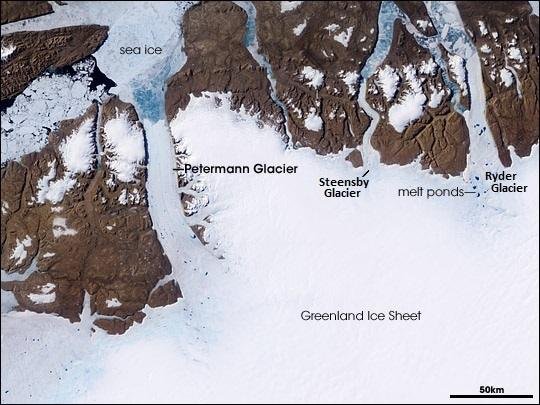
Petermann Glacier in northwest Greenland calved a 76.4 sq. km ice island.
About Petermann Glacier
- Location: Northwest Greenland, east of the Nares Strait, a narrow sea passage between Greenland and Ellesmere Island, Canada.
- It is a major glacier of the Greenland Ice Sheet that extends towards the Arctic Ocean through a floating ice tongue.
- Area: About 1,295 sq. km.
- It is named after August Heinrich Petermann, a German cartographer.
- Calving means the breaking away of ice from the front of a glacier, forming an iceberg or ice island.
Significance
- Ocean warming: Warmer seawater can melt the floating ice tongue from below and weaken it.
- Ice-flow changes: Changes in the floating ice tongue can affect the movement of ice from Greenland towards the ocean.
- Buttressing effect: The floating ice tongue helps slow the movement of land-based ice towards the ocean. Its weakening can increase ice discharge.
- Sea-level rise: Floating ice does not directly raise sea levels when it melts. However, the loss of land-based ice from Greenland contributes to global sea-level rise.
Conclusion
The recent ice loss highlights changes in Greenland’s glacier dynamics. Monitoring Petermann Glacier is important for understanding Arctic ice loss and its impact on global sea levels.
- Where is Petermann Glacier located?
Petermann Glacier is located in northwest Greenland, east of the Nares Strait, which separates Greenland from Ellesmere Island, Canada.
- What was the recent development involving Petermann Glacier?
On 4 August 2026, the glacier broke off a 76.4 sq. km ice island, marking its largest floating-ice loss since 2012.
- What is calving?
Calving is the process in which ice breaks away from the front of a glacier, forming an iceberg or ice island.
- What is the Nares Strait?
The Nares Strait is a narrow sea passage between Greenland and Ellesmere Island of Canada, connecting the Arctic Ocean with the waters to the south.
- What is the buttressing effect of floating ice?
A floating ice tongue can act as a supporting barrier, slowing the movement of land-based ice towards the ocean. Its weakening may increase ice discharge.
- Does melting floating ice directly raise sea levels?
No. Floating ice is already in the ocean. However, weakening of the floating ice tongue can allow more land-based ice to enter the ocean, contributing to sea-level rise.
- Why is Petermann Glacier important for climate studies?
Changes in Petermann Glacier provide insights into Greenland’s ice loss, Arctic warming and potential changes in global sea levels.