Context
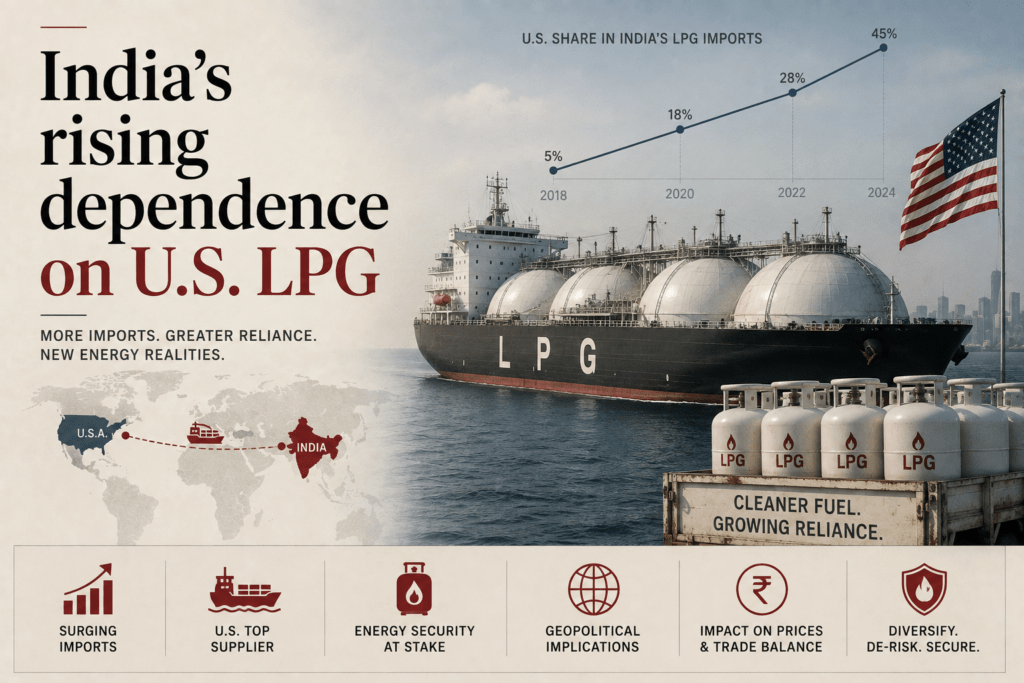
India now sources around 67% of its LPG imports from the United States, compared with about 10% earlier, following disruptions in supplies from West Asia. India is the world’s second-largest LPG importer and meets nearly 60% of its LPG demand through imports.
Why India Shifted to U.S. LPG
- Nearly 90% of India’s imported LPG traditionally passes through the Strait of Hormuz, making the chokepoint critical to the country’s energy supply.
- Between February and June 2026, LPG imports from West Asia declined by nearly 85% amid regional disruptions.
- To maintain domestic availability, state-owned oil refiners secured an agreement for 2.2 million tonnes of U.S. LPG in 2026.
- U.S. supplies reached 0.77 million metric tonnes in June 2026, an increase of 19.4% over May.
Economic and Supply Challenges
- Shipping time: Cargoes from the Gulf generally reach India in 5–10 days, while shipments from the U.S. take around 25–35 days.
- Delivered cost: U.S. LPG may be cheaper at the production stage, but Gulf supplies have traditionally benefited from lower transportation costs because of their proximity to India.
- Price volatility: The Saudi Aramco LPG benchmark rose by nearly 46%, from about $543 to $790 per tonne, between February and June 2026.
- Currency risk: Greater reliance on imported LPG increases the impact of rupee-dollar fluctuations on the domestic cost of the fuel.
Domestic Production Gap
- Indian Oil, Bharat Petroleum and Hindustan Petroleum together had around 14 crore active domestic LPG customers.
- Their customer base grew at a 7.6% CAGR between 2015 and 2026.
- Domestic LPG production stood at 4.3 million metric tonnes, against consumption of 6.5 million metric tonnes.
- During the supply disruption, refinery output was raised from around 34,000 tonnes to 55,000 tonnes per day at the peak.
- Domestic LPG production increased by 35.73% year-on-year in Q1 FY27.
Fiscal Implications
- LPG is a crucial household fuel, making uninterrupted supply an important policy priority.
- When international prices rise while domestic prices remain controlled, oil marketing companies (OMCs) can face higher under-recoveries.
- The government informed Parliament that accumulated OMC under-recoveries had crossed ₹59,000 crore.
Way Forward
India needs to reduce concentration risk through a combination of:
- Supplier diversification: Explore additional sources such as Australia, Argentina, Nigeria and Angola.
- Higher domestic production: Expand refining and LPG-processing capacity to narrow the supply gap.
- Strategic reserves: Build larger buffers to manage temporary disruptions.
- Forex risk management: Strengthen foreign-exchange hedging by OMCs.
- Resilient logistics: Diversify shipping routes and supply contracts to reduce exposure to individual chokepoints.
Conclusion
The shift to U.S. LPG helped India manage a temporary supply disruption. Long-term energy security, however, requires diversified suppliers, stronger domestic production and resilient supply chains.
Frequently Asked Questions
Q1. Why has India increased LPG imports from the U.S.?
Ans: Disruptions around the Strait of Hormuz reduced supplies from West Asia, prompting India to secure additional U.S. LPG cargoes.
Q2. What share of India’s LPG imports comes from the U.S.?
Ans: The latest figure cited is 67%, compared with around 10% earlier.
Q3. Why do U.S. LPG shipments involve higher transportation costs?
Ans: U.S. cargoes travel a longer distance to India and take around 25–35 days, compared with 5–10 days for shipments from the Gulf.
Q4. What is India’s domestic LPG production gap?
Ans: In Q1 FY27, domestic production was 4.3 million metric tonnes, while consumption stood at 6.5 million metric tonnes.
Q5. What are the main risks of concentrated LPG imports?
Ans: Key risks include geopolitical disruptions, freight costs, international price volatility and exchange-rate fluctuations.
Q6. How can India strengthen LPG energy security?
Ans: India can strengthen energy security by increasing domestic production, diversifying suppliers, expanding strategic reserves, improving forex-risk management and strengthening logistics.