Context
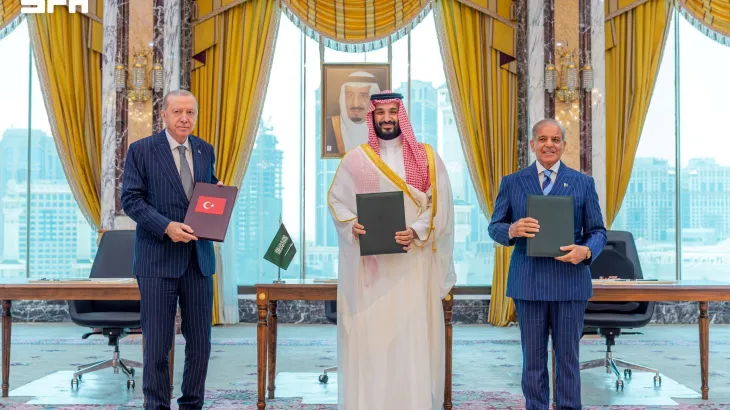
Saudi Arabia, Türkiye and Pakistan signed the Mecca Joint Defence Agreement on 7 August 2026, establishing a trilateral framework for defence cooperation. A key provision states that an armed attack against any one of the three countries will be treated as an attack against all three.
Evolution of the Defence Partnership
- The Mecca Agreement expands the earlier Saudi-Pakistan security partnership into a trilateral framework involving Türkiye.
- The three countries bring different strategic capabilities to the arrangement. Saudi Arabia contributes substantial financial resources and a strategically important geographical position. Türkiye brings significant military capabilities, NATO experience and a growing defence-industrial base. Pakistan contributes military experience, manpower and nuclear capability.
- The complete text of the agreement has not been publicly released. Therefore, the precise scope of its operational commitments and response mechanisms remains unclear.
Major Areas of Cooperation
- The agreement seeks to promote cooperation in collective deterrence, military training, joint exercises, intelligence-sharing and defence-industrial cooperation.
- It also provides scope for greater collaboration in defence production and military technologies. Türkiye’s defence-industrial capabilities can complement Saudi Arabia’s efforts to strengthen domestic defence manufacturing.
- The framework is supported by institutional arrangements for continued coordination. However, it does not yet have the level of integrated military command and institutional maturity associated with NATO.
- The publicly available information does not establish a specific provision for nuclear sharing. The agreement is therefore best understood as a framework for defence cooperation and collective deterrence, rather than a fully integrated military alliance.
Changing Security Environment in West Asia
- The agreement comes amid continuing instability in West Asia and efforts by regional countries to strengthen their security capabilities and diversify strategic partnerships.
- Saudi Arabia has sought to develop multiple security relationships while enhancing its own defence capabilities. Türkiye has expanded its regional defence role, while Pakistan has maintained longstanding military ties with Saudi Arabia.
- The arrangement reflects a broader trend towards greater regional participation in security affairs and additional mechanisms for collective deterrence.
Collective Defence and the NATO Comparison
- The provision that an armed attack against one member will be treated as an attack against all three resembles Article 5 of the NATO Treaty. Türkiye’s Foreign Minister has also described the collective-defence principle as technically comparable to NATO’s provision.
- However, the two arrangements differ in institutional development. NATO has a permanent organisation, integrated military structures, established procedures and decades of operational experience. The Mecca framework is newly established and its institutional and operational mechanisms are still developing.
- Its immediate significance therefore lies in collective deterrence and strategic signalling, while its long-term effectiveness will depend on practical military cooperation among the three members.
Regional Significance
- The agreement could contribute to the evolution of a more regionally driven security architecture in West Asia.
- For Saudi Arabia, closer defence relations with Türkiye and Pakistan provide additional strategic options. Türkiye can deepen its defence engagement with the Gulf, while Pakistan can strengthen its military relationship with Saudi Arabia and expand defence cooperation with Türkiye.
- The pact may also influence the broader strategic balance involving Iran, Israel, Gulf countries and major external powers. However, it should not be described as formally directed against any particular country without an explicit provision to that effect. The participating countries have presented it as a defensive arrangement.
Implications for India
- The agreement is significant for India because Pakistan and Türkiye are members of the new framework, while Saudi Arabia is an important Indian strategic partner.
- India-Saudi Arabia relations have expanded across energy, trade, investment, defence, counterterrorism and the welfare of the Indian diaspora. At the same time, India’s relations with Pakistan and Türkiye remain more challenging.
- A closer Saudi-Pakistan-Türkiye security relationship could provide Pakistan with greater strategic space in West Asia and deepen Türkiye’s defence engagement with the Gulf. For India, this makes sustained engagement with Saudi Arabia and other Gulf countries increasingly important.
- India would also need to continue strengthening its defence diplomacy, maritime presence in the Indian Ocean and wider engagement with West Asian partners. The objective should be to safeguard India’s strategic interests while preventing regional developments from adversely affecting its wider partnerships.
Challenges to the Emerging Framework
- The long-term effectiveness of the agreement will depend on how far political commitments are translated into practical defence cooperation.
- The three countries have different strategic priorities, threat perceptions and relationships with major powers. Their willingness and ability to coordinate during an actual security crisis will determine the credibility of the collective-defence commitment.
- The limited public availability of the agreement’s detailed provisions also makes it difficult to assess the precise circumstances and mechanisms through which collective defence would operate.
Conclusion
- The Mecca Agreement marks an important development in the evolving security architecture of West Asia. By bringing Saudi Arabia, Türkiye and Pakistan into a common defence framework, it expands the earlier Saudi-Pakistan security partnership and creates greater scope for cooperation in military affairs, intelligence and defence production.
- However, the arrangement should not yet be equated with NATO. Its long-term significance will depend on the development of effective institutional mechanisms, military interoperability and credible collective-deterrence arrangements.
- For India, the development highlights the importance of sustained engagement with Saudi Arabia, the Gulf region and the wider Indian Ocean, while carefully assessing the changing strategic relationships among regional powers.
Frequently Asked Questions
Q1. What is the Mecca Agreement?
Ans: The Mecca Joint Defence Agreement is a trilateral defence framework involving Saudi Arabia, Türkiye and Pakistan. It provides that an armed attack against one member will be treated as an attack against all three.
Q2. Which earlier agreement provided the basis for the Mecca Agreement?
Ans: It builds on the Saudi-Pakistan Strategic Mutual Defence Agreement, signed in September 2025, which established a bilateral collective-defence framework between the two countries.
Q3. What are the major areas of cooperation under the agreement?
Ans: The framework seeks to strengthen collective deterrence, military training, joint exercises, intelligence-sharing and defence-industrial cooperation.
Q4. Is the Mecca Agreement equivalent to NATO?
Ans: No. Its collective-defence provision resembles NATO’s Article 5, but NATO has a much more developed institutional structure and integrated military system. The Mecca framework is still evolving.
Q5. What strategic capabilities do the three countries bring to the partnership?
Ans: Saudi Arabia provides financial and geographical advantages, Türkiye contributes NATO experience and defence-industrial capabilities, while Pakistan contributes military experience, manpower and nuclear capability.
Q6. What are the implications of the agreement for India?
Ans: The arrangement could increase Pakistan’s strategic space in West Asia and deepen Türkiye’s defence relationship with Saudi Arabia. India therefore needs to maintain strong engagement with Saudi Arabia and the Gulf region while strengthening its wider defence and maritime partnerships.
Q7. What will determine the long-term effectiveness of the agreement?
Ans: Its credibility will depend on institutional mechanisms, military interoperability, intelligence cooperation and the willingness of the three countries to coordinate during an actual security crisis.