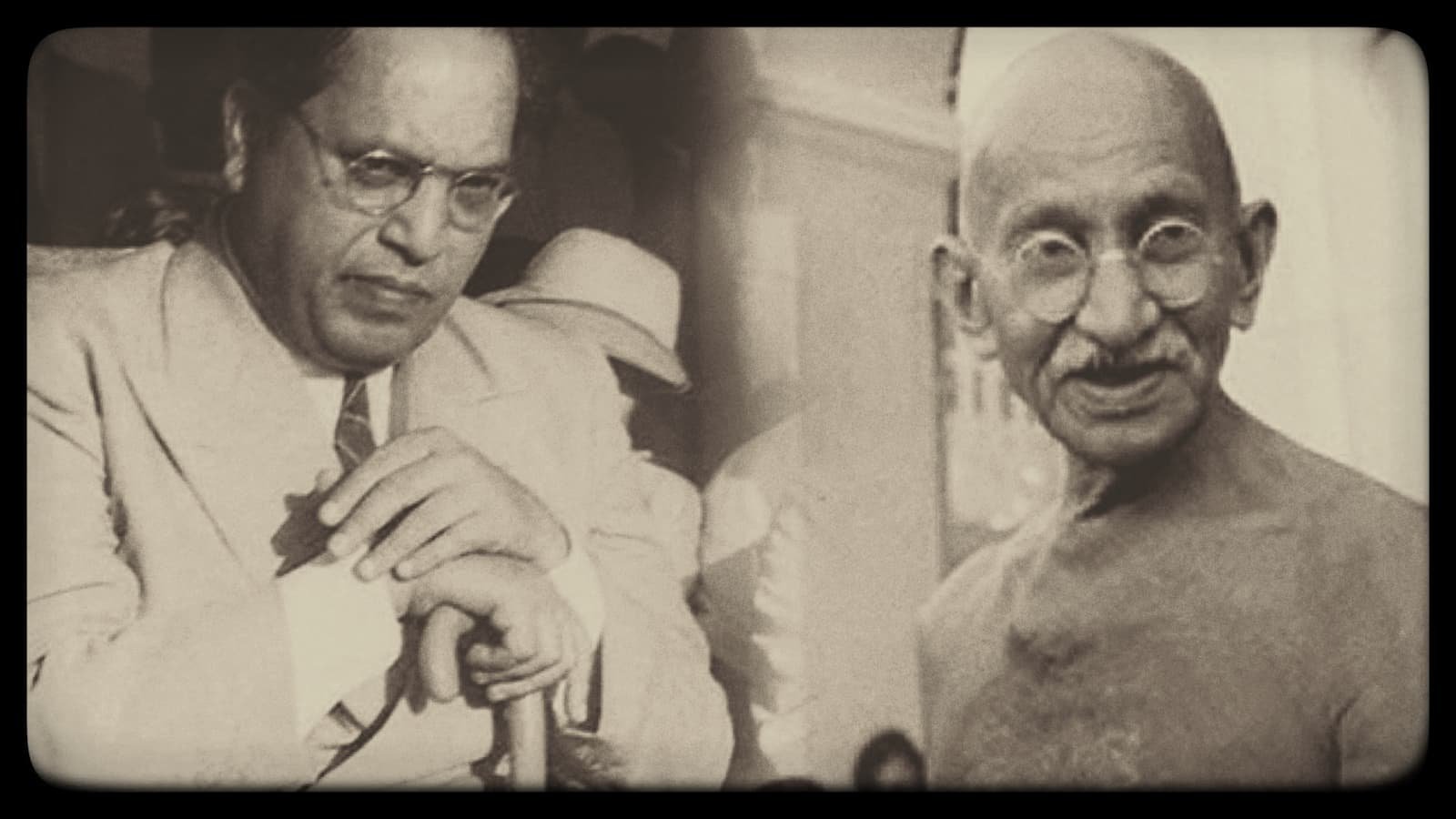
Dr. B.R. Ambedkar and Mahatma Gandhi were among the foremost architects of modern India. Both devoted their lives to building a society based on justice, equality, and human dignity and worked for the upliftment of marginalized communities. While they shared the common objective of creating an inclusive society, they differed considerably in their views on caste, religion, democracy, governance, and economic development. Their ideas continue to influence India’s constitutional values, public policies, and discourse on social justice.
Areas of Ideological Convergence
- Commitment to Peaceful Social Change
Both Ambedkar and Gandhi rejected violence as a means of achieving social and political transformation. They opposed the communist emphasis on violent class struggle and believed that enduring reforms should be achieved through peaceful and ethical methods. Gandhi regarded Ahimsa (non-violence) as the foundation of political action and argued that the means must always be consistent with the ends. Likewise, Ambedkar, in Buddha or Karl Marx (1956), preferred Buddha’s path of compassion, morality, and peaceful reform over coercive revolution.
- Human Dignity and Social Justice
Both leaders sought to establish a society founded on justice, equality, and respect for human dignity. Gandhi promoted Sarvodaya, which aimed at the welfare of all sections of society, while Ambedkar emphasized Bahujan Hitay, focusing on the welfare of the majority, especially the socially oppressed. Despite adopting different approaches, both considered the removal of discrimination essential for building an equitable society.
- Ethics in Public Life
Ambedkar and Gandhi believed that public life should be guided by ethical values. Gandhi’s political philosophy was rooted in truth, self-discipline, and non-violence, whereas Ambedkar emphasized constitutional morality, ethical leadership, and accountability as essential for the success of democracy. Although Ambedkar initially criticized Gandhi’s emphasis on moral politics, he later acknowledged the importance of individual morality and non-violence, drawing inspiration from the teachings of Buddha.
Areas of Ideological Differences
- Approach towards Caste and Social Equality
The most significant difference between the two leaders was their understanding of the caste system. Ambedkar called for the complete annihilation of caste and argued in Annihilation of Caste (1936) that the caste-based social order institutionalized inequality. He also criticized religious texts such as the Manusmriti for legitimizing caste hierarchy.
Gandhi strongly opposed untouchability, but initially viewed the Varna system as a division of labour based on duties rather than birth. Over time, he came to advocate the abolition of caste discrimination. Unlike Ambedkar, Gandhi believed that the Manusmriti contained both valuable and objectionable ideas. He also used the term Harijan for Dalits, which Ambedkar rejected as patronizing.
- Political Representation of Dalits
Ambedkar believed that the Depressed Classes required independent political representation and therefore supported separate electorates. He argued in What Congress and Gandhi Have Done to the Untouchables that constitutional and political safeguards were necessary to secure Dalit rights.
Gandhi opposed separate electorates because he believed they would divide Hindu society. His fast unto death resulted in the Poona Pact (1932), under which separate electorates were replaced by reserved seats for Dalits within joint electorates.
- Religion and Social Reform
Ambedkar viewed the existing Hindu social order as inherently discriminatory and concluded that genuine social equality could not be achieved within it. In 1956, he embraced Buddhism and founded Navayana Buddhism, emphasizing liberty, equality, and fraternity as the guiding principles of society.
Gandhi regarded religion primarily as a source of moral guidance and advocated Sarva Dharma Sambhava, or equal respect for all religions. Rather than rejecting Hinduism, he sought to reform social practices within it while preserving its ethical and spiritual traditions.
- Means of Social Transformation
Ambedkar believed that social transformation should be achieved through constitutional methods, legal reforms, and institutional safeguards. In his view, political democracy could succeed only when accompanied by social and economic equality.
Gandhi, on the other hand, emphasized Ahimsa, Swaraj, self-discipline, and voluntary moral reform as the principal means of transforming society. He believed that lasting social change begins with individual character and collective moral awakening.
- Role of the State
Ambedkar advocated an active and interventionist State to eliminate historical inequalities and protect the rights of marginalized communities. He supported affirmative action, constitutional safeguards, and legal measures to promote social justice and equal opportunities. He believed that democracy was not merely a political system but also a social order based on liberty, equality, and fraternity. Ambedkar was critical of the traditional Indian village, describing it as a “den of ignorance” from where “the stinking smell of superstition comes.” He argued that villages often perpetuated caste discrimination, social exclusion, and unequal power relations. Therefore, he considered constitutional institutions and state intervention essential for ensuring justice and inclusive development.
In contrast, Gandhi envisioned Gram Swaraj (village self-rule) as the foundation of Indian democracy. He regarded villages as self-reliant and self-governing units capable of managing their own social, economic, and political affairs. Gandhi favoured decentralized governance, community participation, and minimal state intervention, believing that moral responsibility and local self-governance were more effective than centralized bureaucratic control in achieving social transformation.
Top of Form
Bottom of Form
Economic Vision
Ambedkar supported state socialism, planned economic development, land reforms, equal wages, and greater public ownership of key industries, as proposed in the States and Minorities (1947) memorandum.
Gandhi proposed the Trusteeship Theory, under which wealth should be used for the benefit of society. He also advocated Swadeshi, village industries, and decentralized production as alternatives to large-scale industrialization.
Conclusion
Dr. B.R. Ambedkar and Mahatma Gandhi shared the common goal of building a just and inclusive society, but they differed in their understanding of the causes of inequality and the methods needed to address it. Gandhi emphasized moral transformation, non-violence, and community-led reform, whereas Ambedkar placed greater emphasis on constitutional safeguards, legal equality, and state intervention. Their complementary yet contrasting perspectives continue to shape India’s constitutional democracy, social justice framework, and inclusive development.