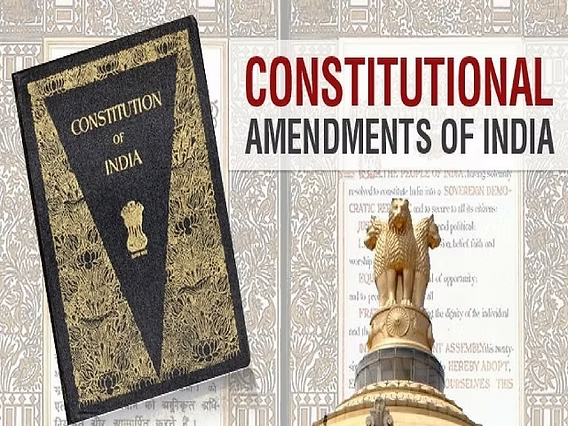
The Constitution of India is often called a living document because it can be amended according to changing social, political, and economic needs. Since its adoption on 26 January 1950, the Constitution has been amended more than 100 times, making constitutional amendments one of the most important topics for the UPSC Civil Services Examination.
Questions related to Constitutional Amendments are frequently asked in UPSC Prelims, while UPSC Mains often requires candidates to analyze their impact on democracy, governance, federalism, and fundamental rights.
This comprehensive guide covers all the important Constitutional Amendments that every UPSC aspirant must know.
What is a Constitutional Amendment?
A Constitutional Amendment refers to any modification, addition, or deletion made to the Constitution under Article 368.
The amendment process allows the Constitution to remain flexible while protecting its basic structure.
Types of Constitutional Amendments
The Constitution can be amended in three different ways.
1. By Simple Majority
Certain provisions are amended like ordinary legislation.
Examples include:
- Creation of new states
- Change in state boundaries
- Salaries of constitutional authorities
- Citizenship provisions
2. By Special Majority
Most Constitutional Amendments require:
- Majority of total membership of each House
- Two-thirds majority of members present and voting
3. By Special Majority + State Ratification
Certain federal provisions additionally require approval by at least half of the State Legislatures.
These include:
- Election of President
- Supreme Court and High Courts
- Legislative relations
- Distribution of powers
- Article 368 itself
Important Constitutional Amendments for UPSC
1st Constitutional Amendment Act, 1951
Why was it introduced?
The amendment was enacted to address judicial challenges regarding land reforms and restrictions on freedom of speech.
Major Provisions
- Added Ninth Schedule
- Introduced Article 15(4)
- Allowed reasonable restrictions on freedom of speech
- Protected land reform laws from judicial review
Importance for UPSC
- Frequently asked in Prelims.
- Connected with Fundamental Rights.
7th Constitutional Amendment Act, 1956
Objective
Implemented the recommendations of the States Reorganisation Commission.
Key Features
- Reorganized states on linguistic basis
- Abolished Part A, B, C and D states
- Created Union Territories
Significance
Laid the foundation of India’s present federal map.
24th Constitutional Amendment Act, 1971
Objective
Restored Parliament’s power to amend Fundamental Rights.
Major Changes
- Made Presidential assent mandatory.
- Parliament received explicit power to amend any part of the Constitution.
- Article 368 strengthened.
Related Case
Golak Nath Case (1967)
25th Constitutional Amendment Act, 1971
Key Features
- Curtailed Right to Property
- Introduced Article 31C
- Gave priority to Directive Principles over certain Fundamental Rights
26th Constitutional Amendment Act, 1971
Main Provision
- Abolished Privy Purses
- Ended official recognition of former rulers of princely states
36th Constitutional Amendment Act, 1975
Importance
- Sikkim became the 22nd State of India.
38th Constitutional Amendment Act, 1975
Highlights
Made Emergency proclamations beyond judicial review (later modified).
39th Constitutional Amendment Act, 1975
Importance
Placed disputes regarding election of the President, Vice President, Prime Minister, and Speaker beyond judicial scrutiny.
Later challenged in court.
42nd Constitutional Amendment Act, 1976 (Mini Constitution)
The 42nd Amendment is considered the most important Constitutional Amendment for UPSC.
Why is it called the Mini Constitution?
Because it made the largest number of changes to the Constitution.
Important Provisions
- Added Socialist
- Added Secular
- Added Integrity in Preamble
- Added Fundamental Duties (Article 51A)
- Strengthened Directive Principles
- Curtailed judicial review
- Extended Lok Sabha tenure from 5 to 6 years (later reversed)
- Added Part IVA
UPSC Importance
One of the highest-weightage amendments.
44th Constitutional Amendment Act, 1978
Passed after the Emergency.
Major Features
- Restored democratic safeguards.
- Right to Property became Legal Right.
- Article 352 made stricter.
- Restored judicial powers.
- Lok Sabha tenure reduced back to five years.
Importance
Known as the “Restoration Amendment.”
52nd Constitutional Amendment Act, 1985
Anti-Defection Law
Added
Tenth Schedule
Purpose
Prevent political defections.
Presiding Authority
Speaker/Chairman decides disqualification.
61st Constitutional Amendment Act, 1989
Major Provision
Voting age reduced
From 21 years to 18 years.
69th Constitutional Amendment Act, 1991
Main Feature
Delhi became the National Capital Territory (NCT).
Created:
- Legislative Assembly
- Council of Ministers
71st Constitutional Amendment Act, 1992
Added:
- Konkani
- Manipuri
- Nepali
to the Eighth Schedule.
73rd Constitutional Amendment Act, 1992
One of the most important amendments for UPSC.
Panchayati Raj
Added
Part IX
Key Features
- Constitutional status to Panchayats
- Three-tier system
- Gram Sabha
- Five-year tenure
- Reservation for women
- State Election Commission
- State Finance Commission
- Eleventh Schedule
76th Constitutional Amendment Act, 1994
Placed Tamil Nadu Reservation Act in Ninth Schedule.
86th Constitutional Amendment Act, 2002
Education became Fundamental Right.
Added
Article 21A
Other Changes
- Modified Article 45
- Added duty of parents under Article 51A(k)
91st Constitutional Amendment Act, 2003
Objective
Prevent political corruption.
Key Changes
- Limited size of Council of Ministers
- Strengthened Anti-Defection Law
92nd Constitutional Amendment Act, 2003
Added four languages
- Bodo
- Dogri
- Maithili
- Santhali
97th Constitutional Amendment Act, 2011
Cooperative Societies
Added:
- Part IXB
- Article 43B
Later partly struck down by Supreme Court regarding State Cooperative Societies.
99th Constitutional Amendment Act, 2014
Established
National Judicial Appointments Commission (NJAC)
Later declared unconstitutional by Supreme Court.
100th Constitutional Amendment Act, 2015
India-Bangladesh Land Boundary Agreement.
101st Constitutional Amendment Act, 2016
One of the most important amendments.
Introduced
Goods and Services Tax (GST)
Added
- Article 246A
- GST Council
- Article 279A
102nd Constitutional Amendment Act, 2018
Main Feature
Constitutional status to
National Commission for Backward Classes (NCBC).
103rd Constitutional Amendment Act, 2019
Introduced
10% reservation for Economically Weaker Sections (EWS).
Added:
- Articles 15(6)
- 16(6)
104th Constitutional Amendment Act, 2020
Key Changes
- Extended reservation for SCs and STs in Lok Sabha and State Assemblies for another 10 years.
- Ended reserved seats for Anglo-Indians through nomination.
105th Constitutional Amendment Act, 2021
Restored States’ power to identify Socially and Educationally Backward Classes (SEBCs).
Most Important Constitutional Amendments for UPSC Prelims
| Amendment | Theme |
|---|---|
| 1st | Ninth Schedule |
| 7th | State Reorganization |
| 24th | Parliament’s Amendment Power |
| 25th | DPSPs vs Fundamental Rights |
| 42nd | Mini Constitution |
| 44th | Right to Property |
| 52nd | Anti-Defection |
| 61st | Voting Age 18 |
| 69th | Delhi NCT |
| 73rd | Panchayati Raj |
| 74th | Municipalities |
| 86th | Right to Education |
| 91st | Council of Ministers |
| 97th | Cooperative Societies |
| 99th | NJAC |
| 101st | GST |
| 102nd | NCBC |
| 103rd | EWS Reservation |
| 104th | Anglo-Indian Reservation |
| 105th | SEBC Powers |
Previous Year UPSC Trends
UPSC has repeatedly asked questions on:
- Fundamental Duties
- Panchayati Raj
- GST Council
- Anti-Defection Law
- Right to Education
- Ninth Schedule
- EWS Reservation
- State Reorganization
- Voting Age
- Constitutional Amendment Procedure
Candidates should focus on understanding the objectives, Articles affected, Schedules introduced, and constitutional significance of each amendment rather than merely memorizing amendment numbers.
Preparation Tips for UPSC
- Make a chronological list of all major amendments.
- Revise the Articles and Schedules introduced by each amendment.
- Study important Supreme Court judgments linked with amendments, such as Golak Nath, Kesavananda Bharati, Minerva Mills, and the NJAC case.
- Practice previous years’ UPSC questions and constitutional MCQs regularly.
- Pay special attention to amendments related to Fundamental Rights, Directive Principles, Local Self-Government, Elections, Emergency provisions, and Reservation policies.
Conclusion
Constitutional Amendments form one of the most scoring and frequently tested topics in the UPSC Civil Services Examination. While dozens of amendments have been enacted, a relatively small group—such as the 1st, 7th, 24th, 42nd, 44th, 52nd, 73rd, 74th, 86th, 91st, 97th, 101st, 102nd, 103rd, 104th, and 105th Amendments—carry the greatest importance for both Prelims and Mains.
Rather than memorizing amendment numbers alone, focus on why each amendment was introduced, the Articles or Schedules it affected, its constitutional significance, and any landmark Supreme Court judgments associated with it. This conceptual approach will help you tackle both objective questions in Prelims and analytical questions in Mains with confidence.
By revising these amendments regularly alongside landmark judgments and current constitutional developments, aspirants can build a strong foundation in Indian Polity and improve their overall UPSC performance.