Context
Recently, India decided to send the sacred relics of Sariputra and Maudgalyayana, two foremost disciples of Lord Buddha, preserved at the Sanchi Stupa, to Mongolia for a special public exposition.
About Sanchi Stupa
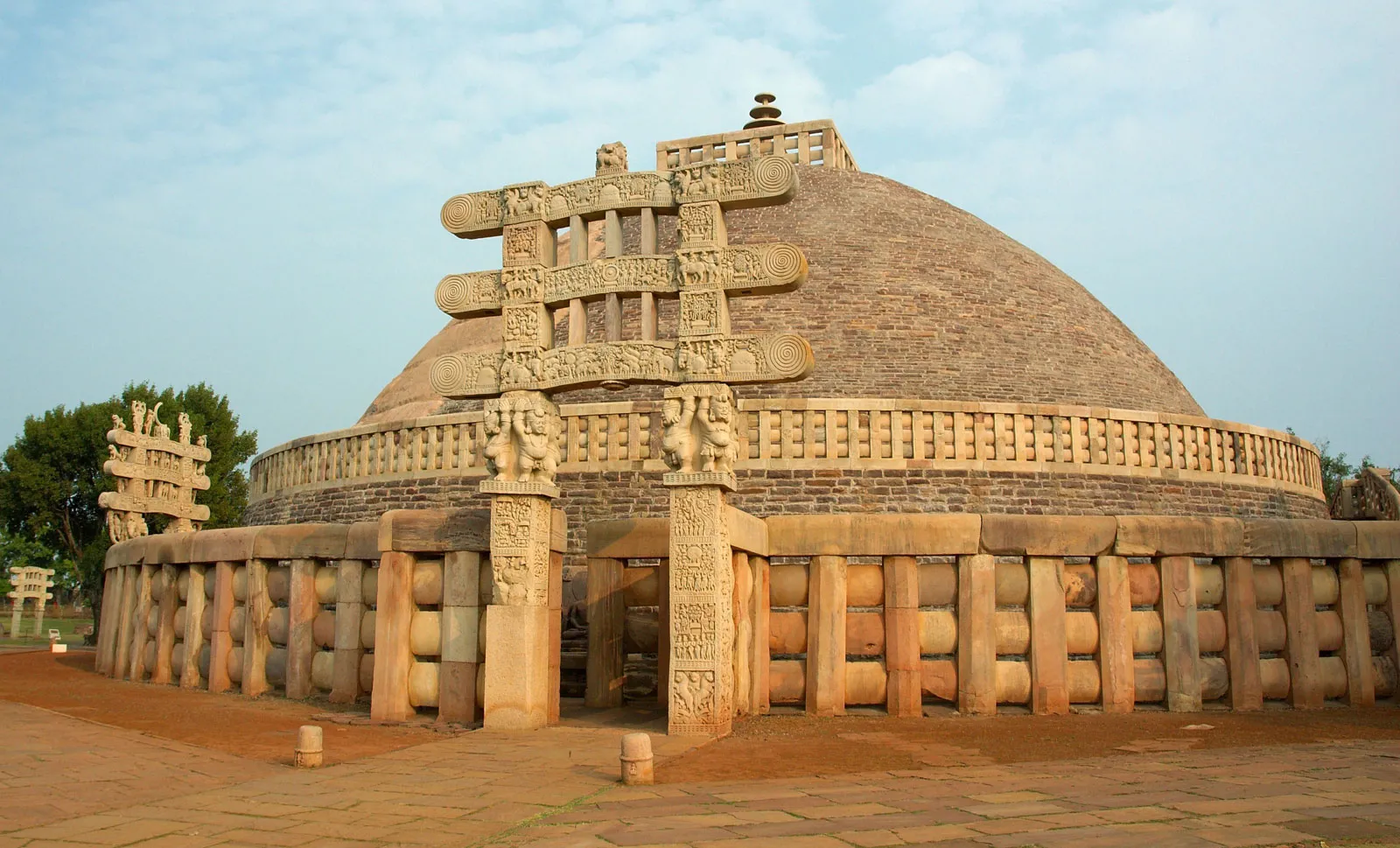
- Sanchi Stupa is one of the oldest and best-preserved Buddhist monuments in India, commissioned by Mauryan Emperor Ashoka in the 3rd century BCE.
- Its construction was overseen by Devi, Ashoka’s wife.
- It enshrines sacred relics of Lord Buddha and his revered disciples.
- The growth of the Sanchi complex was supported by the mercantile community of Vidisha.
- The site was rediscovered by British officer Henry Taylor in 1818.
- Alexander Cunningham conducted the first systematic survey and excavation of the monument in 1851.
Architectural Features
- The stupa is enclosed by a stone railing and features four elaborately carved gateways (toranas), renowned for their distinctive Sanchi sculptures.
- At its core is a hemispherical dome (anda), symbolising the cosmic universe.
- The dome is surmounted by a harmika, a square enclosure representing the sacred world mountain.
- Rising from the harmika is a yashti (mast), symbolising the cosmic axis.
- The mast is crowned with chatras (umbrellas), representing the various heavenly realms (devaloka).