Context
Recent reports highlighted military developments in the Caspian Sea, where Israeli fighter jets reportedly targeted Iranian naval vessels, bringing attention to this strategically important region.
Q1. What is the Caspian Sea?
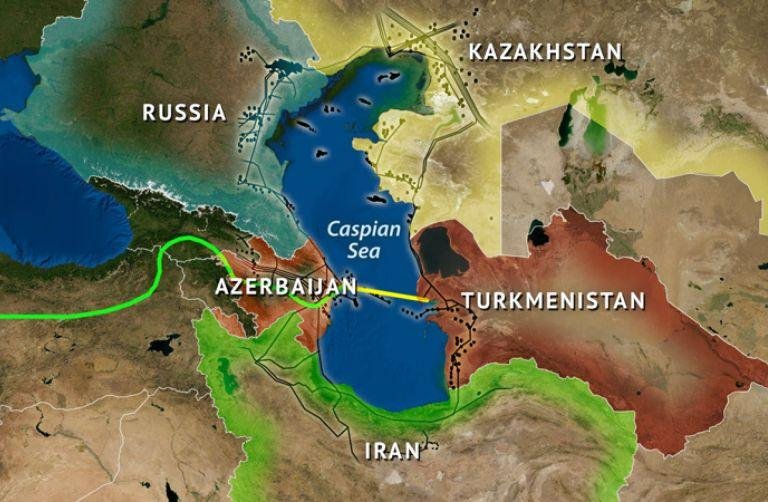
- The Caspian Sea is the largest enclosed water body in the world, surrounded entirely by land.
- It lies between Europe and Asia.
- It is an endorheic basin, meaning it has no outflow to oceans.
- The name comes from the ancient Kaspi people who lived in the region.
Q2. Which countries border the Caspian Sea?
The Caspian Sea is bordered by five countries:
- Russia and Azerbaijan (west)
- Kazakhstan (north)
- Turkmenistan (east)
- Iran (south)
Q3. What are its key geographical features?
- Water composition varies:
- Nearly freshwater in the north
- More saline towards the south
- Major rivers flowing into it:
- Volga River (largest contributor)
- Ural River
- Terek River
- Important cities:
- Baku (Azerbaijan) – largest city on the Caspian
- Nowshahr (Iran)
- Major islands include:
- Chechen, Tyuleny, Kulaly, Zhiloy, Ogurchin
Q4. Why is the Caspian Sea important?
- Energy Resources: Rich in oil and natural gas reserves, both offshore and along the coast
- Strategic Location: Important for regional geopolitics and trade
- Economic Significance: Supports fishing, transport, and coastal economies
Conclusion
The Caspian Sea is a geographically unique and resource-rich inland water body, making it highly significant for energy, geopolitics, and regional economies.