

29-01-2026 Mains Question Answer
Discuss Big bang theory in accordance with standard model of particle physics?
The Big Bang theory describes the origin and evolution of the cosmos, providing the framework for the timeline of the universe. Within this framework, the Standard Model of particle physics details the fundamental forces and particles that governed the universe during its initial moments. In the incredibly hot and dense early universe, all fundamental particles—quarks, leptons, and force-carrying bosons—existed in a high-energy plasma state.
As the universe expanded and cooled, the conditions described by the Standard Model allowed for spontaneous symmetry breaking. This process caused the fundamental forces to separate from an initial unified force, as theorized by grand unified theories that extend the Standard Model.
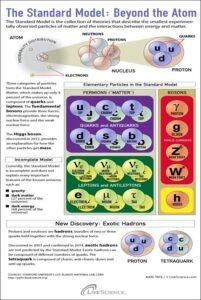
Specifically, the strong nuclear, weak nuclear, and electromagnetic forces emerged, allowing quarks to bind into protons and neutrons during the quark-gluon plasma epoch. As temperatures dropped further, these components formed the first atomic nuclei (nucleosynthesis), the basic matter building blocks described by the Standard Model that eventually led to the large-scale structures observed today. The theory thus reconciles the large-scale history of the cosmos with the fundamental particle interactions described by the Standard Model.