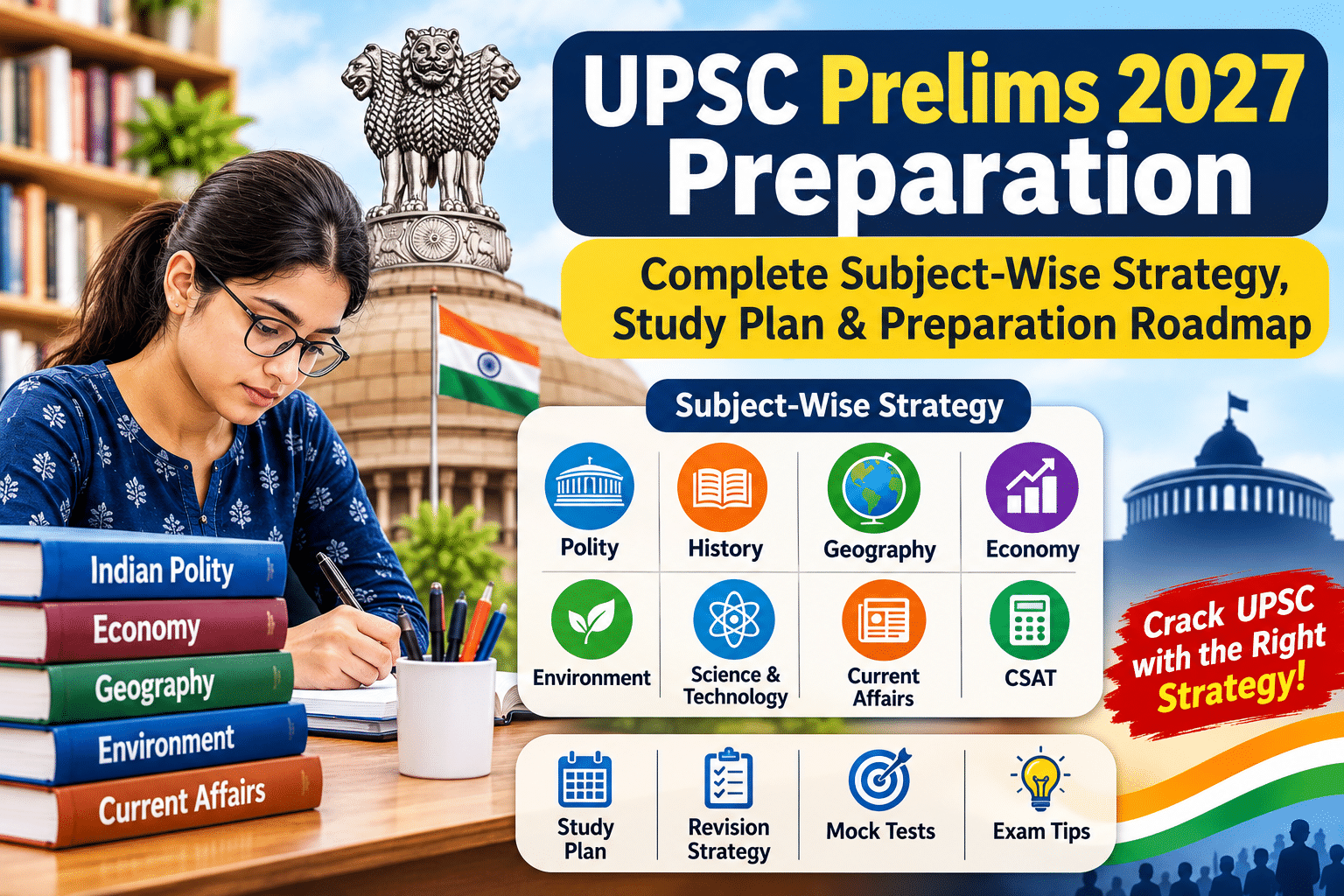
The UPSC Civil Services Preliminary Examination is the first major stage of the journey towards becoming an IAS, IPS, IFS or other civil services officer. Every year, lakhs of candidates appear for this examination, but only a limited number qualify for the Mains Examination.
Preparing for UPSC Prelims is not simply about reading multiple books or memorising facts. It requires a systematic understanding of the syllabus, conceptual clarity, awareness of current affairs, regular revision, previous year question analysis and effective examination techniques.
With the UPSC Prelims 2027 approaching, aspirants need a focused preparation strategy that balances static General Studies, current affairs, CSAT and regular practice.
A common mistake among candidates is spending too much time collecting study material while postponing revision and mock tests. A better approach is to study according to the examination’s requirements, prioritise important concepts and continuously evaluate preparation progress.
This comprehensive guide explains how to prepare for UPSC Prelims 2027, including subject-wise strategies, recommended resources, a practical study timetable, revision techniques and mock test preparation.
1. Understanding the UPSC Prelims Examination 2027
Before beginning preparation, aspirants should understand the examination structure and syllabus.
The Civil Services Preliminary Examination consists of two compulsory objective-type papers:
- General Studies Paper I
- General Studies Paper II (CSAT)
Both papers carry 200 marks each and have a duration of two hours.
UPSC Prelims Exam Pattern
| Particulars | General Studies Paper I | CSAT Paper II |
|---|---|---|
| Total Questions | 100 | 80 |
| Maximum Marks | 200 | 200 |
| Duration | 2 Hours | 2 Hours |
| Nature | Merit-based for cutoff | Qualifying |
| Qualifying Requirement | Cutoff determined by UPSC | 33% |
| Negative Marking | One-third of marks assigned to the question | One-third of marks assigned to the question |
Important points:
- General Studies Paper I determines the Prelims cutoff.
- CSAT is qualifying in nature, but candidates must secure at least 33% marks.
- Both papers are compulsory.
- Incorrect answers attract negative marking.
- Prelims is a screening examination, and its marks are not counted towards the final merit list.
Candidates should refer to the official notification for their examination year to verify the applicable rules and dates.
2. What Makes UPSC Prelims Challenging?
UPSC Prelims tests more than factual knowledge. Questions frequently require candidates to understand concepts, interpret statements, connect current developments with static subjects and eliminate incorrect options.
Some of the major challenges include:
A. Conceptual and Statement-Based Questions
Candidates must understand the subject rather than depend entirely on memorised facts. Questions involving multiple statements often require careful interpretation and conceptual clarity.
B. Integration of Static Subjects and Current Affairs
Many current affairs questions are linked with fundamental concepts from Polity, Economy, Geography, Environment and Science.
For example, a news report about a monetary policy decision may require an understanding of inflation, interest rates, liquidity and the role of the Reserve Bank of India.
C. Increasing Importance of Analytical Thinking
Aspirants must evaluate statements, identify conceptual relationships and apply logical reasoning instead of relying only on direct factual recall.
D. Changing Subject-Wise Distribution
UPSC does not follow a permanently fixed subject-wise question distribution. The number of questions from different subjects can vary between examination years.
Therefore, candidates should avoid preparing only a few selected subjects while neglecting others.
E. Time Management and Accuracy
Negative marking makes intelligent question selection important. Candidates must balance the number of attempts with the probability of answering correctly.
The objective should be to maximise accurate attempts rather than attempt every question.
3. Complete Subject-Wise Strategy for UPSC Prelims 2027
A well-planned subject-wise strategy helps aspirants cover the entire syllabus while avoiding unnecessary study material.
The following approach explains how to prepare each major General Studies subject.
3.1 Indian Polity and Governance
Indian Polity is an important component of UPSC Prelims and requires a clear understanding of constitutional provisions, institutions and governance mechanisms.
Important topics to cover:
- Historical Background of the Indian Constitution.
- Constituent Assembly and Making of the Constitution.
- Preamble.
- Fundamental Rights.
- Directive Principles of State Policy.
- Fundamental Duties.
- President and Vice-President.
- Prime Minister and Council of Ministers.
- Parliament and Parliamentary Committees.
- Supreme Court and High Courts.
- Governor and State Legislature.
- Centre-State Relations.
- Constitutional and Statutory Bodies.
- Panchayati Raj and Municipalities.
- Emergency Provisions.
- Important Constitutional Amendments.
- Elections and Representation of the People Act.
Recommended resources:
- Indian Polity by M. Laxmikanth.
- NCERT Political Science textbooks.
- Previous Year Questions.
- Relevant current affairs and important Supreme Court judgements.
Preparation Strategy:
Begin with the basic structure of the Constitution and understand the functions of different constitutional institutions.
Pay particular attention to distinctions between similar constitutional concepts. For example, aspirants should clearly understand the differences between constitutional bodies, statutory bodies and executive bodies.
Prepare short notes on important Articles, Schedules, amendments and institutions.
Regularly solve statement-based MCQs to improve conceptual accuracy.
3.2 History and Indian National Movement
History requires chronological understanding, knowledge of important developments and the ability to connect historical events with their causes and consequences.
Divide History preparation into four major areas.
Ancient Indian History
Important topics include:
- Indus Valley Civilisation.
- Vedic Period.
- Mahajanapadas.
- Buddhism and Jainism.
- Mauryan Empire.
- Gupta Empire.
- Sangam Literature.
- Ancient Indian Art and Architecture.
Medieval Indian History
Focus on:
- Delhi Sultanate.
- Mughal Empire.
- Vijayanagara Empire.
- Bhakti Movement.
- Sufi Movement.
- Regional Kingdoms.
- Medieval Literature and Architecture.
Modern Indian History
Important topics include:
- Arrival of European Powers.
- British Expansion in India.
- Revolt of 1857.
- Socio-Religious Reform Movements.
- Formation of Indian National Congress.
- Swadeshi Movement.
- Home Rule Movement.
- Non-Cooperation Movement.
- Civil Disobedience Movement.
- Quit India Movement.
- Revolutionary Nationalism.
- Constitutional Developments.
- Independence and Partition.
Art and Culture
Art and Culture should receive dedicated attention because it covers diverse topics that require both conceptual and factual preparation.
Important areas include:
- Indian Architecture.
- Sculpture and Paintings.
- Classical and Folk Dances.
- Music Traditions.
- Literature.
- Religious Movements.
- UNESCO World Heritage Sites.
- Cultural Institutions and Heritage.
Recommended resources:
- NCERT History textbooks.
- A Brief History of Modern India by Spectrum.
- Nitin Singhania for Art and Culture.
- Relevant PYQs and current affairs.
Preparation Strategy:
Prepare timelines, comparative tables and concise notes for important historical developments.
Understand the causes, important personalities, objectives and consequences of major movements rather than memorising dates in isolation.
For Art and Culture, use visual references, maps and topic-wise revision charts.
3.3 Geography
Geography requires conceptual understanding, map-based learning and awareness of physical and human processes.
Divide Geography into three major areas.
Physical Geography
- Earth’s Interior.
- Plate Tectonics.
- Volcanoes and Earthquakes.
- Landforms.
- Climatology.
- Atmospheric Circulation.
- Ocean Currents.
- Oceanography.
Indian Geography
- Physiographic Divisions of India.
- Himalayan Region.
- Northern Plains.
- Peninsular Plateau.
- Indian Rivers.
- Indian Monsoon.
- Soil Types.
- Agriculture.
- Minerals and Energy Resources.
- Industries and Transport.
World Geography
- Continents and Oceans.
- Important Mountain Ranges.
- Deserts and Grasslands.
- Important Rivers and Lakes.
- Climatic Regions.
- Natural Resources.
- Important Geographical Locations.
Recommended resources:
- NCERT Geography textbooks.
- Certificate Physical and Human Geography by G.C. Leong.
- Oxford or Orient BlackSwan Atlas.
- Previous Year Questions.
Preparation Strategy:
Focus on understanding geographical processes instead of memorising isolated information.
Practise maps regularly, especially locations appearing in national and international news.
Connect current developments such as cyclones, earthquakes, floods, droughts and ocean-related events with their underlying geographical concepts.
3.4 Indian Economy
Economy can appear challenging to beginners because it involves multiple technical concepts. However, a systematic approach can make the subject easier to understand.
Important topics include:
- National Income and GDP.
- Economic Growth and Development.
- Inflation and Deflation.
- Monetary Policy.
- Fiscal Policy.
- Banking System.
- Reserve Bank of India.
- Budget and Taxation.
- Government Borrowing.
- Fiscal Deficit.
- Balance of Payments.
- Foreign Exchange Reserves.
- Poverty and Unemployment.
- Inclusive Growth.
- Agriculture and Food Security.
- Infrastructure and Investment.
Recommended resources:
- NCERT Economics textbooks.
- One reliable standard Indian Economy reference book.
- Economic Survey.
- Union Budget.
- RBI publications and relevant current affairs.
Preparation Strategy:
Start with basic concepts such as GDP, inflation, interest rates, banking and taxation.
Understand the relationship between different economic indicators. For example, study how monetary policy affects inflation, borrowing and investment.
Avoid reading multiple economy books simultaneously. Select a reliable source and connect important developments with the concepts already studied.
3.5 Environment and Ecology
Environment and Ecology are important because the subject combines static concepts with current developments.
Important topics include:
- Ecosystem and Ecological Principles.
- Food Chains and Food Webs.
- Biodiversity.
- National Parks and Wildlife Sanctuaries.
- Biosphere Reserves.
- Endangered Species.
- Environmental Pollution.
- Climate Change.
- Global Warming.
- Environmental Conventions.
- Ramsar Sites.
- Conservation Initiatives.
- Renewable Energy.
- Sustainable Development.
Recommended resources:
- Shankar IAS Environment.
- Relevant NCERT Science and Geography chapters.
- Official environmental reports.
- Current affairs and PYQs.
Preparation Strategy:
Develop a strong understanding of ecological concepts before memorising species, protected areas and conventions.
Maintain separate notes for important species, national parks, international agreements and environmental initiatives.
Pay attention to environmental developments in current affairs and connect them with static concepts.
3.6 Science and Technology
UPSC generally focuses on the basic principles, applications and implications of scientific developments rather than highly specialised technical knowledge.
Important topics include:
- Space Technology.
- Biotechnology.
- Artificial Intelligence.
- Quantum Technology.
- Nanotechnology.
- Robotics.
- Defence Technology.
- Information Technology.
- Cybersecurity.
- Nuclear Technology.
- Medical and Health Innovations.
- Renewable Energy Technologies.
Recommended resources:
- NCERT Science textbooks.
- Government publications.
- PIB.
- ISRO and other relevant official websites.
- Science and Technology current affairs.
Preparation Strategy:
For every important technology, understand:
- What it is.
- How it works at a basic level.
- Its applications.
- Its advantages.
- Its limitations.
- Its relevance to India.
Avoid studying highly technical details unless they have a clear connection with the UPSC syllabus.
3.7 Current Affairs
Current Affairs connects different General Studies subjects and helps aspirants understand contemporary national and international developments.
Important areas include:
- Government Schemes and Policies.
- National and International Organisations.
- Important Reports and Indices.
- International Relations.
- Environment and Climate Developments.
- Economic Policies.
- Science and Technology.
- Important Government Initiatives.
- Awards and Significant Events relevant to the syllabus.
Recommended resources:
- One reliable national newspaper.
- Monthly Current Affairs Magazine.
- PIB.
- Government reports and official publications.
- UPSC Current Affairs-based MCQs.
Preparation Strategy:
Do not treat Current Affairs as a separate subject. Connect every important development with its relevant static topic.
For example:
| Current Affairs Topic | Static Subject Connection |
|---|---|
| RBI Monetary Policy | Indian Economy |
| Supreme Court Judgement | Indian Polity |
| Climate Conference | Environment |
| Space Mission | Science and Technology |
| International Agreement | International Relations |
| Agricultural Scheme | Indian Economy and Agriculture |
Prepare concise notes and revise them regularly. Avoid collecting information from too many sources.
4. How to Prepare for CSAT in UPSC Prelims 2027?
CSAT is qualifying in nature, but it is an essential component of the Preliminary Examination.
Candidates must score at least 33% marks in Paper II. A failure to qualify CSAT can eliminate a candidate regardless of their performance in General Studies Paper I.
Important CSAT Topics
Reading Comprehension
- Understanding passages.
- Identifying central ideas.
- Drawing logical conclusions.
- Evaluating arguments.
- Understanding assumptions.
Basic Numeracy
- Number Systems.
- Percentages.
- Ratio and Proportion.
- Averages.
- Profit and Loss.
- Time and Work.
- Speed, Time and Distance.
- Simple and Compound Interest.
- Basic Probability.
Logical Reasoning
- Statements and Conclusions.
- Analytical Reasoning.
- Arrangements.
- Series and Patterns.
- Logical Deductions.
- Problem-Solving.
Data Interpretation
- Tables.
- Graphs.
- Charts.
- Data Sufficiency.
- Numerical Comparisons.
CSAT Preparation Strategy
- Attempt one previous year’s CSAT paper to assess your current level.
- Identify weak areas in comprehension, mathematics and reasoning.
- Revise basic mathematical concepts.
- Practise comprehension passages regularly.
- Solve topic-wise questions.
- Attempt timed sectional and full-length tests.
- Analyse incorrect answers and improve question selection.
Candidates who are weak in mathematics should begin CSAT preparation early rather than postponing it until the final weeks.
5. Importance of Previous Year Questions (PYQs) for UPSC Prelims
Previous Year Questions are among the most valuable resources for understanding UPSC’s examination requirements.
They help aspirants understand how the Commission frames questions, tests concepts and connects different topics.
Why Should You Solve PYQs?
Understand the Examination Pattern
PYQs provide an insight into the style and complexity of questions asked in previous examinations.
Identify Important Topics
They help identify recurring concepts and areas that deserve adequate preparation.
Understand Question Framing
Aspirants become familiar with statement-based, conceptual, factual and application-oriented questions.
Improve Elimination Skills
Analysing options helps develop logical elimination techniques.
Evaluate Preparation
PYQs help identify whether a candidate has understood a topic at the required level.
How to Use PYQs Effectively
- Analyse at least 5–10 years of relevant PYQs.
- Solve questions subject-wise and topic-wise.
- Understand why each option is correct or incorrect.
- Identify recurring concepts.
- Revisit questions during revision.
- Maintain a separate record of mistakes.
Do not simply memorise previous answers. Focus on understanding the concepts behind the questions.
6. How to Prepare Current Affairs Alongside Static Subjects?
One of the most effective UPSC preparation methods is integrating current affairs with static subjects.
Aspirants should avoid studying current affairs only at the end of their preparation.
For example, while studying Indian Polity, candidates can connect constitutional provisions with recent Supreme Court judgements, parliamentary developments and governance initiatives.
Similarly:
- Economy should be linked with the Union Budget and Economic Survey.
- Environment should be linked with climate conferences and conservation developments.
- Geography should be linked with natural disasters and geographical events.
- Science and Technology should be linked with recent research and technological applications.
This approach improves conceptual understanding and reduces the need to study the same issue repeatedly from different sources.
7. Importance of Mock Tests for UPSC Prelims 2027
Mock tests are essential for evaluating preparation and improving examination performance.
Aspirants should not wait until completing the entire syllabus before beginning MCQ practice.
Benefits of Regular Mock Tests
- Improve time management.
- Increase question-solving speed.
- Develop accuracy.
- Improve option elimination.
- Identify weak subjects.
- Build examination confidence.
- Understand personal performance patterns.
How to Analyse a Mock Test
After attempting a test, classify your mistakes into the following categories:
| Mistake Type | Corrective Action |
|---|---|
| Conceptual Error | Revise the underlying concept |
| Factual Error | Review short notes |
| Misinterpretation | Practise statement-based questions |
| Guesswork | Improve elimination and decision-making |
| Time Management | Practise timed tests |
| Revision Gap | Schedule repeated revision |
Important: Attempting a mock test is only half the task. Detailed analysis is equally important.
Maintain a mistake notebook and revisit it during weekly revision.
8. UPSC Prelims 2027 Month-Wise Preparation Strategy
With approximately six months remaining as of November 2026, aspirants should focus on a time-bound strategy that balances syllabus completion, current affairs, revision and mock tests.
The following is a suggested roadmap for candidates preparing for the May 2027 examination. It should be adjusted according to the candidate’s existing preparation level and the official UPSC schedule.
November–December 2026: Consolidate the Foundation
Primary Objective: Strengthen important static subjects and identify incomplete syllabus areas.
Tasks:
- Review the complete UPSC Prelims syllabus.
- Analyse the last 5–10 years of PYQs.
- Revise core Polity and Economy concepts.
- Cover important History and Geography topics.
- Begin or continue regular Environment preparation.
- Maintain daily newspaper reading.
- Practise topic-wise MCQs.
- Start regular CSAT practice.
Target: Build a clear subject-wise preparation plan and establish consistency.
January–February 2027: Complete Syllabus and Strengthen Current Affairs
Primary Objective: Complete remaining important topics and consolidate current affairs.
Tasks:
- Complete pending static syllabus areas.
- Revise important concepts from standard books.
- Cover relevant annual current affairs.
- Solve subject-wise PYQs.
- Attempt weekly sectional tests.
- Practise CSAT every week.
- Identify weak areas through performance analysis.
Target: Achieve comprehensive syllabus coverage and begin serious examination-oriented practice.
March–April 2027: Intensive Revision and Full-Length Mock Tests
Primary Objective: Improve accuracy, speed and examination readiness.
Tasks:
- Revise all major GS subjects.
- Consolidate current affairs notes.
- Attempt regular full-length Prelims mock tests.
- Analyse every test in detail.
- Revise incorrect and doubtful questions.
- Strengthen weak subjects.
- Practise CSAT under timed conditions.
- Avoid unnecessary new study material.
Target: Improve consistency and develop a reliable examination strategy.
May 2027: Final Revision and Examination Preparation
Primary Objective: Retain information and maintain mental and physical readiness.
Tasks:
- Revise short notes and important factual information.
- Review PYQs and frequently misunderstood concepts.
- Revise important maps, schemes, reports and environmental developments.
- Practise selected MCQs.
- Avoid excessive new sources.
- Maintain a healthy sleep schedule.
- Finalise examination-day time management and question-selection strategy.
Target: Enter the examination with clarity, confidence and a well-revised syllabus.
9. Daily Study Timetable for UPSC Prelims 2027
A structured daily routine helps aspirants maintain consistency and avoid unnecessary distractions.
The following is an illustrative timetable for a full-time aspirant.
| Time | Activity |
|---|---|
| 6:00 AM – 7:00 AM | Newspaper and Current Affairs |
| 7:00 AM – 9:00 AM | General Studies Subject 1 |
| 9:00 AM – 10:00 AM | Break |
| 10:00 AM – 12:00 PM | General Studies Subject 2 |
| 12:00 PM – 1:00 PM | Revision |
| 1:00 PM – 2:00 PM | Lunch Break |
| 2:00 PM – 3:00 PM | CSAT Practice |
| 3:00 PM – 4:00 PM | MCQ Practice and PYQs |
| 4:00 PM – 5:00 PM | Break |
| 5:00 PM – 7:00 PM | Revision and Weak Topics |
| 7:00 PM – 8:00 PM | Test Analysis / Current Affairs Notes |
The timetable can be adjusted according to individual learning speed, classes and personal commitments.
Study Strategy for Working Professionals
Candidates preparing alongside employment can follow a flexible routine:
- Morning: 1–2 hours of focused study.
- Lunch Break: Short revision or current affairs.
- Evening: 2–3 hours of subject preparation.
- Weekends: Mock tests, PYQs and detailed revision.
Consistency is more important than following an unrealistic timetable.
10. How to Improve Accuracy and Elimination Techniques in UPSC Prelims?
Negative marking makes accuracy an important factor in Prelims preparation.
Aspirants should develop the ability to evaluate options logically rather than relying entirely on guesswork.
Important Techniques
1. Read Every Statement Carefully
Pay attention to qualifying words such as only, always, all, exclusively, must and never.
2. Eliminate Clearly Incorrect Options
Use conceptual understanding to remove options that contradict established facts or principles.
3. Avoid Blind Guesswork
Attempt questions based on a reasonable understanding of the subject and a calculated assessment of risk.
4. Identify Familiar Concepts
Sometimes a question appears unfamiliar because of its wording, even though it tests a known concept.
5. Practise Statement-Based Questions
Regularly solve questions involving two, three or four statements.
6. Analyse Your Attempt Strategy
After every mock test, assess whether incorrect answers resulted from poor knowledge, overthinking or unnecessary guesswork.
Remember that elimination is a reasoning technique, not a substitute for conceptual preparation.
11. Common Mistakes to Avoid During UPSC Prelims 2027 Preparation
Many aspirants invest considerable time in preparation but fail to achieve their expected performance because of avoidable mistakes.
1. Collecting Too Many Books and Resources
Using multiple sources for the same subject creates confusion and reduces revision time.
Solution: Select limited, reliable resources and revise them repeatedly.
2. Ignoring Previous Year Questions
Preparing topics without understanding how UPSC tests them can lead to inefficient study.
Solution: Analyse PYQs before and after completing each major topic.
3. Delaying Mock Tests
Postponing MCQ practice until the final months makes it difficult to identify weaknesses early.
Solution: Begin topic-wise practice immediately after completing a topic.
4. Neglecting CSAT
Many candidates focus exclusively on General Studies and underestimate the qualifying paper.
Solution: Include CSAT in your weekly timetable.
5. Studying Current Affairs Without Static Linkage
Reading daily news without understanding the underlying concepts results in poor retention.
Solution: Connect current developments with the relevant static subject.
6. Inadequate Revision
Completing the syllabus once does not guarantee that information will be retained.
Solution: Maintain weekly and monthly revision schedules.
7. Ignoring Mock Test Analysis
Attempting tests without reviewing incorrect answers limits improvement.
Solution: Analyse every test and maintain a record of mistakes.
8. Following Unrealistic Study Targets
Excessive daily targets can result in inconsistency and unnecessary stress.
Solution: Set achievable daily goals and evaluate progress regularly.
12. How to Manage Stress During UPSC Prelims Preparation?
UPSC preparation can become stressful, particularly when the examination approaches.
Candidates often feel pressure because of the vast syllabus, competition, mock test scores and uncertainty about results.
A balanced preparation strategy should include mental well-being alongside academic progress.
Some useful practices include:
- Divide large targets into smaller daily tasks.
- Avoid comparing your preparation with other aspirants.
- Follow a consistent sleep schedule.
- Take short breaks during study sessions.
- Exercise regularly.
- Review your progress instead of focusing only on mock test scores.
- Avoid changing your entire strategy because of one difficult test.
Remember that a low score in a mock test is an opportunity to identify weaknesses, not a final judgement of your preparation.
13. Final Checklist Before UPSC Prelims 2027
Before entering the examination hall, aspirants should ensure that the following areas have received adequate attention.
| Preparation Area | Checklist |
|---|---|
| Official Syllabus | Complete understanding of all topics |
| Polity | Constitutional concepts and institutions revised |
| History | Ancient, Medieval, Modern and Art & Culture revised |
| Geography | Concepts and map practice completed |
| Economy | Important economic concepts revised |
| Environment | Ecology, biodiversity and conventions revised |
| Science & Technology | Major developments and applications covered |
| Current Affairs | Important issues consolidated |
| PYQs | Previous papers analysed |
| Mock Tests | Full-length tests attempted and reviewed |
| CSAT | Qualifying-level preparation and timed practice completed |
| Revision | Short notes and weak areas revised |
14. How ENSURE IAS Can Support Your UPSC Prelims 2027 Preparation
Preparing for UPSC Prelims requires more than access to study material. Aspirants need a systematic learning process, regular practice, performance evaluation and the ability to identify areas requiring improvement.
At ENSURE IAS, under the guidance of Sachin Jain Sir (IRS 2016), the focus is on helping aspirants develop a structured and examination-oriented approach to Civil Services preparation.
An effective Prelims preparation programme should include:
1. Structured General Studies Preparation
Systematic coverage of important subjects, including Polity, History, Geography, Economy, Environment and Science & Technology.
2. Conceptual Clarity
Emphasis on understanding fundamental concepts and applying them to UPSC-level questions.
3. Previous Year Question Analysis
Understand UPSC’s question patterns, recurring themes and conceptual requirements.
4. Regular MCQ Practice
Develop accuracy, speed and option-elimination skills through topic-wise and sectional assessments.
5. Current Affairs Integration
Connect important national and international developments with static General Studies topics.
6. CSAT Preparation
Improve comprehension, logical reasoning, analytical ability and basic numeracy through consistent practice.
7. Revision and Performance Evaluation
Identify weak areas, revise important topics and monitor progress through regular assessments.
8. Mentorship and Strategic Guidance
Receive guidance on study planning, resource selection, revision and examination strategy.
The objective is to help aspirants prepare with clarity, discipline and confidence rather than becoming overwhelmed by excessive study material.
Explore UPSC preparation resources and programmes at ENSURE IAS:
Website: https://ensureias.com/
15. Conclusion: Prepare Smartly, Revise Consistently and Practise Regularly
UPSC Prelims 2027 requires a balanced approach that combines conceptual clarity, static syllabus coverage, current affairs, CSAT preparation, PYQ analysis and regular mock tests.
Aspirants should avoid the misconception that success depends on reading the maximum number of books or studying for the longest possible hours.
The real objective is to understand what the examination demands and prepare accordingly.
Remember these five principles:
- Follow the Official Syllabus: Keep your preparation aligned with UPSC requirements.
- Prioritise Conceptual Clarity: Understand subjects instead of relying only on memorisation.
- Integrate Current Affairs: Connect contemporary developments with static subjects.
- Practise and Analyse: Solve PYQs and mock tests regularly.
- Revise Consistently: Repeated revision improves retention and examination confidence.
A disciplined preparation strategy, combined with regular self-evaluation, can make the journey towards UPSC Prelims 2027 more organised and productive.
Your preparation should not be measured by how much you read, but by how well you understand, remember and apply what you study.
Frequently Asked Questions (FAQs)
1. When will UPSC Prelims 2027 be conducted?
UPSC Prelims 2027 is expected to be conducted in May 2027. Candidates should check the official UPSC examination calendar and notification for the confirmed date.
2. How many months are required to prepare for UPSC Prelims 2027?
The required preparation time depends on the candidate’s existing knowledge and syllabus coverage. With approximately six months available, aspirants should prioritise syllabus completion, PYQs, current affairs, revision and mock tests.
3. Which subjects are important for UPSC Prelims 2027?
Important subjects include Indian Polity, History, Geography, Economy, Environment and Ecology, Science and Technology, and Current Affairs. Candidates should also prepare CSAT.
4. Is NCERT enough for UPSC Prelims preparation?
NCERT textbooks provide an important conceptual foundation, but candidates generally need standard reference books, current affairs resources and previous year questions for comprehensive preparation.
5. How many hours should I study daily for UPSC Prelims 2027?
Full-time aspirants can initially target 6–8 focused study hours daily. Working professionals and college students can follow a flexible timetable according to their availability.
6. How important are Previous Year Questions for UPSC Prelims?
PYQs help candidates understand question patterns, conceptual requirements and frequently tested themes. Analysing the previous 5–10 years of papers is a useful preparation strategy.
7. How many mock tests should I attempt before UPSC Prelims 2027?
There is no fixed number. Aspirants should gradually increase sectional and full-length tests according to their preparation level. Detailed test analysis is more important than simply increasing the number of attempts.
8. Is CSAT compulsory for UPSC Prelims 2027?
Yes. CSAT Paper II is compulsory and qualifying in nature. Candidates must secure at least 33% marks to qualify for the Preliminary Examination.
9. How should I prepare Current Affairs for UPSC Prelims?
Read one reliable newspaper, follow a monthly current affairs resource and connect important developments with static subjects. Revise government schemes, reports, environmental developments and scientific innovations regularly.
10. Which subject should I study first for UPSC Prelims?
Beginners can start with Indian Polity, History or Geography to develop their conceptual foundation. However, a balanced subject-wise timetable should be followed throughout preparation.
11. How can I improve accuracy in UPSC Prelims?
Practise statement-based MCQs, understand concepts, analyse incorrect answers and develop logical elimination techniques. Avoid blind guessing and work on time management.
12. Can I prepare for UPSC Prelims 2027 without coaching?
Yes. Aspirants can prepare through self-study using standard books, NCERTs, PYQs, newspapers and mock tests. Structured guidance and mentorship can help with planning, evaluation and identifying preparation gaps.