1. Zambia
Context
Hakainde Hichilema has been re-elected as President of Zambia for a second term securing about 61.4% of the vote.
About
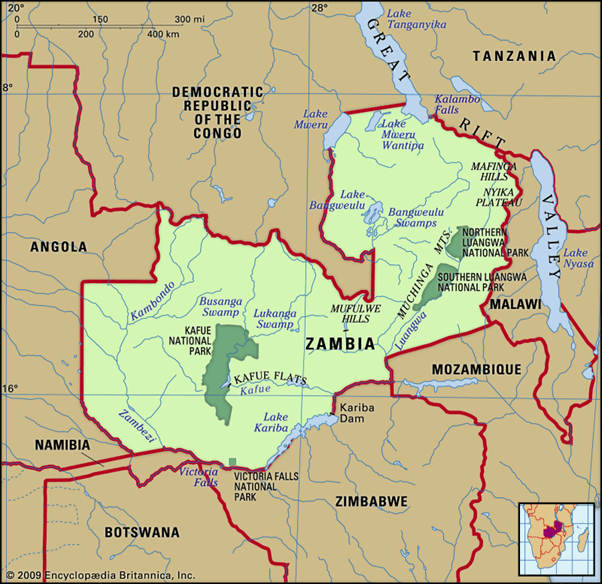
- Zambia is a landlocked country in south-central Africa, with Lusaka as its capital.
- It borders eight countries: Democratic Republic of Congo, Tanzania, Malawi, Mozambique, Zimbabwe, Botswana, Namibia and Angola.
- The country is largely characterised by high plateaus, along with hills, mountains and river valleys.
Geographical Features
- Climate: Tropical climate moderated by high altitude, with a distinct rainy season.
- Rivers: The Zambezi is the principal river; Kafue and Luangwa are other major rivers. The Zambezi flows into the Indian Ocean through Mozambique.
- Mafinga Hills: Located near the Malawi border, they contain Mafinga Central, Zambia’s highest point.
- Lake Tanganyika: Zambia has a shoreline on the lake in the north.
- Lake Kariba: A major artificial reservoir on the Zambezi, shared by Zambia and Zimbabwe.
- Victoria Falls: A major waterfall on the Zambezi River, located on the Zambia–Zimbabwe border.
Mineral Resources
- Copper and cobalt are Zambia’s major mineral resources.
- Other resources include uranium, zinc, lead, coal, gold, silver and emeralds.
- The Copperbelt is a major mining region and an important source of copper and cobalt, giving Zambia strategic relevance in critical-mineral supply chains.
2. Central African Republic
Context
An artisanal gold mine collapsed in the Abba area of Nana-Mambéré Prefecture, western Central African Republic (CAR), on 18 August 2026, reportedly killing at least 30 miners and trapping others.
About Central African Republic
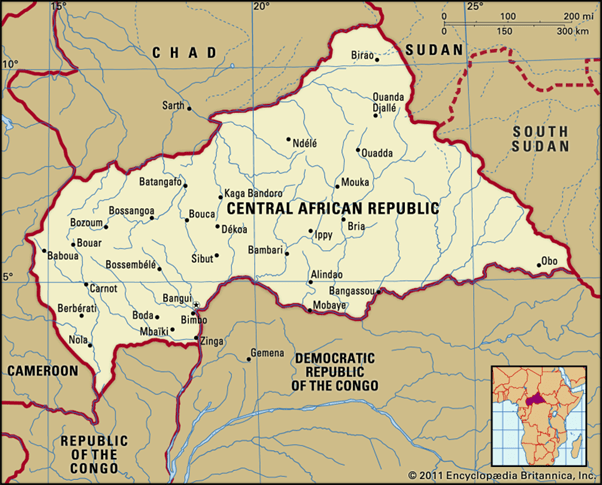
- CAR is a landlocked country in Central Africa, with Bangui as its capital.
- It shares borders with six countries: Chad, Sudan, South Sudan, Democratic Republic of the Congo, Republic of the Congo and Cameroon.
- The country is largely characterised by plateaus and savanna landscapes.
Geographical Features
- Climate: CAR has a predominantly tropical climate, with wetter conditions in the south and relatively drier conditions in the north.
- Rivers: The Ubangi (Oubangui) River is a major river in southern CAR and a tributary of the Congo River. The Chari River drains the northern part of the country towards Lake Chad.
- Highest Point: Mount Ngaoui (1,410 m) in the Karre Mountains is the country’s highest point.
Mineral Resources
- Major mineral resources include diamonds, gold, uranium, iron ore, copper and manganese.
Protected Area
- Dzanga-Sangha Protected Areas in southwestern CAR form part of the Sangha Trinational, a transboundary conservation complex shared by CAR, Cameroon and the Republic of the Congo.
- The Sangha Trinational is a UNESCO World Heritage Site and includes Dzanga-Ndoki National Park in CAR.