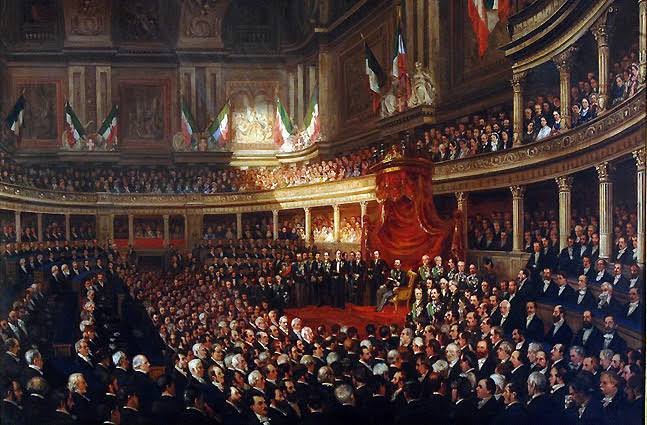
About the Unification of Italy
The Unification of Italy, popularly known as the Risorgimento (meaning resurgence), was one of the most significant nationalist movements of nineteenth-century Europe. It transformed the Italian peninsula from a collection of independent states into a unified nation-state. The process formally began with the establishment of the Kingdom of Italy in 1861 and concluded with the annexation of Rome in 1870. It was driven by the combined influence of nationalism, diplomacy, military campaigns, and popular movements.
Italy Before Unification
Following the Congress of Vienna (1815), Italy remained politically fragmented and largely under foreign control. The Congress restored the old monarchies and sought to suppress nationalist ideas that had spread during the French Revolution and the Napoleonic Wars.
The peninsula was divided into several political units:
- Kingdom of Piedmont-Sardinia in north-western Italy was the most progressive state and became the centre of the unification movement.
- Kingdom of the Two Sicilies controlled southern Italy under the Bourbon dynasty.
- Papal States occupied central Italy under the authority of the Pope.
- Parma, Modena, and Tuscany remained under Austrian influence.
- Lombardy-Venetia was directly governed by the Austrian Empire.
Political division, foreign domination, and economic barriers strengthened the demand for national unity.
Ideological Foundations
Italian unification was shaped by several political and intellectual movements.
- Nationalism promoted the idea that people sharing a common language, culture, and history should live within one nation.
- Liberalism demanded constitutional government, representative institutions, and civil liberties.
- Romanticism revived pride in Italy’s Roman and Renaissance heritage, strengthening national consciousness.
- Giuseppe Mazzini inspired the nationalist movement by advocating a united and republican Italy.
Phases of Italian Unification
Phase I: Revolutionary Nationalism (1830s–1848)
The first phase relied mainly on revolutionary movements.
- Giuseppe Mazzini founded Young Italy in 1831 to establish a united and republican Italy based on popular sovereignty.
- The Revolutions of 1848 spread nationalist sentiment across the Italian states.
- Charles Albert of Piedmont-Sardinia challenged Austrian rule but was defeated.
- These failures demonstrated that revolutionary efforts alone were insufficient to achieve unification.
Phase II: Diplomacy and Statecraft (1852–1861)
The movement entered a decisive stage under Count Camillo di Cavour, Prime Minister of Piedmont-Sardinia.
- He modernised the economy, strengthened the military, and pursued strategic diplomacy.
- Through the Plombieres Agreement, he secured the support of Napoleon III of France against Austria.
- Victory in the Austro-Sardinian War (1859) led to the annexation of Lombardy.
- Several central Italian states joined Piedmont-Sardinia through plebiscites (popular voting).
This phase established diplomacy as the key instrument of unification.
Phase III: Popular Movement and Military Campaign (1860)
The next phase was led by Giuseppe Garibaldi, who mobilised popular support for national unity.
- In 1860, he launched the Expedition of the Thousand and captured Sicily and southern Italy.
- His campaign weakened Bourbon rule with the support of local populations.
- Although Garibaldi supported a republic, he handed over the conquered territories to Victor Emmanuel II, placing national unity above personal political beliefs.
- This enabled the consolidation of Italy under a constitutional monarchy.
Phase IV: Completion of Unification (1861–1870)
The final phase completed the political integration of Italy.
- The Kingdom of Italy was proclaimed in 1861, with Victor Emmanuel II as its first king.
- Venetia was incorporated into Italy in 1866 after Austria’s defeat in the Austro-Prussian War.
- Rome was annexed in 1870 after French troops withdrew during the Franco-Prussian War.
- Rome subsequently became the capital of the unified Italian state, marking the completion of the Risorgimento.
Factors Facilitating Italian Unification
Several political, economic, and international developments contributed to the success of the movement.
- Rise of Nationalism: A common language, culture, and historical identity encouraged the demand for national unity.
- Impact of the French Revolution and Napoleonic Rule: Ideas of liberty, equality, and popular sovereignty, along with administrative reforms, inspired nationalist aspirations.
- Economic Interests: Political fragmentation restricted trade and industrial growth. A unified market promised greater economic development.
- Effective Leadership: Mazzini provided ideological inspiration, Cavour led diplomatic efforts, Garibaldi mobilised military support, and Victor Emmanuel II provided political leadership.
- Foreign Support: French military assistance and Prussia’s conflict with Austria weakened Austrian dominance and created favourable conditions for unification.
Challenges
The process of unification also faced several major obstacles.
- Austrian Control: Austrian dominance in northern Italy remained the greatest political obstacle.
- Opposition of the Papacy: The Pope opposed unification because it threatened his control over the Papal States.
- Ideological Differences: Conflicts between republicans and monarchists weakened the nationalist movement.
- Piedmontization: The unified state largely adopted the administrative and legal system of Piedmont-Sardinia, creating resentment, particularly in southern Italy.
- Regional Disparities: Northern Italy industrialised rapidly, while the south remained largely agrarian, giving rise to the Southern Question.
- Limited Popular Participation: The movement was primarily led by political elites, limiting broader national integration.
Significance
The unification of Italy had lasting political and historical consequences.
- Ended centuries of political fragmentation and foreign domination.
- Established Italy as a modern nation-state.
- Reduced Austrian influence in European politics.
- Inspired nationalist movements, particularly the Unification of Germany.
- Created a unified domestic market, encouraging economic integration.
- Triggered the Roman Question, resulting in prolonged tensions between the Italian state and the Papacy.
- Demonstrated the growing importance of nationalism and realpolitik in reshaping nineteenth-century Europe.
- Highlighted that political unity alone could not ensure complete social, economic, and cultural integration.
Conclusion
The Risorgimento transformed Italy from a politically divided region into a unified nation through the combined efforts of Mazzini, Cavour, Garibaldi, and Victor Emmanuel II. It demonstrated how nationalism, diplomacy, military action, and popular mobilisation could overcome foreign domination and political fragmentation. Although unification was completed in 1870, the challenge of integrating Italy’s diverse regions continued, making the Italian experience a landmark example of nation-building and modern state formation.