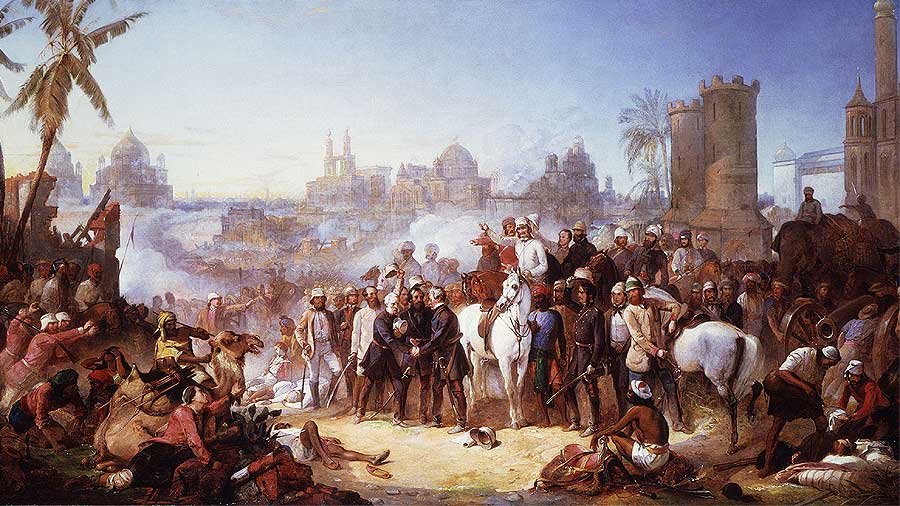
The Revolt of 1857, often hailed as India’s “First War of Independence,” stands as a monumental watershed in the history of the Indian subcontinent. It was the first organized and large-scale resistance against the imperialism of the British East India Company. Beginning on 10 May 1857, the uprising transitioned from a localized sepoy mutiny into a widespread civilian rebellion that threatened the very foundations of British rule in India.
I. Multi-Dimensional Causes of the Revolt
The uprising was not a sudden accident but the result of a century of simmering discontent. The British policy of ruthless exploitation affected every layer of Indian society.
1. Political Causes
British expansionist policies alienated Indian royalty and disrupted traditional governance:
- Doctrine of Lapse: Introduced by Lord Dalhousie, this policy annexed states like Satara, Jhansi, and Nagpur when a ruler died without a natural heir.
- Annexation of Awadh (1856): Annexed on the pretext of “misgovernance,” this move deeply hurt the sentiments of the sepoys, many of whom hailed from this region.
- Humiliation of the Mughals: The British announced that successors to Bahadur Shah II would be evicted from the Red Fort and lose their kingly titles.
2. Economic Causes
Economic policies led to the systematic impoverishment of India:
- Drain of Wealth: Indian resources were funneled to England to fund British industries and wars.
- Exploitative Land Revenue: Systems like Permanent Settlement, Ryotwari, and Mahalwari imposed heavy taxes, leading to peasant indebtedness and land loss.
- De-industrialization: British machine-made goods flooded Indian markets, destroying traditional handicrafts and leaving millions of artisans unemployed.
3. Social and Religious Causes
Interference in local customs created a fear of total cultural erasure:
- Social Superiority: British officials treated Indians with open racial contempt and arrogance.
- Legislative Reforms: The abolition of Sati and the Widow Remarriage Act (1856) were viewed by conservatives as an attack on the socio-religious fabric of India.
- Missionary Activities: Aggressive approach by Christian missionaries fueled fears of forced conversions.
4. Administrative and Military Factors
- Administrative Alienation: Indians were excluded from high-ranking civil and military positions, regardless of merit.
- Sepoy Grievances: Indian soldiers (sepoys) faced discrimination in pay and promotions compared to their European counterparts and were often sent on overseas missions (crossing the “black water”), which violated their caste rules.
5. The Immediate Cause: The Enfield Rifle
The spark that lit the fire was the introduction of the Enfield Rifle. The cartridges were rumored to be greased with cow and pig fat, offending both Hindu and Muslim religious sentiments. The refusal to use these cartridges triggered the initial defiance.
II. Timeline of the Uprising (1857-1858)
| Date | Major Event |
| 29th March 1857 | Mangal Pandey of the 34th Native Infantry revolts at Barrackpore; he is later executed. |
| 10th May 1857 | The formal start of the revolt in Meerut; sepoys free comrades and march to Delhi. |
| 11th-12th May 1857 | Rebels capture Delhi and proclaim Bahadur Shah II as the Emperor of Hindustan. |
| June 1857 | The revolt spreads to Kanpur, Lucknow, and Jhansi. |
| Sept 1857 | The British recapture Delhi; Bahadur Shah II is taken prisoner and exiled to Rangoon. |
| March 1858 | Lucknow is recaptured by British forces. |
| June 1858 | Gwalior is recaptured; Rani Lakshmibai dies in battle. |
| Nov 1858 | The revolt was officially suppressed; the Government of India Act 1858 was passed. |
III. Prominent Leaders and Centers of the Revolt
| Leader | Center of Revolt | Key Contributions |
| Bahadur Shah II | Delhi | Symbolic head of the revolt; provided a unifying figure for rebels. |
| General Bakht Khan | Delhi | The actual military commander of the rebel forces in Delhi. |
| Nana Saheb | Kanpur | Expelled the British from Kanpur; declared himself Peshwa. |
| Begum Hazrat Mahal | Lucknow | Proclaimed her minor son as Nawab; fought alongside Maulavi Ahmadullah. |
| Rani Lakshmibai | Jhansi | Fought heroically against General Hugh Rose; captured Gwalior with Tatya Tope. |
| Kunwar Singh | Bihar | At age 80, led successful guerrilla campaigns against British forces in Arrah. |
| Tatya Tope | Gwalior/Kanpur | Famous for guerrilla warfare; loyal lieutenant to Nana Saheb. |
IV. Why the Revolt Failed
Despite its scale, the uprising failed to overthrow British rule due to several critical factors:
- Localized Nature: Large parts of India, including the South, West, and much of Punjab, remained aloof or supported the British.
- Lack of Unified Leadership: While Bahadur Shah II was the figurehead, there was no coordinated military strategy or central command.
- Superior British Resources: The British had access to the electric telegraph for communication, superior weaponry, and a modern naval force.
- Lack of Support from the Intelligentsia: The modern educated Indian middle class generally viewed the revolt as backward-looking and did not join.
V. Consequences and Impact:
The aftermath of 1857 changed the nature of British administration forever:
- Transfer of Power: The East India Company was abolished, and governance was transferred directly to the British Crown via the Government of India Act 1858.
- Creation of the Viceroy: The Governor-General was given the title of Viceroy, acting as the direct representative of the Crown.
- Military Restructuring: The ratio of European to Indian soldiers was increased. Recruitment shifted toward “Martial Races” (e.g., Sikhs and Gurkhas) who had remained loyal.
- End of Annexations: The Doctrine of Lapse was withdrawn, and princely states were assured that their territories would not be annexed.
- Policy of Divide and Rule: The British increasingly used communal identity to play different groups against each other, particularly fostering a rift between Hindus and Muslims.
FAQs on the Revolt of 1857
Who was the Governor-General during the Revolt of 1857?
Lord Canning was the Governor-General during the uprising.
What was the “Doctrine of Lapse”?
A policy by Lord Dalhousie where the British annexed any Indian princely state if the ruler was “manifestly incompetent” or died without a male heir.
Who was the first martyr of the Revolt of 1857?
Mangal Pandey is considered the first martyr for his act of defiance at Barrackpore.
What was the significance of the “greased cartridges”?
They were rumored to be coated with cow and pig fat, which violated the religious tenets of both Hindu and Muslim sepoys.
Which non-princely classes participated in the revolt?
Peasants, artisans, and religious leaders (Pandits/Maulvis) participated alongside the sepoys.
Why did the educated middle class stay away?
They believed British rule would bring modernization and viewed the revolt as a return to the old feudal order.
What was the “Table of Precedence” changed after 1857?
The East India Company’s directors were replaced by the Secretary of State for India and a 15-member council.
Who led the revolt in Bihar?
Kunwar Singh, the Zamindar of Jagdishpur, led the revolt in Bihar.
What happened to Bahadur Shah Zafar after the revolt?
He was tried for treason, found guilty, and exiled to Rangoon (now Yangon), where he died in 1862.
Was the revolt successful in any way?
While it failed militarily, it sowed the seeds of Indian nationalism and forced the British to radically reorganize their administration.