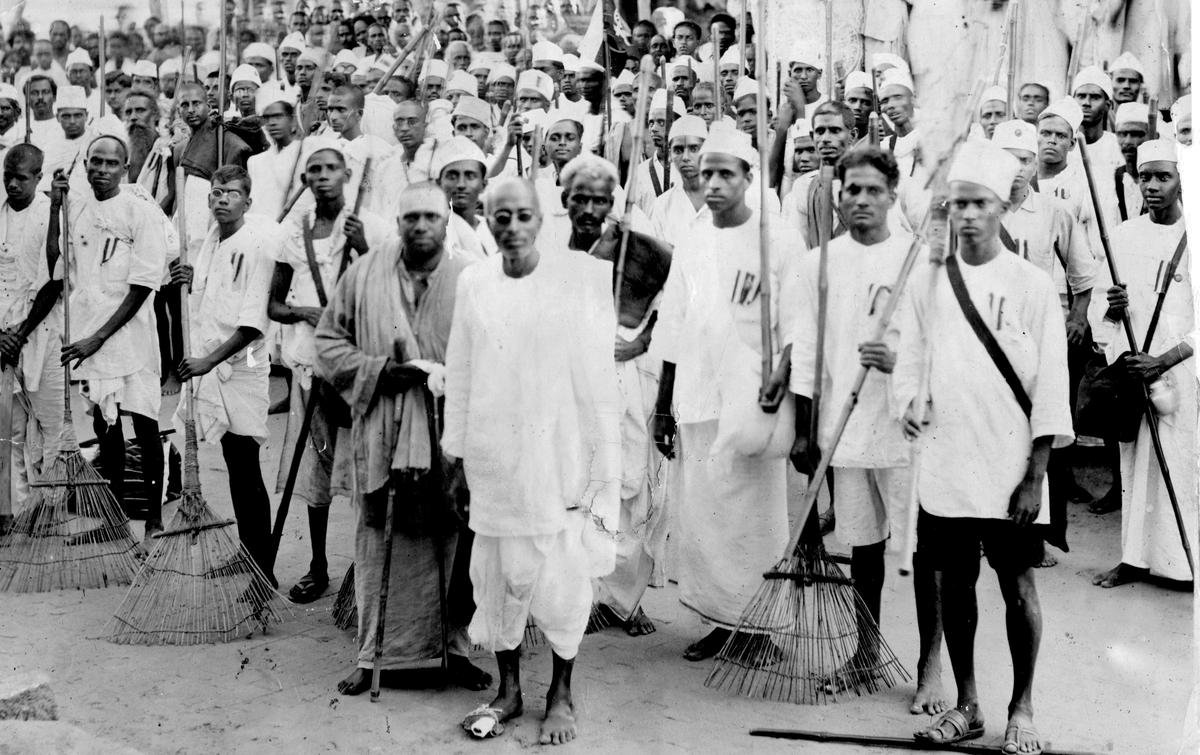
The Civil Disobedience Movement (CDM), launched in 1930, stands as the second great mass mobilization in the history of the Indian National Movement. Unlike the Non-Cooperation Movement of 1920, the CDM was distinct in its objective: it was the first time the Indian National Congress (INC) formally declared Purna Swaraj (Complete Independence) as its goal. By systematically defying British laws, most notably the Salt Tax, .Mahatma Gandhi transformed a legal protest into a nationwide uprising that challenged the moral and political authority of the British Raj.
Background:
The transition from demanding “Dominion Status” to “Complete Independence” was fueled by British recalcitrance and a series of pivotal political events between 1928 and 1929.
- The Calcutta Session (1928): Congress endorsed the Nehru Report but gave the British a one-year ultimatum to grant Dominion Status. Failure to do so by December 31, 1929, would result in a mass movement for independence.
- The Irwin Declaration & Delhi Manifesto (1929): Viceroy Lord Irwin made a vague promise of Dominion Status. Indian leaders issued the Delhi Manifesto, demanding a majority for Congress at the proposed Round Table Conference. Irwin’s rejection of these terms cleared the path for confrontation.
- The Lahore Session (1929): Under the presidency of Jawaharlal Nehru, Congress passed the historic Purna Swaraj resolution. On December 31, 1929, the tricolor was hoisted on the banks of the River Ravi, and January 26, 1930, was designated as “Independence Day.”
Gandhi’s Eleven Demands
Before launching the movement, Gandhi offered the British a compromise through 11 Demands (including reduction of land revenue, abolition of the salt tax, and release of political prisoners). The lack of a positive response from the government became the immediate justification for the struggle.
Salt Satyagraha and the Dandi March
Gandhi chose Salt as the central symbol of the movement. Since salt was a basic necessity, the British monopoly and the “inhumane” salt tax affected every Indian, regardless of caste or religion.
The Historic Dandi March
- Commencement: March 12, 1930, from Sabarmati Ashram (Ahmedabad).
- The Journey: Gandhi, along with 78 chosen followers, marched 240 miles over 24 days.
- The Act of Defiance: On April 6, 1930, at the coast of Dandi, Gandhi picked up a handful of salt, technically breaking the law. He famously declared, “Sedition has become my religion.”
Forms of Protest
The movement rapidly expanded beyond salt:
- Boycott: Foreign cloth and liquor shops were picketed.
- Institutional Resignation: Government servants resigned; lawyers gave up practices.
- Non-payment of Taxes: Refusal to pay land revenue and the Chowkidari tax.
- Forest Law Defiance: Tribals violated restrictive forest regulations.
Regional Spread and Key Leaders
The CDM was a pan-Indian phenomenon, with various regions adopting unique forms of defiance based on local conditions.
| Region | Key Leaders | Major Activity |
| Tamil Nadu | C. Rajagopalachari | The Vedaranyam Salt March from Tiruchirapalli. |
| Malabar | K. Kelappan | Salt marches from Calicut to Poyannur. |
| Peshawar (NWFP) | Khan Abdul Ghaffar Khan | Led the “Red Shirts” (Khudai Khidmatgars); Garhwal Rifles refused to fire on protestors. |
| Dharasana (Gujarat) | Sarojini Naidu, Manilal | A non-violent raid on the Dharasana Salt Works. |
| United Provinces | Jawaharlal Nehru | “No-revenue” and “No-rent” campaigns. |
| Bihar | Ambika Kant Sinha | Anti-Chowkidari tax agitation after salt satyagraha. |
Phases and The Gandhi-Irwin Pact
The Truce (1931)
The movement faced intense repression, but the government was also feeling the economic pinch of the boycott. This led to the Gandhi-Irwin Pact on March 5, 1931.
- Provisions: Release of non-violent political prisoners; right to make salt for personal use.
- Concession: Gandhi agreed to suspend the CDM and attend the Second Round Table Conference.
Second Phase and Final Withdrawal
The Second Round Table Conference failed to address Indian demands. Upon his return in 1932, Gandhi resumed the movement. However, the government responded with unprecedented harshness, confiscating properties and banning Congress organizations. The movement was suspended in 1933 and formally withdrawn in April 1934.
Participation and Social Reach
- Women: Played a pioneering role, leading picketing efforts and braving imprisonment. It was a transformative “liberating experience” for Indian women.
- Business Class: Initially provided strong financial support (notably D. Birla), though support wavered later due to economic losses.
- Peasants & Tribals: Large-scale participation in “No-tax” movements and forest Satyagraha.
- Muslims: Participation was lower than in the Non-Cooperation Movement, partly due to the lack of a religious issue like Khilafat.
Critical Assessment and Legacy
Though the movement did not immediately achieve Purna Swaraj, its impact was profound:
- Mass Victory in 1937: The moral authority gained helped Congress sweep the 1937 provincial elections.
- Radicalization: The Karachi Session (1931) drafted resolutions on Fundamental Rights and a Socialist Economic Policy.
- Global Attention: The non-violent nature of the Salt Satyagraha gained worldwide media coverage, putting the British on the defensive.
- Rise of Socialism: The movement saw the birth of the Congress Socialist Party (1934) under leaders like JP Narayan and Acharya Narendra Deva.
FAQs: Civil Disobedience Movement
- When did the Civil Disobedience Movement start?
It was formally launched on April 6, 1930, after the completion of the Dandi March.
- What was the “Salt Satyagraha”?
It is another name for the Civil Disobedience Movement, highlighting the choice of the salt tax as the primary target of defiance.
- Who were the “Red Shirts”?
The Khudai Khidmatgars, led by Khan Abdul Ghaffar Khan (Frontier Gandhi), who practiced non-violence in the North-West Frontier Province.
- What was the Gandhi-Irwin Pact?
A 1931 agreement where Gandhi agreed to suspend the CDM and attend the Second Round Table Conference in exchange for the release of political prisoners.
- Why was salt chosen as the symbol of protest?
Salt was a universal necessity; taxing it affected the poorest citizens, making it a powerful unifying symbol against British “inhumanity.”
- What was the “Chowkidari Tax” agitation?
In landlocked regions like Bihar and Bengal, where salt satyagraha was difficult, people refused to pay the tax collected for village guards (Chowkidars).
- Did the movement achieve Purna Swaraj?
Not immediately, but it permanently shifted the goal of the national struggle from reform to total independence.
- Who led the Salt March in South India?
- Rajagopalachari led the march from Tiruchirapalli to Vedaranyam on the Tanjore coast.
- What was the significance of the Karachi Session of 1931?
It endorsed the Gandhi-Irwin Pact and passed landmark resolutions on Fundamental Rights and the National Economic Program.
- When was the movement finally withdrawn?
After a period of tapering off, it was formally withdrawn by Gandhi in April 1934.