Important questions for UPSC Pre/ Mains/ Interview:
|
Context
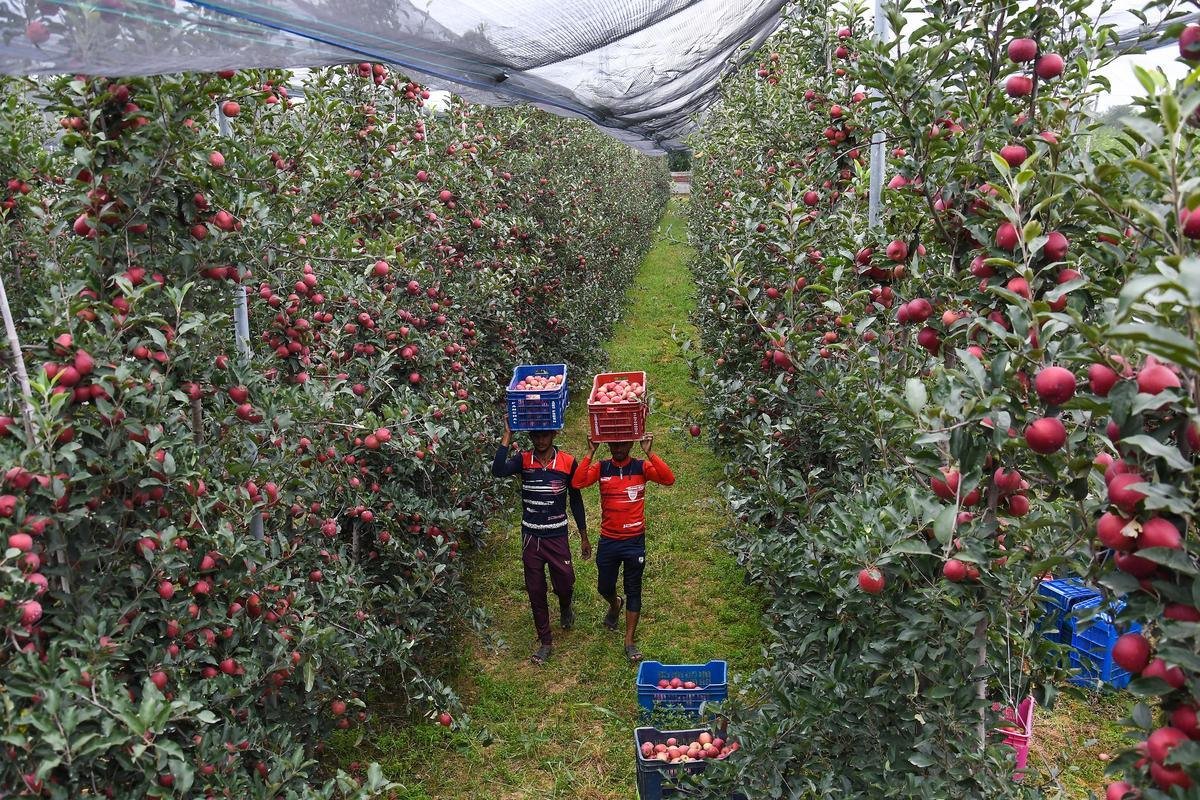
Apple traders and political leaders in Jammu & Kashmir (J&K) have raised concerns over reduced import duties on U.S. and EU apples under recent trade agreements. The move is viewed as potentially disruptive to the region’s horticulture-based economy, which forms the backbone of India’s domestic apple production.
Q1. What changes have been made to apple import duties?
- What is the change regarding U.S. apples?
- Basic customs duty reduced from 50% to 25%.
- Minimum Import Price (MIP) fixed at ₹80 per kg.
- What is the arrangement under the India–EU trade deal?
- Import duty reduced to 20%.
- Applicable under Tariff Rate Quota (TRQ).
- Initial quota: 50,000 tonnes annually.
- Gradual increase to 1,00,000 tonnes over 10 years.
These measures aim to liberalise trade while limiting quantity through TRQs.
Q2. Why is apple cultivation crucial for Jammu & Kashmir?
According to the J&K Economic Survey 2025–26:
- Apple production accounts for 50% of horticulture output.
- Horticulture revenue: Approx. ₹10,000 crore annually.
- 35 lakh people are directly or indirectly employed.
- Around 7 lakh families are dependent on horticulture.
- Apple output in 2024: 21 lakh metric tonnes.
- Contribution: Over 70% of India’s apple production.
Apple cultivation is thus central to J&K’s socio-economic stability.
Q3. What structural disadvantages do J&K orchardists face?
- How do landholding patterns differ?
- Average orchard size in J&K: 0.40 hectares.
- Average farm size in the U.S./EU/New Zealand: 50+ hectares.
- Fragmentation limits economies of scale.
- Why is productivity lower in India?
- India: 7–8 tonnes per hectare.
- U.S./China/New Zealand/Iran: 40–70 tonnes per hectare.
- Higher foreign productivity due to:
- Mechanised farming.
- Advanced pruning and harvesting.
- AI-assisted agricultural techniques.
- Better quality planting material.
- Is there a quality perception gap?
- Western varieties like Gala apples dominate global markets.
- Indian adaptation of premium varieties is recent.
- Quality gaps exist in:
- Colour
- Shape
- Uniformity
- Shelf life
- This affects consumer preference and price realisation.
Q4. How could reduced tariffs affect cold storage economics?
- J&K has 92 cold storage units.
- Controlled-atmosphere capacity: 397.08 lakh metric tonnes.
- Cold storage stabilises off-season prices.
Potential impact of imports:
- Cheaper fresh imports during off-season.
- Undercutting stored apples.
- Reduced profitability of stored stock.
- Risk of distress sales.
- Long-term viability of cold storage infrastructure threatened.
Q5. What political and policy demands have been raised?
Stakeholders demand:
- Exclusion of apples from trade deals.
- Expansion of high-density cultivation (currently limited share).
- Interest-free loans under Holistic Agriculture Development Programme (HADP).
- Expansion of cold storage infrastructure.
- Activation of dry port and logistics projects.
Focus is on boosting competitiveness rather than only protection.
Q6. What is the broader economic trade-off involved?
- What are the consumer benefits?
- Lower apple prices.
- Greater variety availability.
- Reduced inflationary pressure.
- What are the producer risks?
- Income instability.
- Competitive pressure from high-productivity producers.
- Structural disadvantage exposure.
- Trade policy inherently balances consumer welfare and producer protection.
Q7. What administrative and federal dimensions are involved?
- Trade agreements negotiated by the Union Government.
- Agriculture is a State subject.
- Requires Centre–State coordination.
- TRQ enforcement and MIP monitoring required.
Q8. What long-term reforms are necessary?
- Farm consolidation and cooperative models.
- AI-based orchard management adoption.
- High-density plantation scaling.
- Modern value chain integration.
- Branding and export diversification.
Competitiveness must complement trade liberalisation.
Q9. What safeguards could balance trade and domestic interests?
- Strict enforcement of Minimum Import Price.
- Safeguard duties if imports surge sharply.
- Phased liberalisation linked to domestic capacity enhancement.
- Targeted subsidies for productivity modernisation.
- Strong domestic market intelligence systems.
Conclusion
The reduction in apple import duties illustrates the classic tension between trade liberalisation and domestic agricultural protection. While consumers may benefit from lower prices and expanded choice, J&K’s horticulture sector faces structural vulnerabilities due to low productivity and fragmented holdings. Sustainable resolution lies in modernisation, technological upgradation, and calibrated trade safeguards to ensure competitiveness without compromising livelihoods.