Precipitation is a cornerstone of the Earth’s hydrological cycle. It is the primary mechanism by which water from the atmosphere reaches the Earth’s surface, sustaining life, regulating the climate, and recharging essential freshwater resources. Without this natural process, our planet’s agriculture, biodiversity, and energy sectors would face total collapse.
What is Precipitation?
Precipitation refers to any product of the condensation of atmospheric water vapor that falls under gravitational pull. This includes both liquid forms (like rain) and solid forms (like snow or hail).
How it Occurs:
Condensation: Water vapor in the air cools and condenses into tiny droplets or ice crystals, forming clouds.
Coalescence: These droplets collide and grow larger.
Gravitational Fall: Once the droplets become too heavy to remain suspended by atmospheric updrafts, gravity pulls them to the Earth’s surface.
Factors Influencing Precipitation:
- Temperature: Determines the physical state (liquid vs. solid) of the falling water.
- Humidity: Higher humidity levels accelerate the condensation process.
- Atmospheric Pressure and Wind: These currents move clouds and determine the intensity and location of rainfall.
Major Types of Precipitation
Atmospheric conditions vary by region and altitude, leading to diverse forms of precipitation:
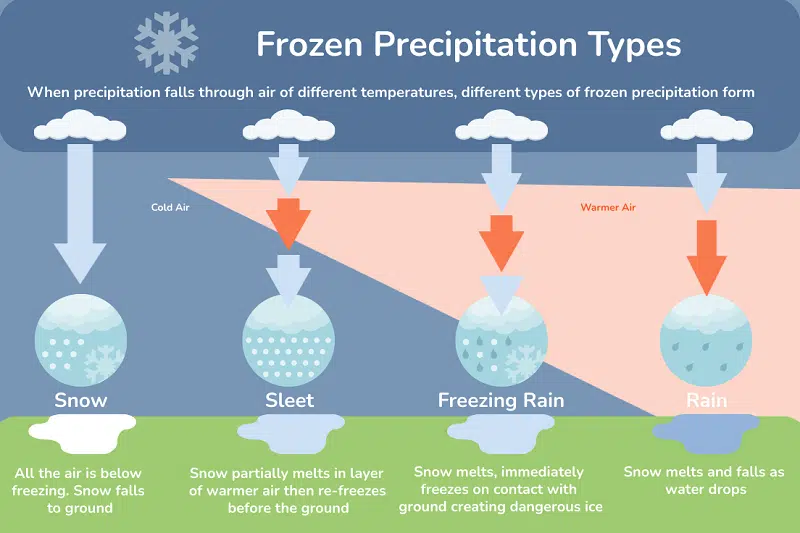
1. Rain
The most common form, occurring when temperatures are above freezing . It is the lifeline of the Indian monsoon and global food security.
2. Snow
Formed in sub-freezing temperatures where water vapor crystallizes into complex snowflakes. Snow serves as a natural storage system, feeding rivers through gradual melting.
3. Sleet
Raindrops that freeze into small, translucent ice pellets as they pass through a cold layer of air near the ground.
4. Hail
Large, solid ice balls formed in powerful thunderclouds (Cumulonimbus). Updrafts carry water droplets into freezing altitudes repeatedly until they fall as heavy ice.
5. Freezing Rain
Rain that falls in liquid form but freezes instantly upon striking cold surfaces like roads or power lines, creating a hazardous “black ice” coating.
6. Drizzle
Very light rain with droplets smaller than $0.5\text{ mm}$. Drizzle often falls from low-level stratus clouds and maintains soil moisture without causing erosion.
7. Graupel
Often called “soft hail,” these are snow crystals that become encased in rime (frozen cloud droplets).
Importance of Precipitation for Life and Climate
Precipitation acts as more than just a weather event; it is a global life-support system:
- Freshwater Replenishment: It recharges groundwater aquifers and fills rivers/lakes used for drinking and industry.
- Ecosystem Maintenance: Sustains forests, wetlands, and grasslands, which are critical for biodiversity.
- Climate Regulation: Redistributes heat energy globally via latent heat transfer during evaporation and condensation.
- Food Security: Agriculture in many nations, including India, depends on predictable rainfall patterns for crop yields.
- Hydroelectric Power: Many regions rely on consistent precipitation to drive turbines for renewable energy.
Global Distribution of Precipitation
Precipitation is unevenly distributed due to geographical and atmospheric factors:
| Region | Precipitation Characteristic | Example Locations |
| Equatorial | Heavy year-round rain (Convectional) | Amazon Basin, Congo Basin |
| Tropical Monsoon | Highly seasonal heavy rains | India, Bangladesh, SE Asia |
| Arid/Semi-Arid | Extremely low rain (Dry air masses) | Sahara Desert, Thar Desert |
| Mountainous | High rainfall (Orographic lifting) | Himalayas, Andes, Rockies |
| Polar | Very low, mostly as snow | Antarctica, Greenland |
Benefits of Managing Precipitation
In the era of climate change, the benefits of understanding and managing precipitation include:
- Disaster Mitigation: Strengthening weather forecasting to predict floods and droughts.
- Resource Conservation: Utilizing Rainwater Harvesting to combat water scarcity.
- Agricultural Resilience: Developing crops that can survive erratic rainfall.
- Infrastructural Integrity: Building dams and embankments to manage runoff and generate power.
FAQs
What is the difference between rain and drizzle?
Drizzle has droplets smaller, whereas rain consists of larger, faster-falling drops.
- Which region receives the maximum precipitation globally?
The Equatorial regions and specific orographic points like Mawsynram, India, receive the highest rainfall.
What does “80% precipitation” mean in a forecast?
It means there is an 80% chance that precipitation will fall at any given point in the forecast area.
Is snow a form of precipitation?
Yes, snow is the solid form of precipitation consisting of ice crystals.
What is orographic precipitation?
It occurs when moist air is forced to rise over a mountain range, cools, and releases moisture as rain or snow.
How does precipitation affect global warming?
It redistributes heat, but changing patterns due to global warming can lead to extreme events like flash floods.
What is sleet?
Sleet is a mixture of rain and snow, or raindrops that freeze into ice pellets before reaching the ground.
Why is the Sahara Desert so dry?
It lies in a high-pressure zone where dry air descends, preventing cloud formation.
What is the primary source of all precipitation?
Evaporation from the Earth’s oceans is the primary source of atmospheric moisture.
How do we measure precipitation?
Rain is measured using a Rain Gauge, while snow is measured using a snow gauge or ruler for depth.