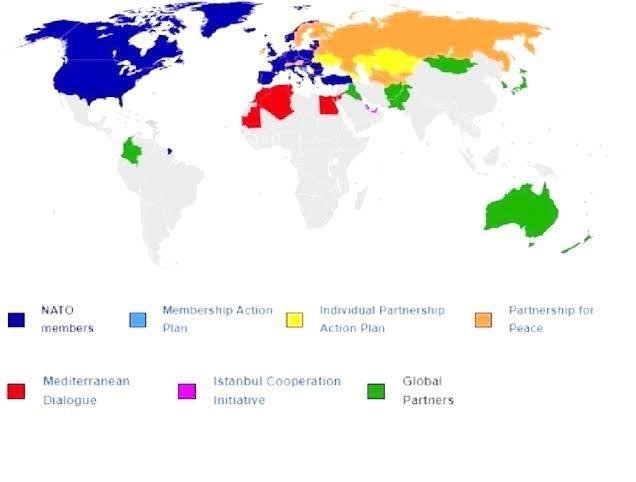
The North Atlantic Treaty Organization (NATO) remains the world’s most powerful political and military alliance, dedicated to the principle of collective security. Established in 1949 at the onset of the Cold War, the alliance has undergone significant transformations, particularly following the geopolitical shifts in Europe since 2022.
NATO consists of 32 member countries, with its newest members, Finland and Sweden, fundamentally altering the security architecture of the Baltic and Arctic regions.
I.Strategic Objectives of NATO
NATO’s core mission is to safeguard the freedom and security of its members through political and military means. Its objectives have evolved to meet modern 21st-century threats:
- Collective Defense (Article 5): The “bedrock” of the alliance, which states that an armed attack against one member is an attack against all.
- 360-Degree Security: A comprehensive approach to protect against threats from all directions, including state aggression, terrorism, and cyberattacks.
- The 5% Commitment: At the 2025 The Hague Summit, allies pledged to increase defense spending to 5% of GDP by 2035, a significant escalation from the previous 2% target, aimed at radical modernization.
- Crisis Management: Utilizing diplomatic and military tools to stabilize fragile regions and prevent conflicts from spilling across borders.
- Partnership Expansion: Strengthening ties with non-member partners in the Indo-Pacific (Japan, South Korea, Australia, and New Zealand) to address global challenges.
II. Full List of NATO Member Countries (2025)
The alliance has grown from 12 founding members to 32 sovereign states. Below is the comprehensive list of members and their capitals:
As of February 2026, the North Atlantic Treaty Organization (NATO) consists of 32 member countries. The alliance has expanded significantly from its original 12 founding members to include much of Europe and North America.
Below is the complete list of members, categorized by their entry into the alliance.
The 12 Founding Members (Joined 1949)
These nations signed the North Atlantic Treaty (Washington Treaty) on April 4, 1949, to establish the alliance.
- Belgium
- Canada
- Denmark
- France
- Iceland
- Italy
- Luxembourg
- Netherlands
- Norway
- Portugal
- United Kingdom
- United States
| S.No | NATO Member | Capital | Year Joined |
| 1-12 | Founding Members
(list given above ) |
1949 | |
| 13 | Greece | Athens | 1952 |
| 14 | Türkiye | Ankara | 1952 |
| 15 | Germany | Berlin | 1955 |
| 16 | Spain | Madrid | 1982 |
| 17 | Czechia | Prague | 1999 |
| 18 | Hungary | Budapest | 1999 |
| 19 | Poland | Warsaw | 1999 |
| 20 | Bulgaria | Sofia | 2004 |
| 21 | Estonia | Tallinn | 2004 |
| 22 | Latvia | Riga | 2004 |
| 23 | Lithuania | Vilnius | 2004 |
| 24 | Romania | Bucharest | 2004 |
| 25 | Slovakia | Bratislava | 2004 |
| 26 | Slovenia | Ljubljana | 2004 |
| 27 | Albania | Tirana | 2009 |
| 28 | Croatia | Zagreb | 2009 |
| 29 | Montenegro | Podgorica | 2017 |
| 30 | North Macedonia | Skopje | 2020 |
| 31 | Finland | Helsinki | 2023 |
| 32 | Sweden | Stockholm | 2024 |
III. Geography and Strategic Borders
NATO’s presence along the “Eastern Flank” has intensified significantly to deter regional aggression.
NATO Countries Bordering Russia
NATO’s direct land border with Russia to approximately 2,300 miles (3,700 km).
- Norway: Long-standing northern frontier.
- Finland: Shares an 832-mile border; the 31st member.
- Estonia, Latvia, Lithuania: The three Baltic states.
- Poland: Borders the Russian exclave of Kaliningrad.
NATO Countries Bordering Ukraine
Nations on the front line of humanitarian and military logistics support:
- Poland
- Slovakia
- Hungary
- Romania
IV. NATO Membership Requirements
Under Article 10 of the North Atlantic Treaty, membership is open to any European state that can further the principles of the Treaty. Applicants must meet the following:
- Democratic Values: Must be a functioning democracy based on a market economy.
- Civilian Control: Military forces must be under firm civilian and democratic control.
- Good Neighborly Relations: Must have resolved any international, territorial, or internal ethnic disputes peacefully.
- Compatibility: Must be able to contribute militarily to the alliance and achieve interoperability with other members.
V. Is India Part of NATO?
India is not a member of NATO and has historically maintained a policy of strategic autonomy. However, the relationship has deepened significantly:
- Framework for Enhanced Cooperation (2021): India and NATO established a structured dialogue on regional security, counter-terrorism, and maritime safety.
- India-EU Strategic Agenda (2026): While separate from NATO, India’s deepening ties with the EU (where 23 out of 27 members are also in NATO) enhances its interoperability with Western defense standards.
- Indo-Pacific Synergy: NATO has increasingly looked toward the “Indo-Pacific Four” (IP4) for maritime security, a goal that aligns with India’s vision for a “Free and Open Indo-Pacific.”
Ten FAQs on NATO 2026
Who is the newest member of NATO?
Sweden, which joined on March 7, 2024, is the 32nd member.
Where is NATO’s headquarters?
It is located in Brussels, Belgium.
Has Article 5 ever been invoked?
Only once, following the September 11, 2001, terror attacks on the United States.
Where will the 2026 NATO Summit be held?
The 2026 summit is scheduled to take place in Türkiye.
Which NATO country has the largest military budget?
The United States provides the largest share of NATO’s defense spending.
What is the “Washington Treaty”?
It is the founding document of NATO, signed on April 4, 1949.
Do all NATO members have an army?
Iceland is the only NATO member that does not have a standing army (it maintains a coast guard and contributes in other ways).
Can NATO members be kicked out?
There is no formal mechanism in the treaty to expel a member, though members can voluntarily withdraw.
What is a “Major Non-NATO Ally” (MNNA)?
A legal status granted by the U.S. to close partners (like Japan or Israel) that provides certain defense benefits without the Article 5 commitment.
What is the NATO 5% goal?
It is a new spending target agreed upon in 2025, where allies aim to spend 5% of their GDP on defense by 2035.