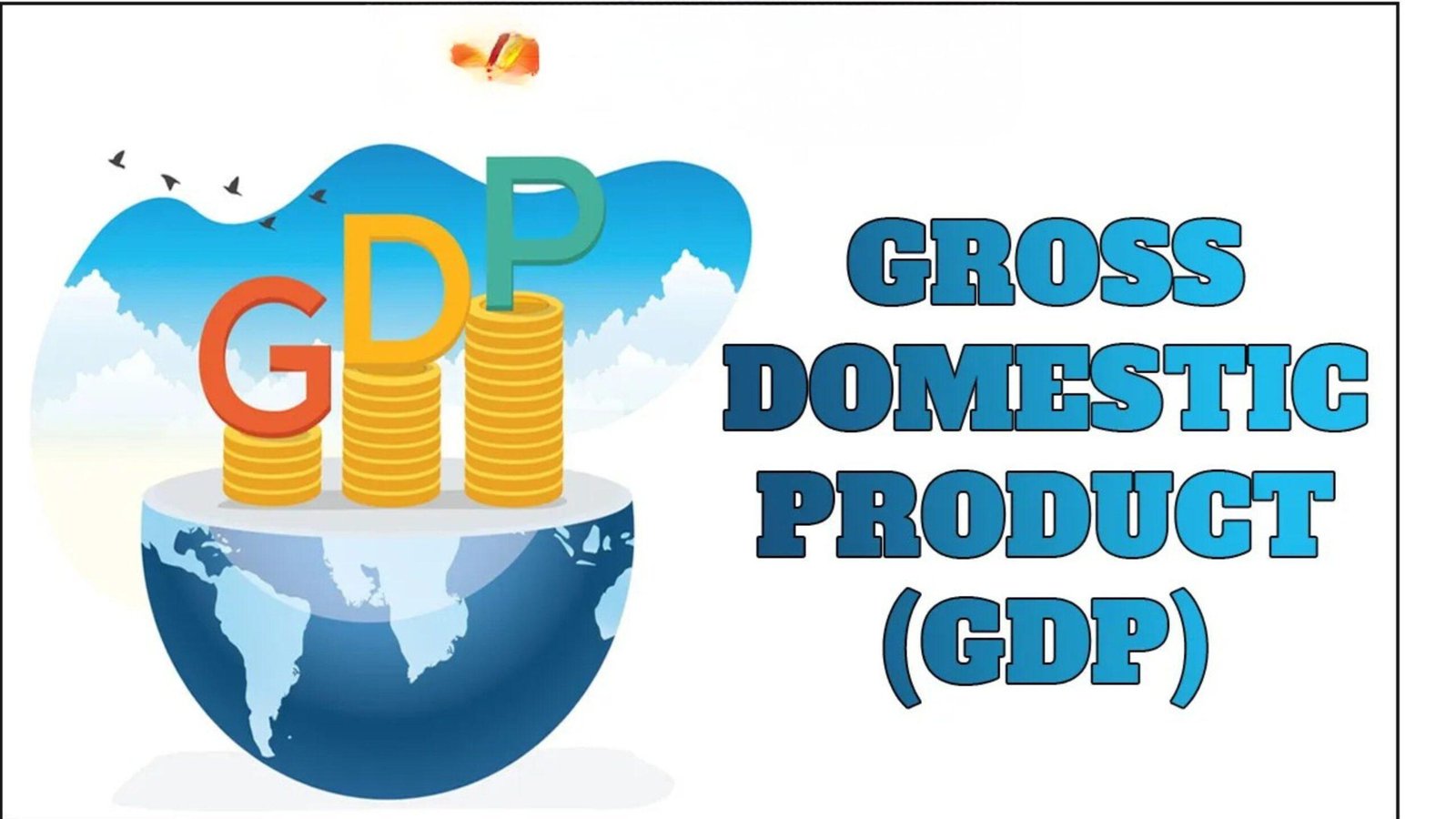
Gross Domestic Product (GDP) is the primary metric used by economists and policymakers to measure the economic health of a nation. It represents the total monetary or market value of all finished goods and services produced within a country’s borders in a specific time period—typically one financial year. As a broad measure of overall domestic production, it functions as a comprehensive scorecard of a given country’s economic health.
While GDP serves as a crucial indicator of growth and development, it is calculated through various lenses—such as Nominal, Real, and PPP—to provide a more nuanced understanding of productivity and living standards.
Types of Gross Domestic Product
Economic analysis requires different versions of GDP to account for factors like inflation and varying costs of living across countries.
- Nominal GDP: This represents the value of all goods and services produced at current market prices. It does not account for inflation, meaning it can appear higher simply due to rising prices rather than increased production.
- Real GDP: This is the most accurate measure of economic growth. It is adjusted for inflation using a GDP price deflator. By using a base year’s prices, it isolates real changes in the volume of goods and services produced.
- Formula: Real GDP = Nominal GDP % Price Deflator
- GDP Per Capita: This measures the average economic output per person. It is used to compare the living standards and productivity of different nations.
- Formula: GDP Per Capita = Total GDP % Total Population
- GDP Growth Rate: This measures the pace of economic expansion or contraction by comparing quarterly or annual changes. A negative growth rate for two consecutive quarters typically signals a recession.
- GDP Purchasing Power Parity (PPP): This adjusts GDP to reflect the differences in the cost of living and local prices. It allows for a “level playing field” when comparing the real output and income levels of different nations by removing currency exchange rate distortions.
GDP Calculation Methodologies
There are three primary approaches to calculating GDP, all of which should ideally yield the same total.
(1) The Expenditure Method
This is the most common approach. It sums up all the spending by different groups within the economy.
- Formula: GDP = C + I + G + (X – M)
- C (Consumption): Spending by households on final goods/services.
- I (Investment): Business spending on capital assets (machinery, inventory).
- G (Government Spending): Public spending on infrastructure, salaries, and services.
- X – M (Net Exports): Total exports minus total imports.
(2) The Income Method
This method sums up all the incomes earned by the factors of production—namely labor and capital—within the domestic boundaries.
- Components: Wages, rent, interest, and profits.
(3) The Production (Output) Method
Also known as the Value-Added Method, it calculates the market value of all goods and services produced, subtracting the cost of intermediate goods to avoid double counting.
Key Macroeconomic Variables of GDP
To dive deeper into economic performance, several related variables are used:
- GDP at Factor Cost: Total production value excluding indirect taxes and including subsidies.
- GDP at Factor Cost = GDP at Market Price – Indirect Taxes + Subsidies
- Net Domestic Product (NDP): GDP minus the value of depreciation (wear and tear of assets).
- NDP = GDP – Depreciation
- Gross National Product (GNP): GDP plus net income earned from abroad.
- GNP = GDP + Exports – Imports
- Net National Product (NNP) at Factor Cost: This is commonly referred to as National Income.
- NNP at Factor Cost = GNP at Factor Cost – Depreciation
India’s GDP Methodology: Pre-2015 vs. Post-2015
In 2015, India significantly overhauled its GDP computing methodology to align with international standards (SNA 2008).
| Aspect | Pre-2015 Methodology | Post-2015 Methodology |
| Base Year | 2004-05 | 2011-12 |
| Primary Metric | GDP at Factor Cost | GDP at Market Price |
| Manufacturing Data | Based on factory-level data (IIP/ASI). | Corporate-level data (MCA 21) covering ~5 lakh companies. |
| Taxes & Subsidies | Excluded product taxes/subsidies. | Included for a comprehensive measure. |
| Financial Sector | Limited data sources. | Included regulators like SEBI, PFRDA, and IRDA. |
The Tax-to-GDP Ratio
The tax-to-GDP ratio indicates the government’s ability to fund public services. India’s ratio is projected to reach 11.7% in 2024-25.
- Challenges for India: A large informal sector, tax exemptions for the agricultural sector (affecting ~15 crore households), and low per capita income levels.
- Significance: A higher ratio allows for robust spending on health, education, and infrastructure.
6. Significance and Limitations of GDP
Significance
- Economic Health: Identifies if an economy is growing or in a recession.
- Policy Planning: Helps governments adjust interest rates and fiscal stimulus.
- Investment Decisions: Guides investors toward high-growth markets.
Limitations
- Excludes Informal Sector: Does not count household work, volunteerism, or the “black market.”
- Ignores Well-being: Does not account for income inequality, environmental degradation, or happiness.
- Repatriated Profits: Profits earned by foreign companies in India are counted in India’s GDP, even if they are sent back to their home country.
FAQs: Understanding Gross Domestic Product
Q1 WHAT IS THE DIFFERENCE BETWEEN REAL GDP AND NOMINAL GDP?
Nominal GDP is calculated at current market prices, while Real GDP is adjusted for inflation using a base year’s prices to reflect actual production growth.
Q2 WHY IS THE BASE YEAR IMPORTANT IN GDP CALCULATION?
A base year provides a constant price reference, allowing economists to eliminate the effects of price changes (inflation/deflation) and measure real economic growth.
Q3 WHAT IS THE EXPENDITURE METHOD FORMULA?
The formula is GDP = C + I + G + (X – M), where C is consumption, I is investment, G is government spending, and (X – M) is net exports.
Q4 HOW DOES DEPRECIATION AFFECT GDP?
Depreciation does not affect GDP directly, but it is subtracted from GDP to calculate Net Domestic Product (NDP), which accounts for the wear and tear of capital assets.
Q5 WHAT IS THE SIGNIFICANCE OF GDP PER CAPITA?
It indicates the average economic output per person, serving as a proxy for the average standard of living and labor productivity in a country.
Q6 WHAT WAS THE MAJOR CHANGE IN INDIA’S GDP CALCULATION IN 2015?
India shifted its base year to 2011-12 and changed its primary measure from GDP at Factor Cost to GDP at Market Price.
Q7 WHAT IS POTENTIAL GDP?
Potential GDP is the maximum level of output an economy can sustain over the long term without triggering a rise in inflation.
Q8 WHY DOES INDIA HAVE A LOW TAX-TO-GDP RATIO?
The primary reasons include a vast informal sector, a large portion of the population being below the tax threshold, and significant tax exemptions for the agricultural sector.
Q9 DOES GDP MEASURE THE HAPPINESS OF CITIZENS?
No, GDP only measures material output and economic activity; it does not account for health, education, environmental quality, or the distribution of wealth.
Q10 WHAT IS THE SECONDARY SECTOR’S ROLE IN GDP?
The secondary sector (manufacturing and industry) gains importance during a nation’s development phase by providing technological advancements and high-value capital investment.