Fiscal Policy in India serves as the cornerstone of the nation’s economic governance, directing growth, stability, and social equity. It represents the government’s decisions regarding public expenditure, taxation, and public borrowing to influence overall economic activity. Grounded in Keynesian economics, fiscal policy acts as a stabilizing force during periods of instability, such as recessions or high inflation, by adjusting spending and tax levels to restore balance.
Objectives of Fiscal Policy in India
The objectives of India’s fiscal policy are interlinked to fulfill both developmental and stabilizing roles:
- Mobilization of Resources: Directing financial resources into productive sectors like infrastructure, healthcare, and education.
- Economic Stability: Countering cyclical fluctuations to maintain a macroeconomic balance.
- Price Stability: Controlling inflationary and deflationary trends to protect the public’s purchasing power.
- Sustained Growth: Maintaining a consistent and balanced rate of economic expansion.
- Reducing Inequality: Using progressive taxation and redistributive policies to minimize disparities in wealth and income.
- Raising Living Standards: Improving public welfare through social development and employment generation.
- External Stability: Preventing excessive dependence on foreign capital to ensure a balance of payments equilibrium.
- Private Sector Support: Providing a conducive environment and incentives for entrepreneurship and investment.
Instruments of Fiscal Policy
The government utilizes three primary instruments, along with supplementary measures, to implement fiscal policy:
1. Public Expenditure
- This encompasses all government spending on goods, services, infrastructure, and welfare programs.
- Role: By altering spending levels, the government directly impacts economic activity.
- Example: Increasing spending on infrastructure during a slowdown creates jobs and stimulates demand.
2. Taxation
- Taxation is a powerful tool influencing disposable income, savings, and investment.
- Reducing Taxes: Increases consumption and investment to spur growth.
- Increasing Taxes: Helps reduce excessive demand and curb inflation.
3. Public Borrowing
- When expenditures exceed revenues, the government borrows internally (from banks or citizens) or externally (from foreign institutions).
- Purpose: To fund welfare schemes, infrastructure, or deficit financing.
- Instruments: These include Treasury Bills, Bonds, and National Savings Certificates.
4. Supplementary Measures
- These include subsidy reforms, price and wage controls, and the regulation of consumption through duties and levies.
Fiscal Policy vs. Monetary Policy
While both aim for economic stability, they differ in authority and tools:
| Aspect | Fiscal Policy | Monetary Policy |
| Authority | Managed by the Government (Ministry of Finance). | Managed by the Reserve Bank of India (RBI). |
| Major Tools | Taxation, public expenditure, and borrowing. | CRR, SLR, Bank Rate, and money supply regulation. |
| Objective | Influencing overall economic activity, growth, and equity. | Maintaining price stability and controlling inflation. |
Types of Fiscal Policy
The government adopts different stances based on prevailing economic conditions:
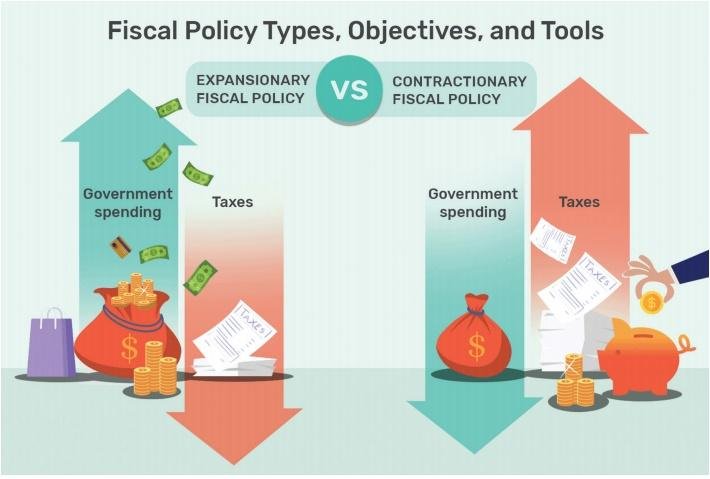
- Expansionary Fiscal Policy: Involves higher spending or lower taxes to stimulate demand during recessions.
- Contractionary (Tight) Fiscal Policy: Reduces spending or increases taxes to control inflation and lower the fiscal deficit.
- Neutral Fiscal Policy: Keeps revenue and expenditure balanced to maintain stability without restricting or stimulating growth.
Cyclicality of Fiscal Policy
Fiscal policy often responds to the business cycle in two distinct ways:
- Counter-Cyclical Policy: Moves opposite to the business cycle. The government increases spending during a slowdown and cuts it during a boom to stabilize the economy.
- Pro-Cyclical Policy: Moves in the same direction as the business cycle (expansionary in booms, contractionary in recessions). This is considered risky as it may deepen economic volatility.
Key Related Concepts
- Fiscal Deficit: The difference between total expenditure and total non-borrowed revenue; it indicates the government’s borrowing requirements.
- Fiscal Consolidation: The process of improving government finances and reducing the fiscal deficit through prudent spending and structural reforms, institutionalized in India by the FRBM Act.
- Crowding Out Effect: Occurs when heavy government borrowing leads to higher interest rates, which can reduce private investment.
- Fiscal Drag: When inflation pushes taxpayers into higher tax brackets without a real increase in purchasing power, reducing demand.
- Pump Priming: Deliberate government effort to inject funds into a sluggish economy to stimulate growth.
- Economic Stimulus: Intervention aimed at reviving growth during a slowdown, such as India’s Atma Nirbhar Bharat Abhiyan during the COVID-19 pandemic.
Frequently Asked Questions (FAQs)
What is the primary difference between expansionary and contractionary fiscal policy?
Expansionary policy increases spending or cuts taxes to boost demand, while contractionary policy reduces spending or raises taxes to curb inflation.
How does fiscal policy influence inflation?
The government can curb inflation by implementing a contractionary policy, which involves reducing public expenditure or increasing taxes to lower aggregate demand.
What is the FRBM Act?
The Fiscal Responsibility and Budget Management (FRBM) Act aims to institutionalize fiscal discipline, ensure prudent spending, and reduce deficits sustainably in India.
What is the “Crowding Out Effect”?
It is a theory suggesting that excessive government borrowing increases interest rates, making it more expensive for the private sector to borrow and invest.
Which ministry manages fiscal policy in India?
In India, fiscal policy is managed by the Ministry of Finance.
What are the main instruments of fiscal policy?
The major instruments are public expenditure, taxation, and public borrowing.
What is meant by “Fiscal Consolidation”?
It refers to policies aimed at reducing the government’s fiscal deficit and improving the overall health of public finances.
What is a “Counter-Cyclical” fiscal policy?
It is a policy that moves opposite to the business cycle—stimulating the economy during a recession and cooling it during a boom.
What is “Fiscal Drag”?
It occurs when inflation or income growth pushes taxpayers into higher tax brackets, reducing their disposable income without a real increase in purchasing power.
What is “Pump Priming”?
It is the deliberate injection of government funds into a sluggish economy to stimulate private-sector spending and recovery.