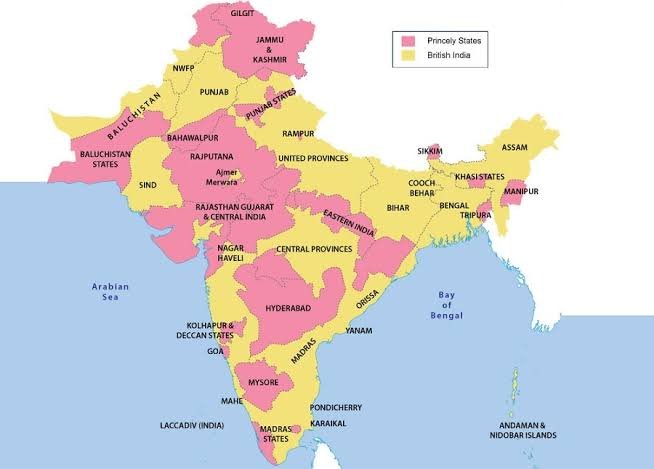
Between 1757 and 1857, the British East India Company evolved from a trading organisation into the dominant political power in India. This transformation was achieved through a combination of military conquest, diplomacy, political alliances and administrative measures. The victories at Plassey (1757) and Buxar (1764) established the Company’s territorial base, while later policies enabled it to extend control over Indian states without relying entirely on direct warfare.
The process gradually moved from securing British territories to subordinating Indian states and annexing territories, thereby establishing British paramountcy.
Early Territorial Consolidation: 1757–1813
The period following the Battle of Plassey marked the Company’s transition from a commercial organisation to a territorial power. The victories at Plassey and Buxar strengthened its position in Bengal, Bihar and Orissa.
The acquisition of Diwani rights in 1765 gave the Company control over revenue collection in Bengal. These revenues provided the financial resources needed for further military campaigns and territorial expansion. Economic interests and control over revenue-rich regions therefore remained closely connected with the Company’s political ambitions.
Shift towards Political Subordination: 1813–1857
With the growth of British power, the Company increasingly combined territorial conquest with indirect political control. Indian rulers could retain nominal authority but gradually lost control over important matters such as defence and external relations.
This approach allowed the British to extend their influence without immediately annexing every Indian state. The Subsidiary Alliance System became a major instrument of this strategy.
Policy of Ring-Fence
The Policy of Ring-Fence, associated with Warren Hastings, represented an early attempt to secure Company territories through neighbouring states.
The British sought to maintain friendly states as buffer zones around their possessions. They provided military assistance to allied rulers against external threats, while the allied states bore the cost of maintaining these forces.
Awadh was particularly important because of its strategic position in relation to Bengal. The policy helped the Company strengthen its security and influence without immediately pursuing widespread annexation. As British power grew, this relatively defensive approach gradually gave way to more interventionist policies.
Subsidiary Alliance System
Lord Wellesley (1798–1805) extensively used the Subsidiary Alliance System to bring Indian states under British political and military influence.
Under the arrangement, an Indian ruler had to accept the permanent stationing of British troops within the state and bear the cost of their maintenance. The ruler also required British approval before employing other Europeans and could not enter into war or diplomatic relations with another Indian ruler without British consent.
In return, the British promised protection against external threats and formally undertook not to interfere in the internal administration of the allied state. In practice, however, the arrangement greatly reduced the ruler’s political independence. The presence of a British Resident further increased British influence at the court.
Important states that accepted subsidiary arrangements included Hyderabad, Mysore, Tanjore, Awadh, the Peshwa, Berar and Scindia. Several Rajput states entered into such arrangements in 1818, while the Holkars were the last major Maratha power to accept the system in the same year.
Doctrine of Lapse
The Doctrine of Lapse, strongly associated with Lord Dalhousie (1848–1856), provided a more direct route to territorial annexation. Under the policy, when a ruler died without a natural male heir, the British could refuse to recognise an adopted successor and annex the state.
Although the principle was not originally devised by Dalhousie, he applied it extensively. Satara, Jhansi and Nagpur were among the major states annexed under the policy, while Jaitpur and Sambalpur were also absorbed.
The policy challenged established practices concerning succession and created considerable insecurity among Indian rulers.
A crucial distinction is that Awadh was not annexed under the Doctrine of Lapse. It was annexed separately in 1856 on the ground of misgovernment, and Nawab Wajid Ali Shah was removed. The annexation further weakened the position of the Indian ruling elite and contributed to the political discontent that preceded the Revolt of 1857.
Contrasting Frontier Policies
British strategy on the north-western frontier, particularly towards Afghanistan, reflected different approaches at different times.
Forward Policy
Associated with Lord Auckland, the Forward Policy sought to extend British strategic influence towards Afghanistan. British concerns about possible Russian expansion towards India were an important factor behind this approach.
The British attempted to create a protective zone beyond their existing frontier through diplomatic influence and military intervention. The First and Second Anglo-Afghan Wars were connected with this broader strategic objective.
Masterly Inactivity
In contrast, Lord Lawrence followed the policy of Masterly Inactivity in relation to Afghanistan. It favoured limited intervention and avoided interference in Afghan affairs unless developments posed a direct and immediate threat to British India.
The emphasis was therefore on frontier stability and non-intervention, rather than continuous expansion.
Political and Economic Impact
British expansion fundamentally altered India’s political structure. Large areas were brought under a common colonial authority, while Indian rulers increasingly lost their independence through annexations and subsidiary arrangements. This strengthened British paramountcy across much of the subcontinent.
The expansion also facilitated the development of common legal, bureaucratic and administrative institutions. However, these institutions primarily served the objective of consolidating colonial rule.
Territorial control enabled extensive revenue extraction and economic exploitation. Changes in land revenue arrangements and the commercialisation of agriculture disrupted traditional agrarian relationships, while India’s integration into the global economy placed it in a subordinate colonial position. The process also contributed to the drain of wealth.
Social, Military and Political Consequences
Annexations and administrative changes weakened several traditional ruling families and local power holders. Indian states also lost much of their independent military capacity as British authority expanded.
These changes affected different sections of society in different ways. Rulers faced the loss of political authority, while soldiers, peasants and other groups experienced the effects of military, economic and administrative changes.
The resulting discontent became one among several political, economic, military and social factors that contributed to the Revolt of 1857.
Expansion, Resistance and the Revolt of 1857
British territorial expansion therefore had a dual consequence. It strengthened colonial authority while simultaneously generating resistance. The annexation of Indian states, erosion of princely power, economic pressures, administrative changes and military grievances contributed to a wider climate of discontent.
These factors did not operate in isolation, but together formed an important part of the background to the Revolt of 1857, which became a major turning point in the history of British rule in India.
Transition to Crown Rule
Following the Revolt of 1857, the Government of India Act, 1858 ended the political authority of the East India Company and transferred the administration of India to the British Crown.
The emphasis subsequently shifted from aggressive territorial expansion towards consolidation, administrative control and maintenance of British paramountcy.
Although colonial expansion was driven by imperial interests, the administrative integration that developed under British rule later provided some institutional foundations for political integration in India.
Conclusion
British territorial expansion in India evolved from military conquest to political subordination and finally territorial annexation and consolidation. The Policy of Ring-Fence focused on strategic protection, the Subsidiary Alliance reduced the autonomy of Indian states, and the Doctrine of Lapse facilitated direct annexation. The Forward Policy and Masterly Inactivity represented contrasting approaches to the north-western frontier.
The expansion established British supremacy but also weakened indigenous political authority and intensified economic and social disruption. These developments became important elements in the wider background to the Revolt of 1857, after which India came under direct Crown rule in 1858.
Frequently Asked Questions
Q1. What were the major methods of British territorial expansion in India?
Ans: The British used military conquest, political alliances, diplomatic arrangements and annexation policies to establish and consolidate their control over Indian territories.
Q2. What was the objective of the Policy of Ring-Fence?
Ans: Associated with Warren Hastings, it sought to protect Company territories by maintaining friendly buffer states around them and using allied states as a strategic defence against external threats.
Q3. Who extensively used the Subsidiary Alliance System?
Ans: Lord Wellesley extensively used the system from 1798 to bring Indian states under British political and military influence.
Q4. What was the Doctrine of Lapse?
Ans: Associated with Lord Dalhousie, it enabled the British to annex certain states when their rulers died without a natural male heir and the British refused to recognise an adopted successor.
Q5. Was Awadh annexed under the Doctrine of Lapse?
Ans: No. Awadh was annexed in 1856 on the ground of misgovernment. Its annexation was therefore distinct from the Doctrine of Lapse.
Q6. How did the Forward Policy differ from Masterly Inactivity?
Ans: The Forward Policy favoured extending British influence towards Afghanistan, partly in response to concerns about Russian expansion. Masterly Inactivity, associated with Lord Lawrence, preferred limited intervention unless British India faced a direct threat.
Q7. How did British expansion contribute to the Revolt of 1857?
Ans: Annexations, loss of political authority, economic pressures, administrative changes and military grievances generated resentment among different sections of society. These factors formed part of the wider background to the Revolt of 1857.