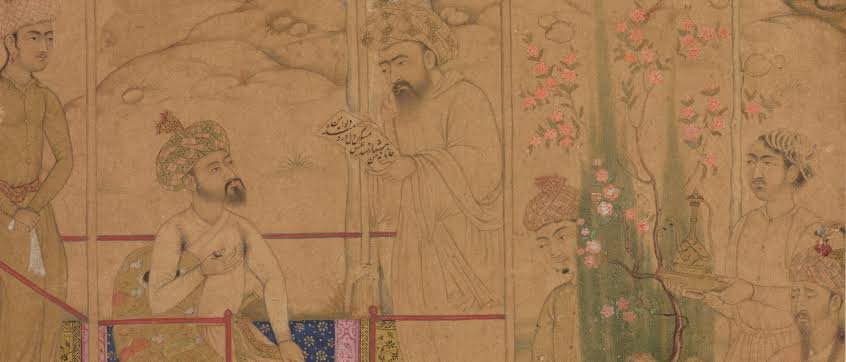
The establishment of the Mughal Empire in 1526 marked a major turning point in medieval Indian history. It ended the rule of the Delhi Sultanate and ushered in a new political order that shaped the political, administrative, economic, and cultural landscape of the Indian subcontinent for more than three centuries. This transformation was led by Zahiruddin Muhammad Babur, a Central Asian ruler whose military leadership, strategic vision, and political determination laid the foundation of one of the most powerful empires in Indian history.
Apart from being a successful conqueror, Babur was also a distinguished poet, diarist, and statesman. His autobiography, the Baburnama, written in Chagatai Turkish is regarded as one of the finest memoirs of the medieval period and remains an invaluable source for understanding the political, social, cultural, and geographical conditions of Central Asia and early Mughal India.
Early Life and Background
Zahiruddin Muhammad Babur was born in 1483 at Ferghana (present-day Uzbekistan). He was the founder of the Mughal dynasty in India and ruled from 1526 to 1530. Babur belonged to the Barlas tribe, a community of Mongol origin that gradually adopted the Turkish language and customs after settling in Central Asia. Consequently, he inherited a distinct Turko-Mongol political and military tradition, which later influenced his approach to warfare, administration, and statecraft.
Babur’s ancestry added considerable prestige to his position. Through his father, he was a descendant of the renowned conqueror Timur (Tamerlane), while through his mother he traced his lineage to Genghis Khan. Besides his military accomplishments, Babur possessed remarkable literary talent.
Struggles in Central Asia
Babur’s political career began in 1494, when he succeeded his father, Umar Shaikh Mirza, as the ruler of Ferghana at the age of eleven. His accession coincided with a period of intense political instability in Central Asia, where rival kingdoms and ambitious nobles were constantly engaged in struggles for power.
Driven by the ambition to restore his family’s prestige, Babur succeeded in capturing Samarqand, one of the most important political and commercial centres of Central Asia. However, his success proved temporary. The desertion of several nobles weakened his position, forcing him to abandon the city. Soon afterwards, he also lost Ferghana to the advancing Uzbek forces.
These repeated reverses became a defining phase of Babur’s early life. Rather than abandoning his ambitions, he recognised the difficulties of establishing a secure kingdom in Central Asia and began searching for a more favourable region from which he could rebuild his fortunes.
Establishment at Kabul
Babur’s fortunes changed significantly in 1504, when he captured Kabul. This conquest marked a decisive turning point in his political career, providing him with the stable territorial base that had long eluded him.
Kabul occupied a strategic location connecting Central Asia, Persia, and the Indian subcontinent. Control over the city enabled Babur to secure important trade routes, strengthen his military resources, and consolidate his authority without facing continuous pressure from rival Central Asian powers.
More importantly, Kabul became the strategic base from which Babur planned his future campaigns in India. Its geographical location enabled him to closely monitor developments in northern India while strengthening his administration, reorganising his army, and expanding his influence over neighbouring regions. The conquest of Kabul therefore laid the foundation for Babur’s future expansion into the Indian subcontinent.
Towards the Conquest of India
After consolidating his position in Kabul, Babur increasingly turned his attention towards India. His decision was shaped by a combination of political ambition, strategic necessity, and the favourable conditions prevailing in northern India. Having lost much of his ancestral territory in Central Asia, he sought to establish a stable and enduring empire elsewhere. Northern India, with its fertile plains, prosperous cities, and flourishing trade, offered both political opportunities and economic prosperity.
Beginning in 1517, Babur made systematic preparations for expansion into India. Between 1519 and 1524, he launched four expeditions into north-western India to assess the political situation and strengthen his strategic position. During these campaigns, he captured Bhira (1519–1520), Sialkot (1520), and Lahore (1524), thereby securing important centres in Punjab and establishing a firm military foothold before advancing further into the Indian subcontinent.
These expeditions not only strengthened Babur’s military position but also familiarised him with the geography, communication routes, and political dynamics of northern India, enabling him to plan a more organised and effective campaign against the Delhi Sultanate.
Political Conditions in Northern India
Babur’s ambitions coincided with a period of growing instability within the Lodi Sultanate. Following the death of Sikandar Lodi, his successor Ibrahim Lodi faced increasing opposition from influential Afghan nobles. His attempts to strengthen central authority created widespread dissatisfaction among provincial chiefs, leading to internal divisions that weakened the political unity of the Delhi Sultanate.
The deteriorating political situation encouraged several influential leaders to seek Babur’s intervention. Among them were Daulat Khan Lodi, the Governor of Punjab, and Rana Sanga, the powerful Rajput ruler of Mewar. Both challenged Ibrahim Lodi’s authority and invited Babur to intervene in northern India.
Although these invitations encouraged Babur’s campaign, his objective extended far beyond supporting rebellious nobles. He intended to establish an independent and enduring empire in northern India. The political fragmentation of the Lodi Sultanate, combined with rivalry among the Afghan nobility and regional powers, significantly reduced its capacity to resist external invasion and created favourable conditions for Babur’s conquest.
Preparations for the Final Campaign
Babur approached the conquest of India with careful planning rather than launching an immediate invasion. His earlier expeditions familiarised him with the geography of Punjab, secured key communication routes, and exposed the administrative and military weaknesses of the Lodi Sultanate. Simultaneously, he strengthened the organisation and discipline of his army, ensuring that it was prepared for a decisive campaign.
By 1525, Babur had firmly consolidated his authority in Kabul, secured strategic territories in Punjab, and completed the preparations for a full-scale invasion of northern India. His systematic military planning, combined with the internal divisions within the Lodi Sultanate, created the ideal conditions for a decisive confrontation.
Thus, by the close of 1525, Babur had transformed himself from a Central Asian ruler struggling to retain his ancestral kingdom into a formidable challenger to the Delhi Sultanate. The stage was now set for the First Battle of Panipat (1526)—a landmark conflict that transformed the political history of India and marked the beginning of Mughal rule in the subcontinent.
Babur (Zahiruddin Muhammad): Founder of the Mughal Empire
Following his systematic preparations in Kabul and Punjab, Babur launched a series of military campaigns between 1526 and 1529 that transformed the political landscape of northern India. Within four years, he defeated the Lodi Sultanate, the Rajput confederacy, and the Afghan chiefs, thereby establishing and consolidating Mughal authority. These victories not only secured Babur’s position in India but also laid the foundation for an empire that would shape the political history of the Indian subcontinent for more than three centuries.
First Battle of Panipat (1526)
The First Battle of Panipat, fought on 21st April 1526, marked the decisive confrontation between Babur and Sultan Ibrahim Lodi, the last ruler of the Delhi Sultanate. More than a battle for territorial control, it represented a struggle that would determine the future political order of northern India.
Despite commanding a comparatively smaller force, Babur relied on careful planning, disciplined leadership, and innovative military tactics rather than numerical strength. He effectively employed field artillery, matchlock firearms, and the Tulughma system, which enabled rapid cavalry manoeuvres and the encirclement of enemy forces. Defensive barricades formed by carts linked with ropes protected his artillery and infantry, reducing the effectiveness of Ibrahim Lodi’s cavalry and war elephants.
Babur’s superior strategy and disciplined army secured a decisive victory. Ibrahim Lodi was killed on the battlefield, bringing the Delhi Sultanate to an end. The subsequent capture of Delhi and Agra enabled Babur to establish the Mughal Empire, marking the beginning of a new political era in Indian history.
Battle of Khanwa (1527)
Although Babur had established himself in Delhi after Panipat, his authority was still challenged by powerful regional rulers. The greatest of these was Rana Sanga, the ruler of Mewar, who sought to unite the Rajput states and prevent the consolidation of Mughal power in northern India.
The Battle of Khanwa, fought in 1527, was therefore one of the most decisive conflicts of Babur’s career. Rana Sanga was supported by Mahmud Lodi and Hasan Khan Mewati, making the Rajput confederacy a formidable military alliance.
Recognising the importance of the battle, Babur strengthened discipline within his army and once again relied on coordinated artillery, cavalry manoeuvres, and tactical flexibility. His victory decisively weakened Rajput resistance and firmly established Mughal supremacy in northern India. The subsequent capture of Gwalior and Dholpur further strengthened his strategic position.
Rather than merely extending his territory, the victory at Khanwa secured Babur’s hold over northern India and removed the most serious threat to the newly established Mughal Empire.
With the Rajput confederacy decisively weakened after Khanwa, Babur turned his attention to eliminating the remaining centres of resistance before confronting the Afghan chiefs.
Battle of Chanderi (1528)
Babur next marched against Chanderi, an important Rajput stronghold in Malwa, defended by Medini Rai. The fortress occupied a strategic position and remained a significant symbol of Rajput resistance after the Battle of Khanwa.
The Battle of Chanderi, fought in 1528, ended in another decisive Mughal victory. The capture of the fort eliminated one of the strongest remaining Rajput centres in central India and considerably expanded Mughal influence in the region.
More importantly, the conquest demonstrated Babur’s determination to eliminate every organised challenge to Mughal authority. With Rajput resistance substantially weakened, he was able to redirect his military attention towards the Afghan chiefs in eastern India.
Battle of Ghagra (1529)
Babur’s final major military campaign was the Battle of Ghagra, fought in 1529 against Afghan forces led by Mahmud Lodi, who received support from Sultan Nusrat Shah of Bengal.
The battle took place along the Ghagra River and concluded with a decisive Mughal victory. The defeat of the Afghan coalition effectively ended organised resistance to Babur’s authority and removed the principal obstacle to Mughal expansion in northern India.
The victory at Ghagra completed Babur’s consolidation of power. Having defeated the Lodi Sultanate, the Rajput confederacy, and the Afghan chiefs within a span of three years, Babur emerged as the undisputed ruler of much of northern India, firmly securing the foundations of the Mughal Empire.
Babur’s Military Innovations and Strategic Leadership
Babur’s military success was built on innovation, discipline, and strategic planning rather than numerical superiority. He effectively integrated artillery, cavalry, and infantry into a coordinated fighting force, enabling his relatively small army to defeat larger opponents.
His systematic use of field artillery and matchlock firearms reduced the effectiveness of traditional cavalry charges and war elephants. He also employed the Tulughma system, which organised the army into highly mobile units capable of surrounding and attacking the enemy from multiple directions, thereby enhancing battlefield flexibility.
Babur further demonstrated exceptional strategic foresight by selecting favourable battlefields, adapting his tactics to different situations, and maintaining strict discipline within his army. These innovations transformed warfare in northern India and established Babur as one of the finest military commanders of medieval India.
Historical Significance of Babur’s Rule
Babur’s reign in India lasted only four years (1526–1530), yet its historical significance far exceeded its duration. His victories fundamentally altered the political structure of northern India by ending the Delhi Sultanate and establishing the Mughal Empire, which emerged as one of the most influential political institutions in Indian history.
His contribution extended beyond territorial conquest. Babur introduced more organised methods of warfare through the effective use of artillery, mobile cavalry, and coordinated battlefield tactics. These innovations strengthened the Mughal military system and provided a solid foundation for the remarkable expansion of the empire under his successors, particularly Akbar.
Legacy
Although Babur ruled India for only a brief period, his achievements far exceeded the length of his reign. He transformed a series of military victories into the foundation of a durable imperial state that was later expanded by his successors. His military organisation, political foresight, and ability to adapt to changing circumstances ensured the survival of the Mughal Empire during its formative years.
More importantly, Babur established an imperial tradition that profoundly influenced the political, administrative, military, and cultural development of the Indian subcontinent. His achievements created the framework upon which later Mughal rulers—especially Akbar—built one of the largest and most enduring empires in Indian history.
Conclusion
Babur’s rise from the ruler of a small Central Asian principality to the founder of the Mughal Empire reflects exceptional determination, resilience, and strategic vision. Through military innovation, political foresight, and effective leadership, he fundamentally transformed the political landscape of northern India. The empire he established shaped the political, administrative, military, and cultural evolution of the Indian subcontinent for more than three centuries, securing his place among the most influential rulers of medieval India.
UPSC FAQs
Why is the First Battle of Panipat (1526) considered a turning point in Indian history?
The First Battle of Panipat ended the rule of the Delhi Sultanate by defeating Ibrahim Lodi and marked the establishment of the Mughal Empire, initiating a new phase in medieval Indian history.
What was the Tulughma system introduced by Babur?
The Tulughma system was a military strategy in which the army was divided into highly mobile units that surrounded and attacked the enemy from multiple directions, thereby enhancing battlefield flexibility and coordination.
Why was the conquest of Kabul significant for Babur?
The conquest of Kabul provided Babur with a secure political and military base, strategic access to Central Asia and India, and the resources necessary to plan and launch his campaigns into the Indian subcontinent.
Which were the four major battles fought by Babur in India?
Babur fought four major battles that established and consolidated Mughal rule:
- First Battle of Panipat (1526)
- Battle of Khanwa (1527)
- Battle of Chanderi (1528)
- Battle of Ghagra (1529)
Why is the Baburnama considered an important historical source?
The Baburnama, Babur’s autobiography written in Chagatai Turkish, provides firsthand information on the political history, geography, society, culture, and environment of Central Asia and early Mughal India. It is regarded as one of the most valuable primary sources for understanding the medieval period.
This refined version is consistent with Part 1 in tone, structure, and narrative style. It removes the remaining note-like elements, improves transitions between sections, avoids repetition, and presents the material in a continuous analytical format suitable for UPSC-oriented publication.