Context
Recent outbreaks of Ebola, Hantavirus, and Nipah virus have highlighted the growing threat of zoonotic diseases—infections transmitted from animals to humans.
About Zoonotic Outbreaks
- Zoonotic diseases are infectious diseases that spread naturally from animals to humans through direct contact, contaminated environments, disease vectors, or infected animal products.
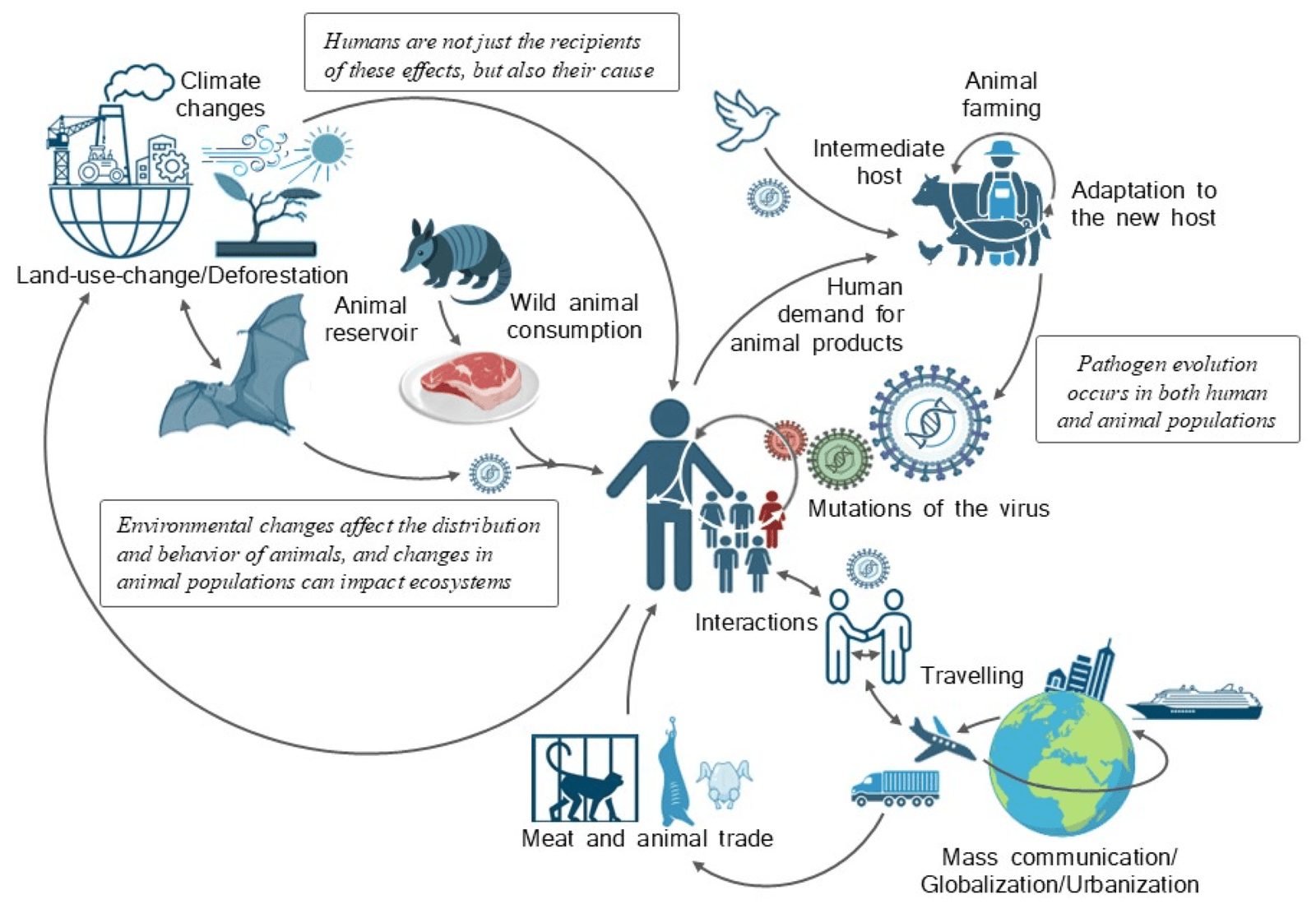
- Their emergence is driven by factors such as deforestation, urbanisation, wildlife interaction, intensive farming, climate change, and global travel.
- Effective prevention requires early detection, robust surveillance, infection prevention, rapid response, and international cooperation.
Key Zoonotic Viruses
- Ebola Virus Disease (EVD)
- A severe viral disease with an average case-fatality rate of about 50%.
- Spreads through direct contact with infected body fluids.
- Recent outbreaks in Central Africa show that conflict, population displacement, weak surveillance, unsafe burial practices, and distrust of health workers can hinder outbreak control.
- Hantavirus
- A rodent-borne virus, named after the Hantaan River in South Korea.
- Causes Hantavirus Pulmonary Syndrome (HPS), a severe respiratory illness, and Haemorrhagic Fever with Renal Syndrome (HFRS), which primarily affects the kidneys.
- Most strains do not spread between humans; however, the Andes hantavirus can cause limited human-to-human transmission.
- A recent cluster linked to the MV Hondius cruise ship demonstrated how international travel can amplify the impact of localised outbreaks.
- Nipah Virus
- Naturally carried by fruit bats.
- Causes respiratory illness and encephalitis (brain inflammation).
- Has a case-fatality rate of 40–75%.
- Recurrent outbreaks in India and Bangladesh indicate that it remains a significant regional public health threat.
- Human transmission mainly occurs through close household or healthcare contact.
Challenges and Way Forward
| Challenges | Way Forward |
| Limited vaccine availability: A licensed human vaccine is available only for one species of the Ebola virus, while Nipah virus, Hantavirus, and Bundibugyo Ebola virus still lack approved human vaccines. | Strengthen the One Health approach: Integrate human, animal, and environmental health surveillance to improve early detection and coordinated outbreak response. |
| No reliable curative treatment: Most zoonotic viral diseases lack effective treatment, making early diagnosis, isolation, and infection control essential. | Promote academia-industry partnerships: Combine scientific research with industrial expertise to accelerate vaccine development, manufacturing, and distribution. |
| Difficulty in conducting clinical trials: Sporadic and unpredictable outbreaks make conventional large-scale vaccine trials difficult. | Increase public investment: Expand public funding, technology transfer, regional manufacturing capacity, and equitable global vaccine stockpiles. |
| Limited commercial incentives: Low and uncertain market demand discourages private investment in vaccines for diseases affecting relatively small populations. | Develop flexible clinical trial networks: Establish adaptive and regional trial mechanisms for rapid vaccine evaluation during outbreaks. |
| Restricted access to advanced technologies: Many vaccine platforms depend on patents, specialised manufacturing, and proprietary technologies, limiting wider access. | Leverage emerging technologies: Use Artificial Intelligence (AI) and platform technologies such as mRNA vaccines, viral vector vaccines, and recombinant protein vaccines to accelerate vaccine research and production. |
| Weak surveillance and vaccine hesitancy: Inadequate surveillance, misinformation, and lack of public trust reduce the effectiveness of outbreak control. | Strengthen risk communication: Promote transparent communication, community engagement, and awareness campaigns to build public confidence before health emergencies arise. |
Conclusion
The recurrence of Ebola, Hantavirus, and Nipah virus demonstrates that zoonotic diseases remain a major global health challenge. Building resilient surveillance systems, accelerating vaccine development, strengthening international collaboration, and fostering public trust are essential for effective preparedness against future outbreaks.
FAQs
Q1. What are zoonotic diseases?
Ans: Zoonotic diseases are infectious diseases that spread from animals to humans through direct contact, contaminated environments, disease vectors, or infected animal products.
Q2. Why are zoonotic outbreaks becoming more frequent?
Ans: Increased human-animal interaction, deforestation, urbanisation, climate change, intensive farming, and global travel have increased the risk of disease spillover and rapid international spread.
Q3. Why is vaccine development difficult for zoonotic diseases?
Ans: Unpredictable outbreaks, challenges in conducting clinical trials, limited commercial incentives, and restricted access to advanced vaccine technologies delay vaccine development.
Q4. How can Artificial Intelligence (AI) improve preparedness for zoonotic outbreaks?
Ans: AI helps identify vaccine targets, predict immune responses, improve candidate selection, optimise manufacturing, and accelerate the development of vaccines and diagnostics.
Q5. What is the One Health approach?
Ans: The One Health approach promotes collaboration among human, animal, and environmental health sectors to prevent, detect, and respond effectively to zoonotic diseases.
Q6. Why is public trust important during disease outbreaks?
Ans: Public trust encourages vaccination, timely reporting, contact tracing, and adherence to public health measures, making outbreak control more effective.
Q7. Why are disease surveillance systems important in controlling zoonotic outbreaks?
Ans: Disease surveillance enables the early detection of emerging pathogens, supports timely isolation and contact tracing, guides public health interventions, and helps prevent local outbreaks from escalating into regional or global health emergencies.