Context
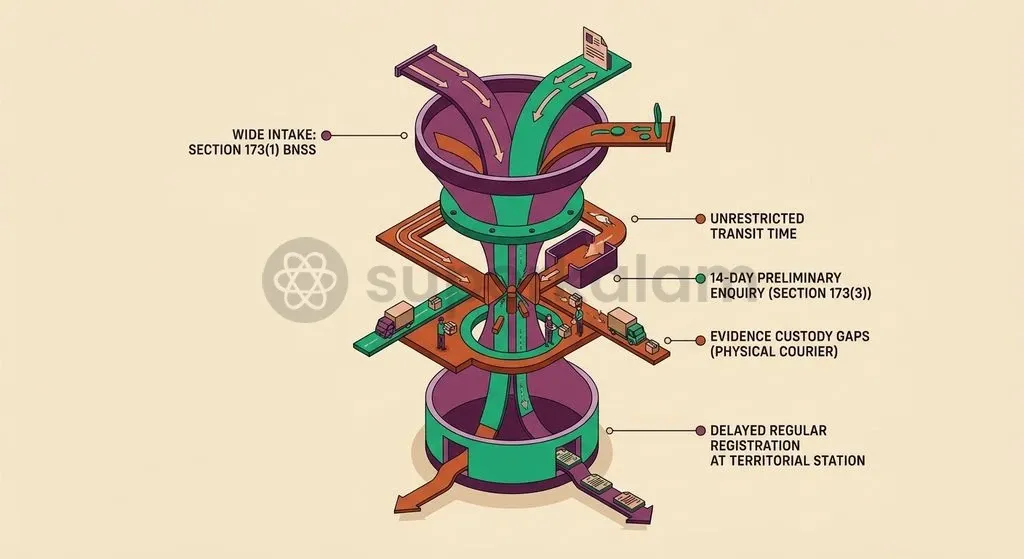
A recent Mumbai sexual assault case involving a 15-year-old girl has highlighted gaps in the implementation of Zero FIR, as transferring the case to another district caused repeated travel, financial hardship and procedural difficulties, raising concerns about effective access to justice for victims.
About Zero FIR
- Definition: An FIR (First Information Report) filed at any police station, no matter where the crime happened, and later sent to the police station with area jurisdiction; holds the same legal validity as a regular FIR.
- Origin: Suggested by the Justice J.S. Verma Committee (2013) after the 2012 Delhi gang rape case.
- Legal Basis: Section 173 of the BNSS (Bharatiya Nagarik Suraksha Sanhita), 2023 gives clear legal recognition to Zero FIR.
- Electronic Filing (e-FIR): Complaints can be sent online, with the informant’s signature needed within three days to register it.
- Free Copy: The informant has the right to get a free copy of the FIR immediately.
- Child-Friendly Rules: Both the POCSO (Protection of Children from Sexual Offences) Act, 2012 and BNSS, 2023 allow recording statements at a place safe and convenient for child victims (such as their home).
Significance of Zero FIR
- No Area Barriers: Gives territorial flexibility, letting victims report crimes quickly at the nearest police station.
- Victim-Friendly Justice: Makes justice easier to reach for women, children, and PwDs (Persons with Disabilities).
- Quick Action & Evidence Safety: Allows immediate police action, timely medical tests, and protection of key evidence before it is lost.
- Constitutional Values: Supports Article 14 (Equality before Law) and Article 21 (Right to Life, Dignity, and Fair Investigation).
Challenges in Implementation
- Travel After Transfer: Even after filing, victims often travel repeatedly to the jurisdictional police station for probes, medical checks, and court dates.
- Financial Burden: High travel costs and loss of daily wages hurt poor and migrant victims.
- Secondary Victimisation: Repeated questioning and insensitive behaviour cause fresh mental trauma.
- Weak Coordination: Poor teamwork among police, courts, hospitals, and welfare bodies delays justice.
- Police Reluctance: Unfair refusal to file complaints, intimidation, and delays in sending FIRs weaken the rule.
Way Forward
- Better Police Coordination: Appoint nodal officers and use digital networks (CCTNS — Crime and Criminal Tracking Network & Systems) for fast FIR transfers.
- Victim-Friendly Steps: Record statements (including via audio-video mode) and do medical checks near the victim’s home wherever allowed.
- One-Roof Support: Strengthen OSCs (One Stop Centres) to give medical, legal, mental health, and shelter help in one place.
- Legal & Child Support: Provide free legal aid via LSAs (Legal Services Authorities) and child care through CWCs (Child Welfare Committees).
- Money Support: Offer travel support and timely interim compensation to victims.
- Police Accountability: Train officers in trauma-sensitive, child-friendly policing and punish unjustified refusal to file FIRs.
- Result-Based Checks: Measure success by victim welfare, speedy probes, and fair justice, not just FIR counts.
FAQs
Q1. What is a Zero FIR?
Ans. An FIR registered at any police station, irrespective of jurisdiction, and later transferred to the appropriate police station.
Q2. Which committee recommended Zero FIR and in what context?
Ans. Justice J.S. Verma Committee (2013), formed after the 2012 Delhi gang rape case.
Q3. How does Zero FIR promote access to justice?
Ans. Removes territorial barriers, supports vulnerable victims and enables prompt police action and evidence preservation.
Q4. What is secondary victimisation?
Ans. Additional trauma caused by repeated questioning, insensitive treatment or procedural difficulties during the justice process.
Q5. How can the system reduce repeated appearances by victims?
Ans. Through local statement recording, electronic procedures, nodal officers and integrated victim-support services.