Current Context
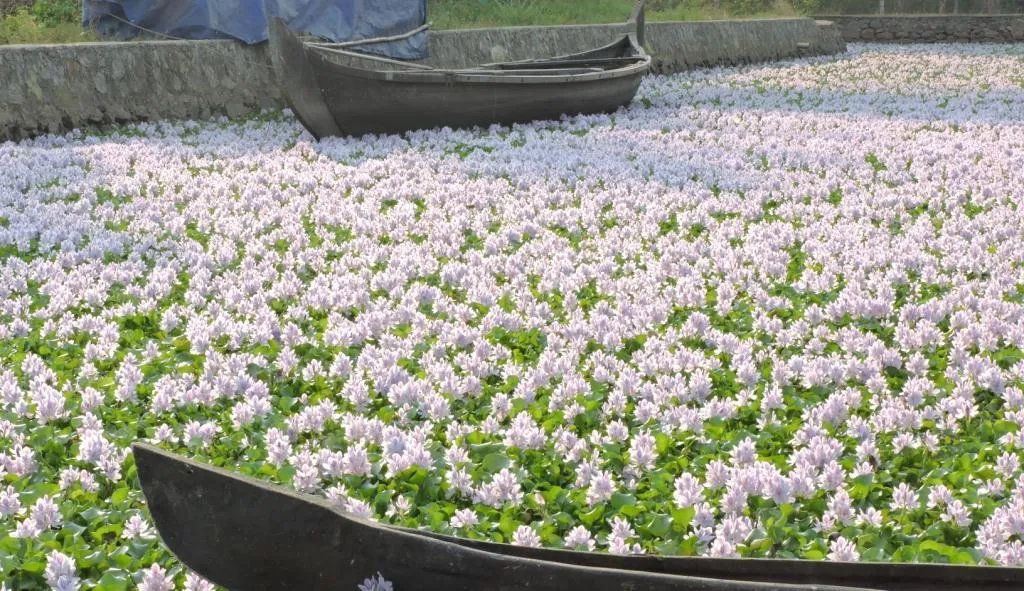
Rapid growth of water hyacinth has severely affected parts of Vembanad Lake in Kerala.
Water Hyacinth
- Scientific name: Eichhornia crassipes.
- Origin: Native to South America.
- Nature: A free-floating freshwater aquatic plant.
- Appearance: Has broad, glossy leaves and attractive lavender/purple flowers.
- Habitat: Grows rapidly in still or slow-moving, nutrient-rich freshwater.
- Global spread: It has become an invasive species across tropical and subtropical regions of the world.
Useful Applications:
- Phytoremediation: Can absorb certain pollutants and heavy metals from contaminated water.
- Compost: Plant biomass can be converted into compost and organic manure.
- Handicrafts: Fibrous plant material can be used for baskets, mats and decorative products.
Why Water Hyacinth is an invasive alien species?
- Rapid reproduction: It can multiply extremely quickly under favourable conditions.
- Dense mats: Forms thick floating layers over the water surface.
- Habitat alteration: Competes with native aquatic plants and alters aquatic habitats.
- Nutrient enrichment: Excess nutrients from agricultural runoff and sewage can promote its growth.
- Light blockage: Reduces sunlight reaching submerged plants.
Ecological and Economic Impacts
- Biodiversity loss: Crowds out native aquatic vegetation and affects associated fauna.
- Water quality: Dense growth can deteriorate water quality.
- Navigation: Makes movement of boats difficult.
- Fisheries: Alters fish habitat and can interfere with fishing activities.
- Mosquito breeding: Dense vegetation can create favourable stagnant-water conditions for some vectors.
- Irrigation: Can obstruct canals and water-management infrastructure.
Management Measures
- Mechanical removal: Remove large floating mats from affected waterways.
- Nutrient control: Reduce sewage and agricultural nutrient inflow into water bodies.
- Biological control: Explore scientifically tested biological-control agents where ecologically appropriate.
- Biomass utilisation: Convert safely collected biomass into compost or other useful products.
- Regular monitoring: Use remote sensing and field surveys to identify new infestations early.
- Integrated management: Combine physical, biological and nutrient-management approaches rather than relying on removal alone.
Vembanad Lake
Geographical Features
- Location: Located along the Kerala coast and extends across several districts.
- Type: A large brackish-water backwater/wetland system connected to the Arabian Sea.
- Freshwater input: Major rivers including Pamba, Manimala, Achankovil and Meenachil drain into the lake system.
Unique Features
- Below-sea-level farming: The Kuttanad region contains extensive paddy cultivation in areas below sea level.
- Coconut landscape: Coconut plantations are a prominent feature around the backwaters.
- Boat races: The famous Vallam Kali, including the Nehru Trophy Boat Race, is associated with Kerala’s backwater culture.
- Wetland ecosystem: Supports fisheries, agriculture, tourism and diverse aquatic biodiversity.
Conservation Significance
- Ramsar Site: Vembanad-Kol Wetland was designated a Ramsar site in 2002.
- Migratory birds: The wetland provides habitat for numerous resident and migratory birds.
- Kumarakom Bird Sanctuary: Located on the eastern bank of Vembanad Lake and is an important bird habitat.
- Livelihoods: Supports fishing, agriculture, inland navigation and tourism.
FAQs
Q1. What type of plant is water hyacinth?
Ans: A free-floating freshwater aquatic plant that is highly invasive.
Q2. What is the scientific name of water hyacinth?
Ans: Eichhornia crassipes.
Q3. Where is water hyacinth native to?
Ans: South America.
Q4. Why is water hyacinth harmful when it grows uncontrollably?
Ans: It forms dense mats that block sunlight and water flow, reduce oxygen and compete with native aquatic species.
Q5. Why is Vembanad Lake important?
Ans: It is a major Ramsar wetland supporting fisheries, agriculture, migratory birds, tourism and backwater ecosystems.
Q6. Which bird sanctuary is associated with Vembanad Lake?
Ans: Kumarakom Bird Sanctuary, located on the eastern bank of the lake.