Context
U.S. President Donald Trump recently invoked India’s electoral system while renewing his support for the Safeguard American Voter Eligibility (SAVE) America Act. Donald Trump contrasted India’s predominantly in-person voting system with the wider use of mail voting in the US and argued for stronger voter-identification requirements.
U.S. Electoral System
- Article I, Section 4 of the US Constitution, known as the Elections Clause, gives State legislatures authority over the time, place and manner of federal elections, while allowing Congress to modify these rules.
- Election administration is largely carried out by State and local authorities. The Federal Election Commission (FEC) primarily regulates federal campaign finance and does not conduct elections.
- The National Voter Registration Act, 1993 expanded voter-registration opportunities, while the Help America Vote Act, 2002 strengthened election technology and voter-registration systems.
- Voter registration is generally elector-initiated, and identification requirements vary across States. There is therefore no single nationwide photo-ID requirement for voting.
Indian Electoral System
- Article 324 of the Constitution vests the Election Commission of India with the superintendence, direction and control of elections to Parliament, State legislatures, and the offices of the President and Vice-President.
- Electoral rolls are prepared and revised through an institution-led process, supported by field-level election officials.
- Registered voters are issued an Elector Photo Identity Card (EPIC). The ECI also permits specified alternative identity documents for voting.
- India’s framework therefore combines central constitutional supervision with standardised electoral procedures, although election-related administration is carried out through State and local officials.
SAVE America Act
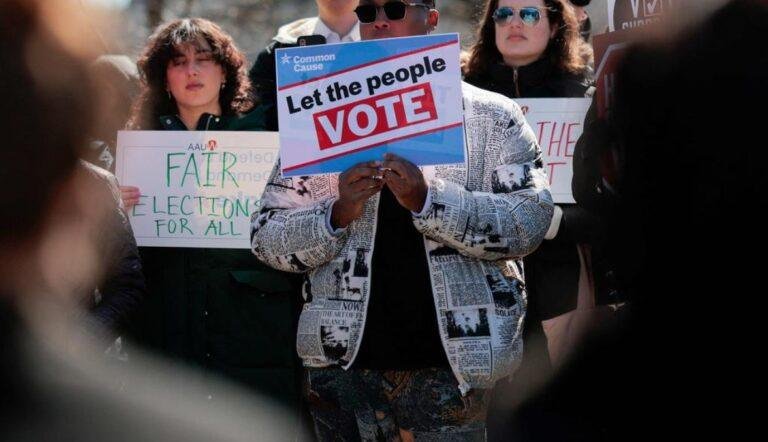
- The SAVE America Act seeks to strengthen citizenship verification and voter identification in US federal elections.
- The House of Representatives passed the current version of the Bill on 11th February 2026 by 218–213 votes. It has not become law and faces consideration in the Senate.
- The legislation proposes documentary proof of US citizenship for voter registration and a federal photo-identification requirement for voting.
- Supporters argue that stronger verification would protect electoral integrity. Critics contend that documentary requirements could make registration more difficult for eligible citizens who do not possess the specified documents.
- The SAVE America Act should not be confused with the existing SAVE system, a government service used for immigration-status verification.
Non-Citizen Voting Debate
- Non-citizen voting in federal elections is illegal in the US, while available evidence indicates that such voting is uncommon.
- The central policy debate concerns the extent of preventive verification required to protect elections.
- The issue involves balancing measures to prevent irregularities with the need to ensure that additional documentation does not create unnecessary barriers for eligible voters.
Electoral Roll Revision in India
- The Special Intensive Revision (SIR) is an ECI-led exercise to improve the accuracy of electoral rolls by identifying eligible electors and removing dead, shifted, duplicate or otherwise ineligible entries.
- The process involves house-to-house enumeration, verification, publication of draft rolls, claims and objections, and finalisation of electoral rolls.
- The exercise has generated debate over documentation, voter inclusion and the burden of verification, making procedural safeguards important to prevent wrongful exclusion.
- SIR and the SAVE America Act are not legally equivalent: SIR concerns electoral-roll revision, whereas the US legislation proposes new federal requirements for citizenship verification and voter identification.
Comparative Significance
- Institutional structure: The US relies substantially on State and local election authorities, while India has a constitutionally empowered national election commission.
- Voter registration: US registration is generally voter-initiated, whereas India’s electoral-roll preparation involves a stronger role for election authorities.
- Identification: US voter-ID requirements vary by State, while India follows a more uniform national framework based on EPIC and other approved documents.
- Common policy challenge: Both systems must balance electoral integrity and accurate voter rolls with accessibility and protection against wrongful exclusion.
Conclusion
The comparison between the two systems shows that electoral integrity depends on both identification mechanisms and the institutions responsible for maintaining voter eligibility. While the US and India follow different constitutional models, both face the challenge of improving verification without making electoral participation unnecessarily difficult. Transparency, accessible procedures and safeguards against wrongful exclusion are therefore essential to credible electoral governance.
FAQs
- What is the main difference between the US and Indian electoral systems?
The US follows a decentralised model, with substantial authority vested in States and local jurisdictions. India has a constitutionally supervised national electoral framework under the ECI.
- What is the Elections Clause?
Article I, Section 4 of the US Constitution empowers State legislatures to regulate the time, place and manner of federal elections, subject to Congress’s power to alter those rules.
- What is the SAVE America Act?
It is a US electoral-reform Bill seeking documentary proof of citizenship for voter registration and photo identification for federal voting. The House passed the current version in February 2026, but it has not become law.
- What is the role of the FEC?
The Federal Election Commission primarily administers federal campaign-finance laws. It does not perform the election-conducting role assigned to India’s ECI.
- What is Special Intensive Revision?
SIR is a process for revising electoral rolls through enumeration, verification, claims and objections, with the objective of maintaining accurate and eligible voter lists.
- Are the SAVE America Act and SIR equivalent?
No. The SAVE America Act proposes new federal requirements for citizenship verification and voter identification in the US. SIR is an electoral-roll revision exercise in India. Their common concern is ensuring accurate voter eligibility while protecting legitimate voters from exclusion.