Context
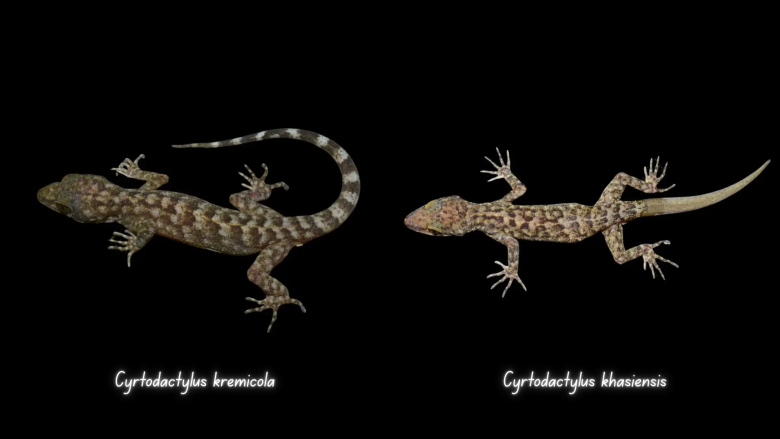
Scientists recently discovered two new bent-toed gecko species, Cyrtodactylus bossmit and Cyrtodactylus kremicola, in Meghalaya’s limestone caves, increasing the number of known Cyrtodactylus species in the state to nine.
About the Newly Discovered Bent-Toed Geckos
- Scientific Names & Classification: Cyrtodactylus bossmit and Cyrtodactylus kremicola; belong to genus Cyrtodactylus and family Gekkonidae.
- Discovery Region: Found in the Khasi and Jaintia Hills of Meghalaya.
- Habitat: Live inside limestone caves, rocky cracks (crevices), and nearby forest vegetation.
Key Features of the Two Species
| Feature | Cyrtodactylus bossmit | Cyrtodactylus kremicola |
| Common Name | Bossmit bent-toed gecko | Krem bent-toed gecko |
| Discovery Site | Maw Tynghiang Cave, Nongnah village | Rupasor Cave, Syndai village |
| District | South West Khasi Hills | West Jaintia Hills |
| Naming Origin | Named after Shillong’s traditional wooden Bossmit bus | From the Khasi word ‘Krem’, meaning cave |
| Maximum Length | 81.7 mm | 83.6 mm |
| Distribution | Multiple sites in Khasi Hills | Known only from its discovery site |
About Limestone Caves of Meghalaya
- Formation (Karst Topography): Formed when weakly acidic rainwater dissolves calcium carbonate-rich limestone, creating karst topography (underground cave and sinkhole landforms).
- Major Regions: Spread across the Khasi, Jaintia, and Garo Hills.
- Notable Caves: Krem Liat Prah, Mawsmai Cave, and Siju Cave.
- Ecological & Hotspot Value: Offer unique micro-habitats for rare, locally restricted (endemic) species inside the Indo-Burma Biodiversity Hotspot.
FAQs
Q1. Where was Cyrtodactylus kremicola discovered?
Ans. Rupasor Cave, Syndai village, West Jaintia Hills district, Meghalaya.
Q2. What is karst topography?
Ans. A landscape formed by the dissolution of soluble rocks like limestone, featuring caves, sinkholes and underground drainage.
Q3. Meghalaya forms part of which biodiversity hotspot?
Ans. The Indo-Burma Biodiversity Hotspot.