Context
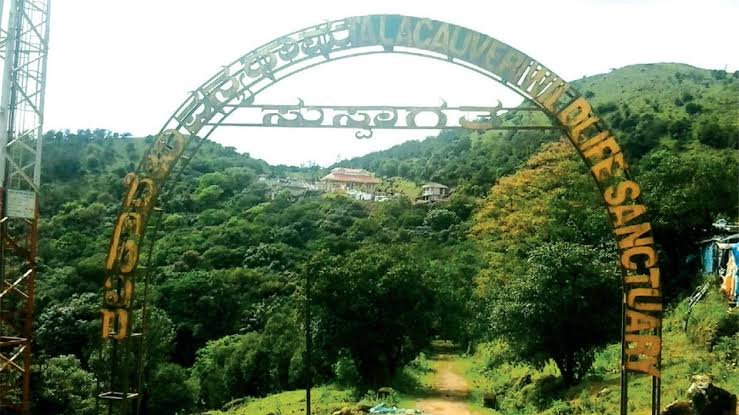
Karnataka Forest Department officials arrested eight alleged poachers inside the Talacauvery Wildlife Sanctuary, Kodagu.
Location and Geography
- Geographic Location: Located in Kodagu (Coorg) district, Karnataka, within the Western Ghats (nearest town: Madikeri).
- Status & Area: Sprawls over 105 sq km; declared a Wildlife Sanctuary in 1987 under the Karnataka Forest Department.
- Inter-State Boundary: Contiguous with the Ranipuram and Kottencheri hills in Kasaragod district, Kerala.
- Terrain & Climate: Characterized by rugged, steep topography with high annual rainfall (6,000–7,000 mm).
- ESZ (Eco-Sensitive Zone): Encompasses a 1–16 km buffer zone notified by the MoEFCC (Ministry of Environment, Forest and Climate Change) in 2017 to regulate ecological activities.
- Hydrological Significance: Named after Talakaveri—the origin point of the Cauvery River located on Brahmagiri Hill. The river flows through Karnataka and Tamil Nadu before discharging into the Bay of Bengal.
Biodiversity
- Vegetation Types: Dominately tropical evergreen, semi-evergreen forests, and montane grasslands.
- Key Flora: Features valuable timber and canopy species including Champak, Ironwood, Ebony, Indian Mahogany, Chukrasia, and Poon Spar.
- Key Fauna: Protects major flagship mammals such as the Asian elephant, tiger, leopard, dhole (Asiatic wild dog), gaur, and sloth bear.
- Wildlife Corridor: Serves as a vital ecological link connecting large mammal populations between Nagarahole National Park (Karnataka) and the Wayanad & Aralam Wildlife Sanctuaries (Kerala).
- Avian Significance: Designated as an IBA (Important Bird Area) by BirdLife International; home to notable species like the Nilgiri wood pigeon, Asian fairy-bluebird, Malabar trogon, and great hornbill.
- Global Ecological Status: Forms part of the Western Ghats Biodiversity Hotspot and was inscribed as a UNESCO World Heritage Site in 2012.
FAQs
Q1. Why is it named Talacauvery?
Ans. It is named after Talakaveri, the place on Brahmagiri Hill within the sanctuary where the Cauvery River originates.
Q2. What types of vegetation does it have?
Ans. Tropical evergreen forests, tropical semi-evergreen forests and grasslands.
Q3. What is an Important Bird Area (IBA)?
Ans. It is a site identified by BirdLife International for its importance to bird conservation.
Q4. What is an Eco-Sensitive Zone (ESZ)?
Ans. A buffer around a protected area where certain activities are regulated to minimise environmental pressure.