Context
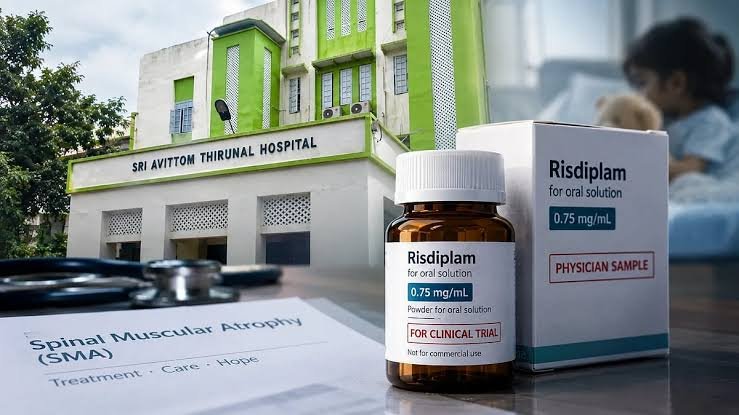
Kerala’s free treatment programme for Spinal Muscular Atrophy (SMA) came under scrutiny after generic risdiplam supplied to some patients carried wording associated with clinical-trial or physician-sample use. The episode raised wider questions over drug labelling, regulatory assurance, affordability and patient communication in rare-disease treatment.
What is Spinal Muscular Atrophy?
- SMA is an inherited neuromuscular disorder in which lower motor neurons progressively degenerate, causing muscle weakness and wasting.
- Loss of these neurons reduces signals from the spinal cord and brainstem to skeletal muscles, leading to progressive loss of movement and muscle mass.
- Weakness generally affects proximal muscles more severely, while advanced disease can impair swallowing and breathing.
Genetic Basis and Disease Mechanism
- SMN1 defect: Most common 5q SMA results from abnormalities in both copies of the SMN1 gene, reducing production of survival motor neuron protein.
- Motor-neuron degeneration: Low SMN protein impairs motor-neuron survival, progressively weakening voluntary muscles.
- SMN2 modifier: The SMN2 gene produces some functional SMN protein; a higher copy number is generally associated with milder disease, though severity varies among individuals.
Types and Clinical Expression
- Type 1: Usually begins before 6 months and is the most severe childhood form, often causing major respiratory and feeding difficulties.
- Type 2: Usually appears between 6 and 18 months; affected children may sit independently but generally cannot walk unaided.
- Type 3: Begins after 18 months and progresses more slowly, with patients often initially able to walk.
- Type 4: A rare adult-onset form characterised by comparatively mild and slowly progressive weakness.
Treatment
- SMN2-directed therapy: Risdiplam and nusinersen modify SMN2 processing to increase production of functional SMN protein, helping slow disease progression.
- Gene replacement: Onasemnogene abeparvovec delivers a functional SMN1 gene, addressing the underlying genetic deficiency in eligible patients.
- Supportive care: Respiratory support, physiotherapy, nutritional care and scoliosis management remain necessary because established motor-neuron loss may not be fully reversible.
- Early-treatment advantage: Earlier treatment can preserve more motor function, making timely diagnosis and access especially important in severe childhood SMA.
Kerala’s SMA Treatment Initiative
- Expanded access: Under Kerala’s KARE rare-disease programme, free risdiplam coverage was extended to genetically confirmed SMA Type 2 patients up to 25 years.
- Public financing: The State allocated ₹30 crore for the expanded programme, reducing the financial burden associated with long-term rare-disease therapy.
- Wider reach: Kerala estimated that the expansion could cover nearly 80% of confirmed SMA patients in the State, substantially broadening access to treatment.
FAQs
Q1. What is Spinal Muscular Atrophy?
It is an inherited disorder causing progressive motor-neuron loss, muscle weakness and atrophy.
Q2. Which gene is mainly associated with 5q SMA?
The SMN1 gene.
Q3. What role does SMN2 play?
It produces some functional SMN protein, and a higher copy number is generally associated with milder disease.
Q4. Which major disease-modifying therapies are used for SMA?
They include risdiplam, nusinersen and onasemnogene abeparvovec.
Q5. Why is Kerala’s SMA programme in news?
Because concerns over drug labelling and communication surrounding generic risdiplam triggered debate over treatment assurance and patient trust.