Context
A project will revive traditional surangams (underground water tunnels) in eight grama panchayats of Kasaragod, Kerala, to address dry-season water scarcity despite heavy rainfall.
About Surangams
- Definition: Horizontal tunnel wells excavated into hillside slopes to tap seeping groundwater.
- Other Names: Suranga, Thurangam, Thorappu, or Mala.
- Geographic Distribution: Found mainly in Kasaragod (Kerala) and Dakshina Kannada (Karnataka) along the Western Ghats.
- Current Status: Over 5,000 surangams exist in Kasaragod, though usage is declining due to modern borewell adoption.
- Historical Origin: Linked by some to Persia’s Qanat system via ancient trade/Silk Routes, while others view them as indigenous technologies (remains debated).
Structure & Working Mechanism
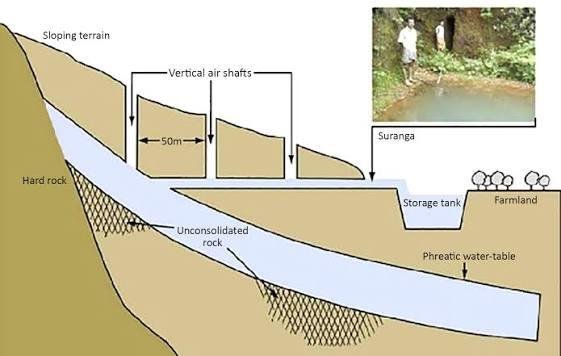
- Physical Design: Tunnels dug horizontally into laterite hillocks (45–0.70 m wide, 1.8–2 m high, extending up to 300 m long).
- Ventilation: Longer tunnels feature vertical air shafts for airflow and safety during digging.
- Water Flow: Groundwater seeps through walls and flows via gravity into external storage pits or reservoirs.
- Zero Energy Need: Functions purely on natural percolation and gravity, requiring no electricity or pumps.
- Geological Suitability: Ideal for porous laterite terrain, which stores water effectively while holding tunnel structures firm.
- Traditional Skill: Construction depends on indigenous knowledge of local slopes, soil stability, and natural groundwater indicators.
- Community Use: Serves as a reliable source of drinking water and micro-irrigation for local household clusters.
Key Challenges
- Borewell Expansion: Widespread deep borewells deplete aquifers and render traditional surangams obsolete.
- Loss of Traditional Skills: A declining pool of skilled tunnel diggers threatens the survival of this technique.
- Maintenance Burden: Requires regular desilting and cleaning to prevent tunnel clogging.
- Declining Groundwater Table: Dropping water levels reduce natural seepage, causing systems to dry up.
- Weakening Community Institutions: Erosion of informal collective governance leads to asset neglect.
Significance
- Environmental Sustainability: Operates with zero electricity or pumping, ensuring a zero-carbon footprint and low maintenance.
- Cost-Effectiveness: Economically more viable than borewells and open wells over the long term.
- Water Quality: Naturally filtered through soil, delivering cool, clear, and potable groundwater.
- Climate Resilience: Provides a decentralized, community-managed water source during seasonal droughts.
- Cultural Heritage: Preserves critical indigenous traditional knowledge of local water management.
FAQs
Q1. How do they work without pumps?
Ans. Groundwater seeps into the tunnel and flows by gravity to a storage pit at its mouth.
Q2. Why are they built in laterite terrain?
Ans. Laterite is stable enough to support tunnels and porous enough to allow groundwater seepage.
Q3. What are the other names of surangams?
Ans. Suranga, Thurangam, Thorappu and Mala.
Q4. What is the use of air shafts in long surangams?
Ans. They provide ventilation and help maintain air pressure inside long tunnels.