Context
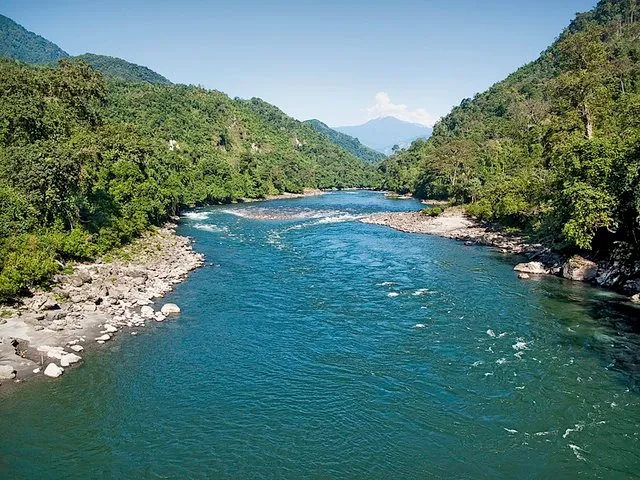
The Subansiri River in Arunachal Pradesh’s Upper Subansiri district recently recorded an unusually high and strong flow despite no reported rainfall in the area, raising concerns among nearby communities.
About the Subansiri River
- Subansiri is the largest right-bank tributary of the Brahmaputra, originating in Tibet and flowing through Arunachal Pradesh and Assam.
- It is a trans-Himalayan and antecedent river, meaning its course existed before the Himalayan uplift and was maintained as the mountains rose.
- It is called the “Gold River” due to the presence of gold dust in its waters.
- Course and Drainage
- Origin: Formed by the meeting of Lokong Chu, Chayal Chu and Tsari Chu on the Tibetan Plateau.
- Flows about 170 km in Tibet before entering India near Taksing, Arunachal Pradesh.
- Passes through the Miri Hills, cutting deep gorges, and enters the Assam Valley at Dulangmukh (Dhemaji).
- Flows about 86 km through Assam, passes near Majuli, and joins the Brahmaputra at Jamurighat (Lakhimpur).
- Its flow is mainly supported by Tibetan snowmelt and southwest monsoon rainfall in the Himalayan region, especially during June–September.
- Major Tributaries: Laro, Nye, Yume, Tsari, Kamla, Jiyadhol, Ranganadi and Dikrong.
Hydropower Projects
- Lower Subansiri Hydroelectric Project:
- It is a major 2000 MW run-of-the-river hydropower project being developed by National Hydroelectric Power Corporation (NHPC)on the river.
- It is located at Gerukamukh, near the Arunachal Pradesh–Assam border.
- On completion, it is expected to become India’s largest hydroelectric power plant.
- Oju Hydroelectric Project: Itis another major project proposed on the Subansiri River near Taksing in Arunachal Pradesh, close to the China border. It is planned as a 2,220 MW project. The central government granted environmental clearance to the project in 2025.
Specific Concerns
- Seismic and landslide risks: The river flows through a seismically active, landslide-prone Himalayan region, creating concerns over dam safety and slope stability.
- Downstream impacts: The Lower Subansiri Project has raised concerns in Assam over flood risks, sudden water releases, sediment flow, fish movement and livelihoods.
- Sediment management: High Himalayan sediment loads can be trapped by dams, affecting river channels, aquatic ecosystems and floodplains downstream.
Conclusion
The Subansiri is an important Brahmaputra tributary with major hydropower potential. However, projects such as Lower Subansiri and Oju highlight the need to balance renewable energy goals with dam safety, ecological protection and downstream interests.
UPSC FAQs
Q1. The Subansiri River is a tributary of which river?
Ans: It is the largest right-bank tributary of the Brahmaputra River.
Q2. Where does the Subansiri originate?
Ans: It originates on the Tibetan Plateau and enters India near Taksing in Arunachal Pradesh.
Q3. Which Indian states does it flow through?
Ans: The river flows through Arunachal Pradesh and Assam before joining the Brahmaputra.
Q4. What is an antecedent river?
Ans: It is a river whose original course existed before mountain uplift and was maintained as the mountains rose.
Q5. What is the Lower Subansiri Hydroelectric Project?
Ans: It is a 2,000 MW run-of-the-river hydropower project at Gerukamukh on the Arunachal Pradesh–Assam border.