Context
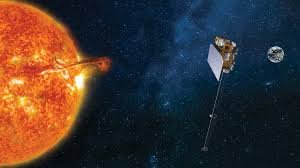
The United States has activated SOLAR-1 (Space Weather Observations at L1 to Advance Readiness-1), its first dedicated space weather monitoring satellite, to provide early warnings of solar storms and improve protection of satellites, communication networks, navigation systems, and power grids from space weather disturbances.
About SOLAR-1
- It is operated by the National Oceanic and Atmospheric Administration (NOAA) and was earlier known as Space Weather Follow-On–Lagrange 1 (SWFO-L1).
- It was launched on 24th September 2025 using a SpaceX Falcon 9 rocket.
- The spacecraft is positioned at the Sun–Earth Lagrange Point 1 (L1), about 1.6 million km from Earth towards the Sun.
- This gravitationally stable location provides a continuous and unobstructed view of solar activity.
- It monitors solar wind and tracks Coronal Mass Ejections (CMEs) before they reach Earth.
- It carries a compact coronagraph and other instruments for real-time observation of the Sun and space weather conditions.
- It can transmit CME images and data to NOAA’s Space Weather Prediction Center within about 30 minutes, enabling faster warnings.
- The mission is expected to improve space weather forecasts and strengthen the protection of satellites, communication systems, navigation networks, power grids, and space missions from solar storms.