Context
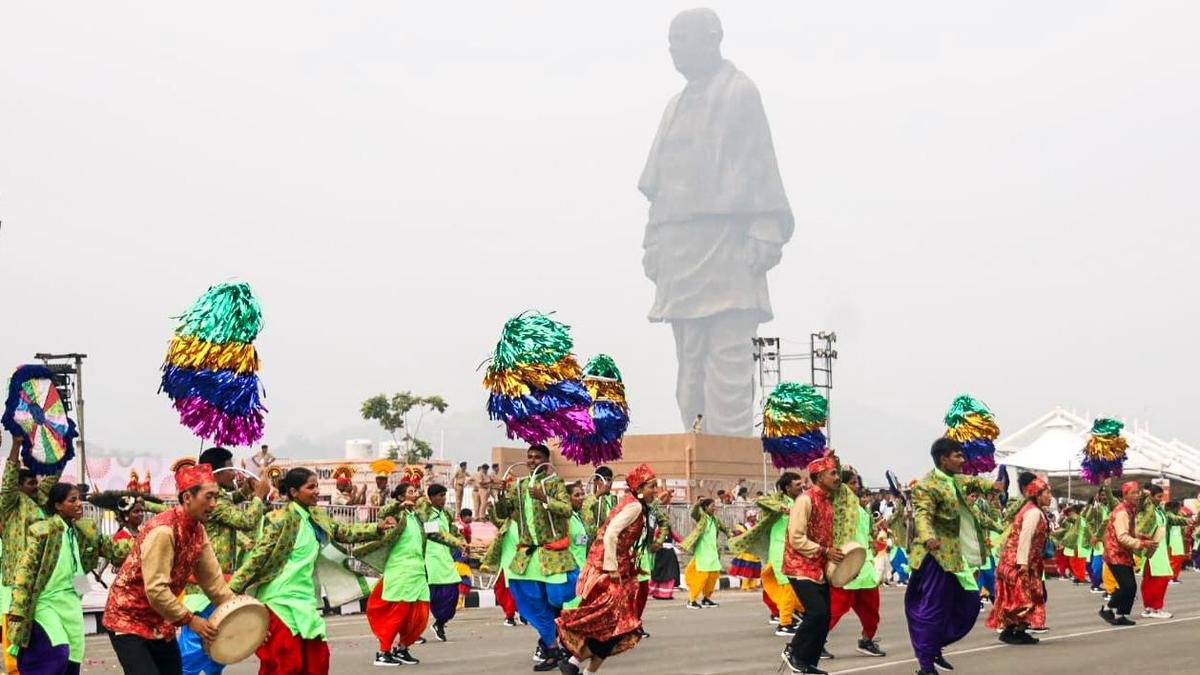
India celebrates Rashtriya Ekta Diwas (National Unity Day) every year on October 31, marking Sardar Vallabhbhai Patel’s birth anniversary. The 150th year of his birth (2025) is being observed with cultural events at Ekta Nagar, Gujarat, home to the Statue of Unity, the world’s tallest statue.
About Sardar Vallabhbhai Patel
- Born October 31, 1875, in Nadiad, Gujarat, Patel was trained as a lawyer in England (Middle Temple) before joining India’s freedom struggle.
- Known as the “Iron Man of India”, he was admired for his firm leadership, realism, and administrative skills.
- He served as India’s first Deputy Prime Minister and Home Minister, helping lay the foundations of a united, secure, and administratively strong India.
Major Contributions
- Freedom Struggle:
- Led the Kheda (1918) and Bardoli (1928) Satyagrahas, securing relief for farmers.
- Active in the Non-Cooperation (1920) and Quit India (1942)
- Earned the title “Sardar” (leader) for his success in Bardoli.
- Nation-Building (Post-1947):
- Integrated 560+ princely states into the Indian Union through persuasion and firmness, avoiding the country’s Balkanization.
- Established the All India Services (IAS, IPS), the “Steel Frame” of India’s administration.
- Strengthened India’s federal structure while preserving national unity.
Ideology / Vision
- Unity in Diversity: Patel saw India’s strength in its pluralism many languages, faiths, and regions bound by a shared civilizational ethos.
- Strong Centre with Cooperative States: He believed a powerful Union was vital to prevent disintegration, but also valued local governance.
- Discipline and Integrity: Advocated for a disciplined civil service and clean politics.
- Pragmatism over Idealism: His realism helped handle crises like Hyderabad, Junagarh, and Kashmir swiftly and decisively.
Significance
- Patel’s integration efforts preserved India’s territorial unity after Partition.
- His vision underpins India’s federal polity, civil service, and national integration policies.
- The Statue of Unity (2018) and Rashtriya Ekta Diwas (since 2014) symbolise his ideals.
- His message: “Manpower without unity is not a strength unless it is harmonised and united properly”; remains relevant for India’s diverse democracy.
Government Initiatives
- Rashtriya Ekta Diwas (National Unity Day): Observed on October 31 annually since 2014.
- ‘Run for Unity’: Nationwide events reaffirming unity and integrity.
- Ek Bharat Shreshtha Bharat: State and cultural exchange programme inspired by Patel’s vision.
- Statue of Unity (2018): 182-metre statue at Ekta Nagar, Gujarat, honouring his role in unifying India.
- Panch Pran (Five Pledges) under Azadi ka Amrit Mahotsav emphasizes national solidarity.
Conclusion
Sardar Patel’s legacy reminds India that unity is a continuous effort, not a settled fact. His vision of “Ek Bharat, Shreshtha Bharat” remains the guiding light for India’s strength, stability, and inclusiveness.
| Ensure IAS Mains Question
Q. “Sardar Vallabhbhai Patel’s vision of national unity was rooted in pragmatism, federal cooperation, and cultural harmony.” Discuss its relevance in contemporary India. (150 words) |
| Ensure IAS Prelims Question
Q. Consider the following statements about Sardar Vallabhbhai Patel: 1. He was India’s first Deputy Prime Minister and Home Minister. 2. He led the Bardoli Satyagraha, which earned him the title “Sardar”. 3. The Statue of Unity, dedicated to him, is located in Gujarat. Which of the statements given above is/are correct? a) 1 and 2 only b) 2 and 3 only c) 1 and 3 only d) 1, 2 and 3 Answer: d) 1, 2 and 3 Explanation Statement 1 is correct: Sardar Vallabhbhai Patel was Independent India’s first Deputy Prime Minister and Home Minister, playing a key role in national integration. Statement 2 is correct: He led the Bardoli Satyagraha (1928) against increased land revenue; his leadership earned him the title “Sardar” (leader). Statement 3 is correct: The Statue of Unity, the world’s tallest statue, is located at Ekta Nagar (Kevadia), Narmada district, Gujarat, built in his honour. |