Context
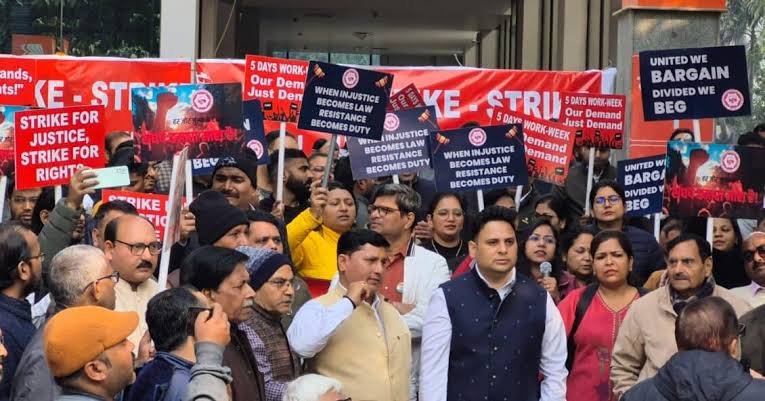
Public sector bank employees went on a nationwide strike over unresolved demands, particularly the five-day work week. The Department of Financial Services (DFS) put the revised Performance-Linked Incentive (PLI) scheme on hold, but the United Forum of Bank Unions (UFBU) continued the strike.
PLI Scheme: Background
- Revised Framework: DFS introduced a revised PLI scheme for Public Sector Banks (PSBs) for 2025–26, covering Scale IV officers and above.
- Incentive: Eligible officers could receive up to 365 days of basic pay, based on individual performance.
- Union Concern: Unions opposed the selective coverage, citing disparity with other employees, whose PLI was linked to 15 days of basic pay plus DA.
Key Issues and Demands
- PLI Dispute: Unions said the revised PLI framework departed from the 2020 agreement with the Indian Banks’ Association (IBA), which linked incentives to bank-level performance and covered employees more broadly.
- Five-Day Work Week: Unions seek a five-day week, with 40 additional minutes of daily work to maintain weekly hours. The proposal remains pending with the government.
- Pension Reforms: Demands include a uniform Dearness Allowance (DA) formula for pensioners and an option for National Pension System (NPS)-covered employees to shift to Old Pension Scheme (OPS).
- Employee Welfare: Unions also seek revision of ex-gratia benefits and medical facilities for retired employees.
Government Response
- Consultation: The Finance Ministry and DFS held discussions with bank employee representatives.
- PLI on Hold: The government placed the revised PLI scheme in abeyance for further consultation.
Outcome: The five-day work week remained unresolved, prompting the UFBU to continue its strike programme.
Impact and Future Course
- Service Disruption: The strike disrupted cash transactions, cheque services and branch-level operations, particularly affecting customers dependent on physical banking.
- Labour Relations: The dispute highlights tensions in collective bargaining between bank unions, management and the government.
- Continued Role of Branches: Despite the growth of digital banking, branches remain important for rural, semi-urban customers and senior citizens.
- Further Action: Unions have warned of a three-day nationwide strike (28–30 September) and an indefinite strike from 26 October if their demands remain unresolved.
Way Forward
- Promote Dialogue: Resolve pending issues through structured negotiations among the Government, IBA and UFBU.
- Ensure Fair PLI: Align incentives with individual and bank-level performance while ensuring fairness.
- Reform Work Practices: Assess the five-day week with staffing, digitalisation and customer-service needs.
- Safeguard Banking Services: Maintain essential services through contingency arrangements during strikes.
- Ensure Sustainable Benefits: Address pension and retiree welfare within a transparent and financially viable framework
Additional Information: Public Sector Banks (PSBs)
- Definition: Banks where the Government of India holds 51% or more of the voting equity/shares.
- Evolution: Bank nationalisation began with 14 major banks in 1969, followed by 6 more in 1980, expanding the public role in banking.
- Regulation: Regulated by the Reserve Bank of India (RBI) under the Banking Regulation Act, 1949, while ownership/policy is managed by the Department of Financial Services, Ministry of Finance.
- Role: PSBs support financial inclusion, priority-sector lending, government schemes and credit delivery, especially in underserved regions.
- Number: India currently has 12 PSBs, including SBI, Bank of Baroda, PNB, Canara Bank, Union Bank of India and Indian Bank.
- Key Challenges: Major concerns include NPAs, operational efficiency, governance, employee costs, technology adoption and competition from private banks and fintechs.
- Reform Focus: Current reforms aim to improve financial strength, governance, digital capability and customer service while retaining PSBs’ developmental role.
FAQs
Q1. What is the five-day work week demand?
Ans: Bank unions want banks to operate on a five-day weekly schedule. They proposed increasing daily working hours by about 40 minutes so that weekly working hours would not fall.
Q2. What is the role of the IBA in this dispute?
Ans: The Indian Banks’ Association (IBA) represents banks in negotiations on various employment-related matters and was part of the 2020 understanding concerning PLI.
Q3. What is the major pension-related demands?
Ans: Employees seek a uniform DA formula for pensioners and an option for NPS-covered employees to shift to OPS