Context
The Ministry of Tribal Affairs, with TRIFED as a key implementing agency, is implementing the Pradhan Mantri Janjatiya Vikas Mission (PMJVM) to strengthen tribal livelihoods by improving the value chain, entrepreneurship and market access for Minor Forest Produce (MFP), farm and non-farm products.
About PMJVM
- PMJVM was introduced in 2021–22 as an integrated framework to strengthen the marketing and institutional ecosystem for tribal products, particularly MFP.
- The scheme guidelines were notified in March 2023.
- It supports tribal enterprises through skill development, infrastructure, processing, finance and market linkages.
- TRIFED (Tribal Cooperative Marketing Development Federation of India) plays a central role in implementing the mission, including the Van Dhan Vikas Kendra (VDVK) component.
Key Features
- Price Support: MSP has been notified for 87 MFPs/commodities, helping protect tribal gatherers from distress sales.
- Value Addition: Assistance is provided for primary processing, packaging, branding and marketing to increase the value of tribal produce.
- Capacity Building: Producer groups receive support for skills, processing infrastructure and equipment.
- Financial and Logistical Support: The mission facilitates access to finance, storage, transportation and markets.
- Diversified Livelihoods: Its scope extends beyond MFP to include farm and non-farm tribal products.
Van Dhan Vikas Kendra (VDVK)
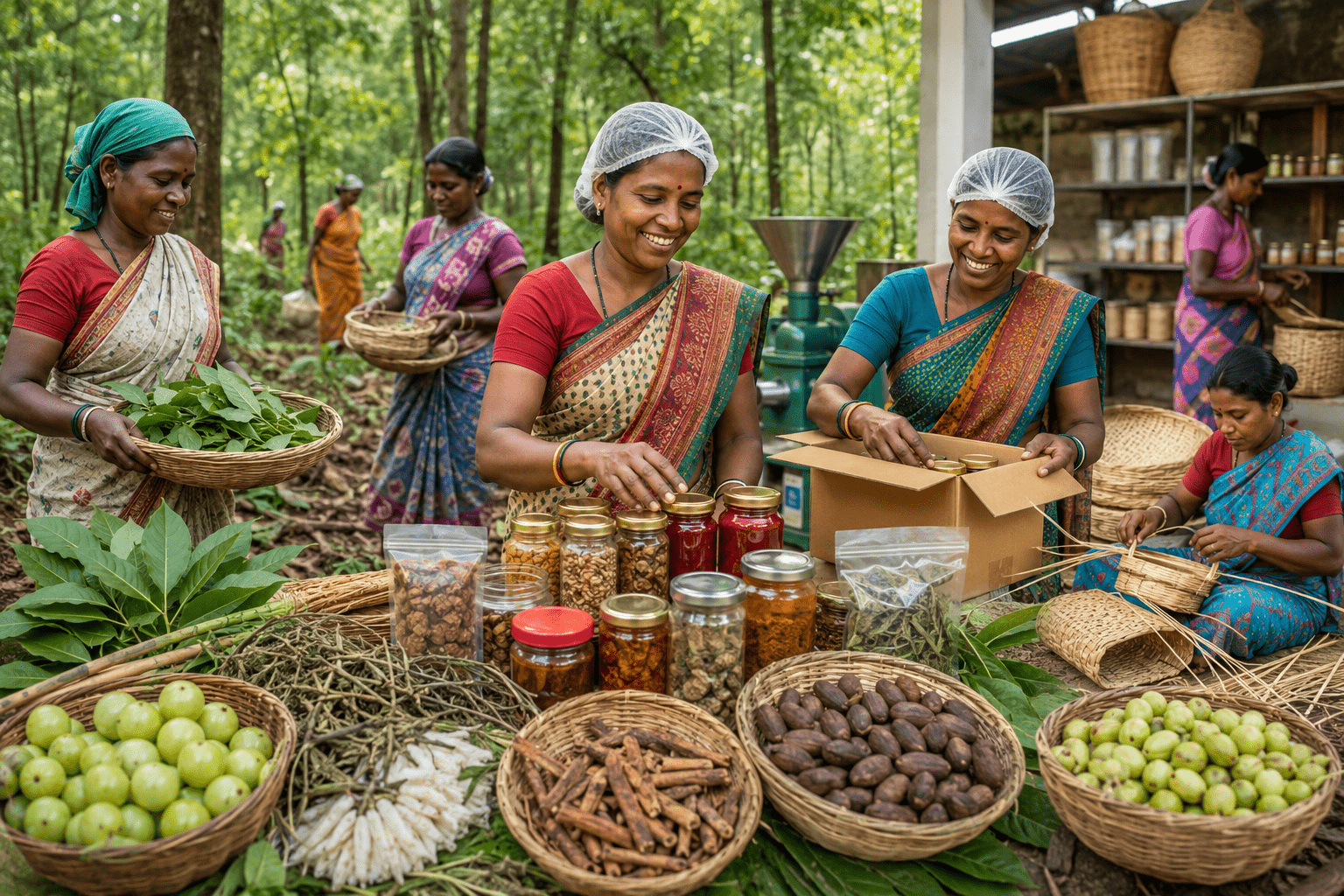
- VDVKs organise tribal Self-Help Groups (SHGs) into collective units for processing and marketing.
- A typical VDVK consists of 15 SHGs, with 20 beneficiaries in each, covering around 300 beneficiaries.
- These centres undertake aggregation, primary processing, value addition and marketing of tribal products.
- The model builds on the Van Dhan Yojana, launched in 2018 to create livelihood opportunities through better utilisation of forest and other local resources.
Significance
- Income Enhancement: Value addition enables tribal producers to capture greater economic value from local resources.
- Enterprise Creation: The mission encourages community-based businesses based on forest, farm and non-farm resources.
- Market Access: Collective marketing helps tribal producers participate in larger and organised markets.
- Skill Development: Training improves capabilities in sustainable collection, processing, packaging and marketing.
- Women’s Economic Participation: VDVKs provide opportunities for tribal women to engage in income-generating activities.
Conclusion
PMJVM provides an institutional framework for converting tribal resources and traditional skills into market-oriented enterprises, thereby strengthening livelihoods and economic participation.
FAQs
- What is PMJVM?
Pradhan Mantri Janjatiya Vikas Mission is a Ministry of Tribal Affairs initiative aimed at strengthening tribal livelihoods through value addition, entrepreneurship and market access.
- How was PMJVM created?
It was formulated in 2021–22 by merging schemes related to MFP marketing through MSP and value-chain development and institutional support for marketing tribal products.
- What is the role of a VDVK?
A Van Dhan Vikas Kendra brings SHGs together for collective processing, value addition and marketing of tribal products.
- What is the usual structure of a VDVK?
A typical VDVK has 15 SHGs, with 20 beneficiaries per SHG, covering around 300 beneficiaries.
- What is the current status of VDVKs?
As of 5 August 2026, 4,172 VDVKs had been sanctioned across 28 States/UTs, covering about 12.48 lakh beneficiaries.
- How many VDVKs were operational?
3,406 VDVKs were operational as of 5 August 2026, with reported sales of approximately ₹174 crore.
- What is the connection between PMJVM and Van Dhan Yojana?
The Van Dhan Yojana, launched in 2018, provides the foundation for the VDVK model, which promotes collective processing and value addition of forest and local produce.