Context
- The Union Government approved assistance for 3 crore additional houses under PMAY—2 crore rural houses under PMAY-G and 1 crore urban houses under PMAY-U 2.0—to meet additional housing requirements.
Dual Architecture of PMAY
- Pradhan Mantri Awas Yojana (PMAY) is the Government of India’s flagship housing programme aimed at enabling eligible households to access pucca houses with basic amenities.
- It operates through two major components:
- PMAY-Urban 2.0 (PMAY-U 2.0) for urban households.
- PMAY-Gramin (PMAY-G) for eligible rural households.
- The programme combines housing assistance with access to sanitation, electricity, drinking water and clean cooking fuel through convergence with other government schemes.
- PMAY therefore goes beyond shelter by linking housing with basic services, asset creation and household security.
PMAY-Urban 2.0: Housing Support for Urban Families
- Coverage: PMAY-U 2.0 aims to support 1 crore urban poor and middle-class families during 2024–29.
- Eligible groups: It covers households belonging to Economically Weaker Section (EWS), Low-Income Group (LIG) and Middle-Income Group (MIG) categories, subject to prescribed eligibility conditions.
- Beneficiary-Led Construction (BLC): Provides assistance to eligible families for constructing houses on their own land.
- Affordable Housing in Partnership (AHP): Supports affordable housing projects developed through public or private participation.
- Affordable Rental Housing (ARH): Provides rental housing options for groups such as urban migrants, workers, students and other eligible beneficiaries.
- Interest Subsidy Scheme (ISS): Reduces the effective cost of eligible housing loans through interest support.
PMAY-Gramin: Pucca Housing for Rural Households
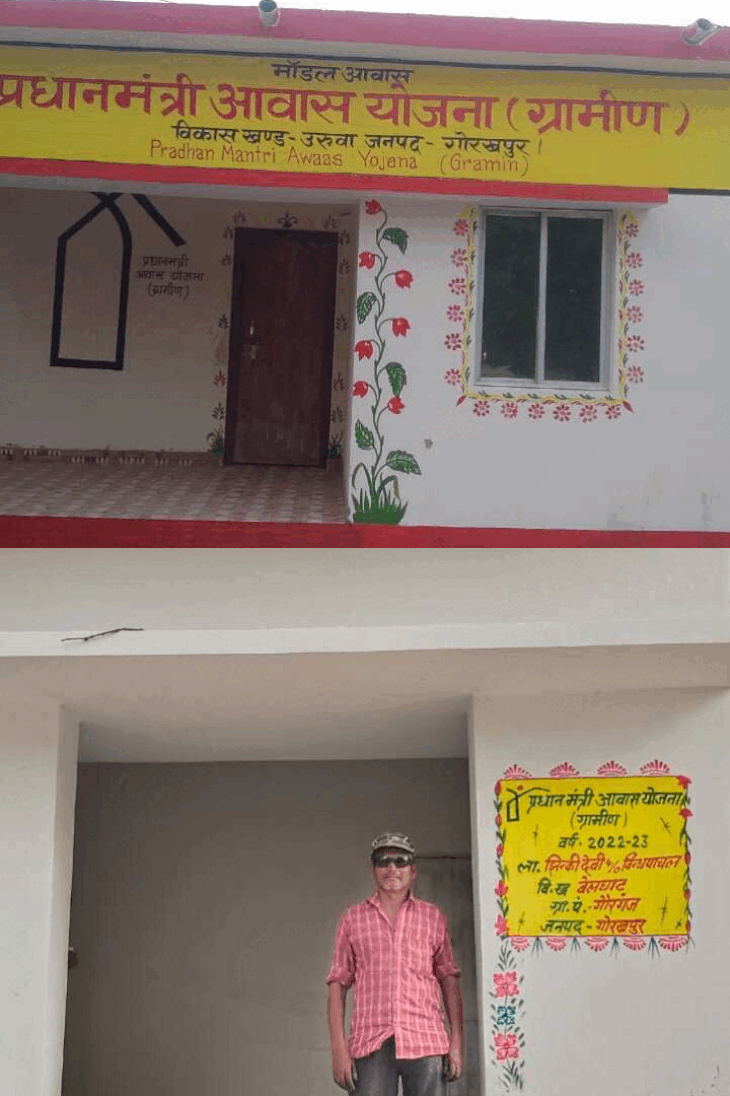
- Objective: PMAY-G provides pucca houses with basic amenities to eligible rural households that are houseless or living in kutcha or dilapidated houses.
- Additional coverage: The scheme has been extended for construction of 2 crore additional rural houses during 2024–25 to 2028–29.
- Financial assistance: Beneficiaries receive ₹1.20 lakh in plain areas and ₹1.30 lakh in specified hill and difficult areas.
- Beneficiary identification: Selection is based on housing deprivation criteria using SECC 2011, Awaas+ data and subsequent verification mechanisms.
- Beneficiary-led construction: Houses are generally constructed by beneficiaries themselves, with technical assistance and prescribed quality standards.
- Scheme convergence: PMAY-G links with MGNREGS for labour support and Swachh Bharat Mission-Gramin for toilet construction, while other basic services are provided through relevant schemes.
FAQs
Q1. What are the two major components of PMAY?
They are PMAY-U 2.0 for urban areas and PMAY-G for rural areas.
Q2. How many additional houses have been approved under PMAY?
The government approved assistance for 3 crore additional houses—2 crore rural and 1 crore urban.
Q3. What are the four verticals of PMAY-U 2.0?
They are BLC, AHP, ARH and ISS.
Q4. What financial assistance is provided under PMAY-G?
It provides ₹1.20 lakh in plain areas and ₹1.30 lakh in specified hill and difficult areas.
Q5. How are PMAY-G beneficiaries identified?
They are identified using housing deprivation criteria, SECC 2011, Awaas+ data and verification mechanisms.