Context
- The Union Cabinet recently approved the ₹1.86 lakh crore PM-DHARA Scheme to strengthen intra-state transmission networks and battery storage for integrating large-scale renewable energy into India’s electricity grid.
Grid Expansion and Storage Architecture
- PM-DHARA stands for PM-Developing Harmonized and Accelerated Renewable-energy Access.
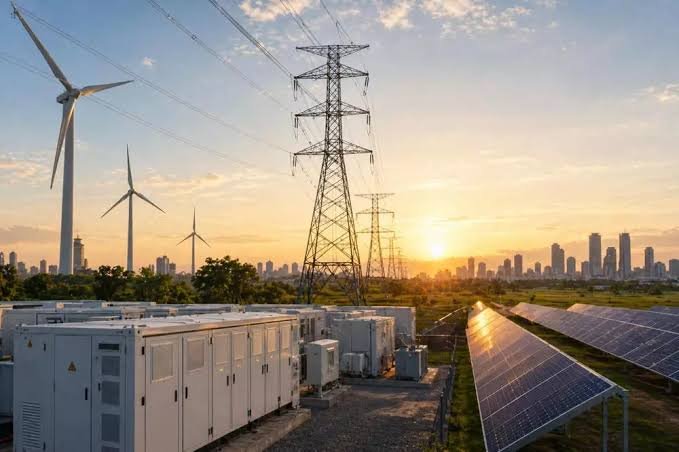
- It will strengthen the Intra-State Transmission System (InSTS) to enable evacuation of up to 135 GW of renewable energy across States and Union Territories.
- The scheme includes Green Energy Corridor Phase-III (GEC-III) for expanding and upgrading state-level transmission infrastructure.
- It also provides for 50 GWh of Battery Energy Storage Systems (BESS) at generation sites and other critical grid locations.
- BESS will help manage the intermittency of solar and wind power, store surplus electricity and release it when generation falls or demand rises.
- The scheme is targeted for implementation by FY 2032–33.
Financing, Implementation and Energy-Transition Role
- The large public investment, backed by Central Financial Assistance, seeks to overcome the high upfront cost of transmission and storage infrastructure.
- State Transmission Utilities as implementing agencies strengthen the role of States in integrating renewable-rich regions with electricity demand centres.
- Use of competitive bidding for new projects can attract private investment and improve cost efficiency, while existing networks can be upgraded according to system requirements.
- Combining transmission expansion with battery storage addresses two major renewable-energy constraints simultaneously—power evacuation and intermittency.
- The scheme can therefore reduce renewable-energy curtailment, improve grid reliability and flexibility, and enable a larger share of variable renewable power in India’s electricity mix.
- PM-DHARA represents a shift from merely expanding renewable-generation capacity towards building the grid infrastructure required for a reliable clean-energy transition.
FAQs
Q1. What does PM-DHARA stand for?
It stands for PM-Developing Harmonized and Accelerated Renewable-energy Access.
Q2. How much renewable-energy evacuation capacity is targeted?
The scheme aims to enable evacuation of up to 135 GW of renewable energy.
Q3. How much battery-storage capacity is proposed?
It provides for 50 GWh of Battery Energy Storage Systems (BESS).
Q4. What is the total outlay of PM-DHARA?
The total project outlay is ₹1,86,405 crore.
Q5. Which agencies will primarily implement the scheme?
State Transmission Utilities (STUs) will be the principal implementing agencies.