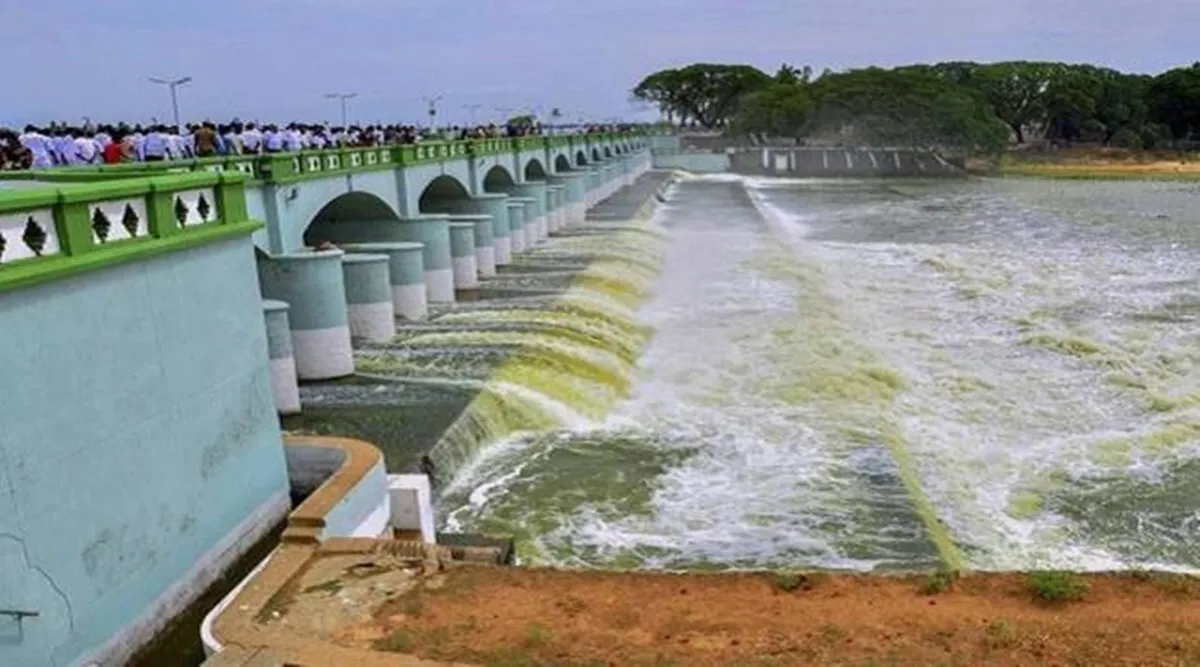
Context
Karnataka has identified 2,500 acres for the Mekedatu project, including about 500 acres of private farmland for acquisition. The project awaits Central Water Commission (CWC) appraisal of its revised DPR (Detailed Project Report) and subsequent clearances.
About the Project
- Project Type: A multipurpose balancing reservoir designed for drinking water supply and hydropower generation.
- Geographical Location: Located in Ramanagara district, Karnataka (near Kanakapura), approximately 90 km from Bengaluru and 4 km upstream of the Tamil Nadu border.
- River Confluence: Situated at the confluence of the Cauvery River and its major tributary, the Arkavathi River.
- Structural Design: Proposed concrete gravity dam (99 m high, 735 m long) featuring an underground powerhouse.
- Storage & Output: Storage capacity of 67 TMC (Thousand Million Cubic Feet), supplying 4.75 TMC of drinking water annually to Bengaluru and generating 400 MW of hydropower.
- Balancing Role: Stores surplus monsoon runoff for release during lean seasons, assisting Karnataka in fulfilling its statutory water-sharing obligations to Tamil Nadu.
- Ecological Submergence: Submerges over 5,000 hectares, primarily forest cover within the Cauvery Wildlife Sanctuary, requiring compensatory afforestation to mitigate environmental loss.
Dispute and Legal Position: Mekedatu Project
- Inter-State Context: Rooted in the Cauvery Water Dispute between Karnataka, Tamil Nadu, Kerala, and Puducherry.
- CWDT Award & SC Order (2018): Following the CWDT (Cauvery Water Disputes Tribunal) award, the Supreme Court ordered Karnataka to ensure 177.25 TMC water flow at Biligundlu in a normal year.
- Enforcement Bodies: Monitored and enforced by the CWMA (Cauvery Water Management Authority) and CWRC (Cauvery Water Regulation Committee).
- State Stances:
- Tamil Nadu (Lower Riparian): Fears reduced downstream flow and loss of its allocated water share.
- Karnataka (Upper Riparian): Asserts it only meets Bengaluru’s drinking water needs without reducing Tamil Nadu’s share.
- Supreme Court Stance (Nov 2025): Termed Tamil Nadu’s plea premature as the CWC (Central Water Commission) only allowed preparing the DPR, reiterating that water release targets remain binding.
- Pending Approvals: Final DPR review by CWC and CWMA, plus environmental clearances from MoEFCC (Ministry of Environment, Forest and Climate Change).
Environmental Concerns
- Biodiversity Impact: Threatens core wildlife in the Cauvery Wildlife Sanctuary, including Asian elephants, mugger crocodiles, and the critically endangered hump-backed mahseer.
- Habitat Fragmentation: Forest submergence cuts through wildlife corridors and disrupts critical elephant movement routes.
- Statutory Mitigation: Mandatory forest loss must be offset through land allocation and compensatory afforestation mandated under the FCA (Forest Conservation Act).
FAQs
Q1. What is the Mekedatu project?
Ans. A multipurpose balancing reservoir on the Cauvery River in Ramanagara district, Karnataka, for drinking water and hydropower.
Q2. What are the project’s main outputs?
Ans. About 400 MW hydropower, 4.75 TMC annual drinking water for Bengaluru and nearby areas, and 67 TMC storage capacity.
Q3. Why does Tamil Nadu oppose it?
Ans. As a lower riparian state, Tamil Nadu fears the dam will restrict Cauvery water flow and reduce its allocated share.