Context
The Ministry of Statistics and Programme Implementation (MoSPI) has proposed valuing marine fish stocks as natural wealth through experimental monetary accounts based on the UN-SEEA (System of Environmental-Economic Accounting) framework.
About the Initiative
- Treats marine fish stocks as natural capital and measures their economic value.
- Monetary asset accounts help assess whether fish resources are being maintained, depleted or regenerated, beyond annual catch data.
- Builds on EnviStats India, launched in 2018 for accounting of key environmental resources.
- The exercise is still experimental due to gaps in marine fisheries and stock-level data.
Key Facts on India’s Marine Fisheries
- World’s 2nd-largest fish producer globally; about 8% of global output.
- FY2024–25 fish production: 19.77 million tonnes (MMT) — 77% inland and 23% marine.
- Marine fish production: 46.15 lakh tonnes (2024–25), up from 34.43 lakh tonnes (2013–14).
- Fisheries contribute 1.09% of GVA and support nearly 30 million livelihoods.
- Marine exports (FY2024–25): 1.7 MMT, worth ₹62,408 crore, reaching 130 countries.
How Will Marine Fish Stocks Be Valued?
- Identify stocks: Select economically or ecologically important fish stocks.
- Assess stock health: Use about 10 years of species-wise catch data to track depletion or recovery.
- Estimate asset life: Determine how long the stock can generate economic benefits.
- Calculate resource rent: Estimate returns from fish resources after deducting fishing costs and normal returns.
- Value future benefits: Project future resource rent and discount it at a proposed 2% real rate to estimate the stock’s present value.
Significance
- Natural wealth: Adds marine fish stocks to national wealth accounting.
- Sustainable fishing: Shows whether fish stocks are healthy, declining or recovering.
- Better policy: Supports catch limits, stock restoration and fishing-capacity decisions.
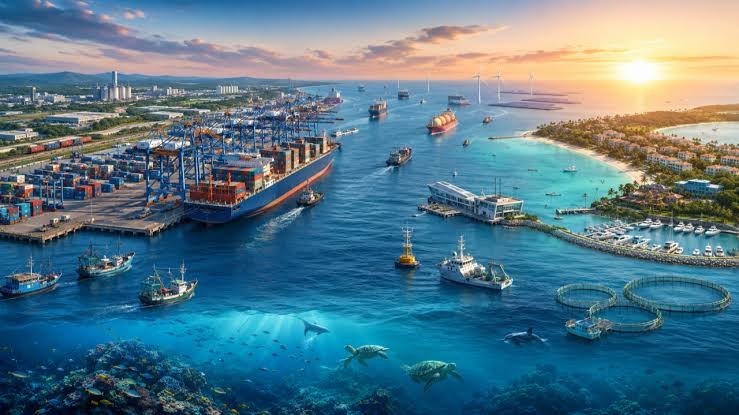
- Blue economy: Helps balance fisheries with ports, tourism, offshore energy and coastal development.
- International relevance: Helps India join countries such as Norway, Australia, Canada and the UK in developing monetary accounts for aquatic resources.
- Future security: Links present fishing benefits with the long-term sustainability of marine resources.
India’s Blue Economy Potential
- Coastline: ~11,100 km; Exclusive Economic Zone (EEZ): over 2 million sq km.
- EEZ resource potential: 7.16 million tonnes, as estimated by NITI Aayog; some deep-sea resources face overexploitation risks.
- Government support: Pradhan Mantri Matsya Sampada Yojana (PMMSY) is a key fisheries scheme, with ₹2,500 crore allocated for 2026–27.
- India aims to expand its blue economy while ensuring sustainable use of marine resources.
Challenges
- Data gaps: Limited species-wise and stock-wise fisheries data.
- Estimation issues: Reliance on proxy data makes stock health and asset-life estimates uncertain.
- Overfishing & climate change: Fishing pressure and changing ocean conditions can reduce fish stocks.
- Competing uses: Fisheries compete with shipping, tourism, ports and offshore energy for ocean space.
- Methodological gaps: SEEA-Fisheries guidelines for aquatic-resource valuation are still evolving.
Way Forward
- Better data: Strengthen species-wise stock surveys and fisheries databases.
- Scientific management: Use stock data for catch limits, fishing regulation and stock restoration.
- Climate resilience: Promote sustainable and climate-resilient fishing practices.
- Institutional coordination: Improve coordination among fisheries, environment and statistical agencies.
- Better accounting: Integrate marine asset accounts into environmental-economic accounting after improving data and methods.
- Sustainable blue economy: Balance economic growth with marine biodiversity and fisher livelihoods.
Conclusion
Marine fish accounting can help India treat ocean resources as natural capital, linking economic growth with sustainable fisheries. It can strengthen blue economy planning, biodiversity conservation and livelihood security, supporting long-term intergenerational sustainability.
FAQs
Q1. Why is MoSPI valuing marine fish resources?
Ans. To measure marine fish stocks as natural capital and assess whether India’s marine wealth is being maintained, depleted or regenerated over time.
Q2. Which framework guides India’s marine fish asset accounting?
Ans. The exercise follows the UN System of Environmental-Economic Accounting (SEEA), which connects environmental resources with economic accounts.
Q3. What is resource rent in fisheries accounting?
Ans. It is the economic return attributable to the natural fish resource after deducting costs such as labour, operations, depreciation and normal returns on fishing assets.
Q4. How is the monetary value of fish stocks estimated?
Ans. The proposed method considers stock condition, asset life and future resource rents, which are discounted at a proposed 2% real rate.
Q5. How is marine asset accounting different from fish production data?
Ans. Production data measures the quantity of fish caught. Asset accounting additionally examines the condition and economic value of the underlying fish stocks.