Context
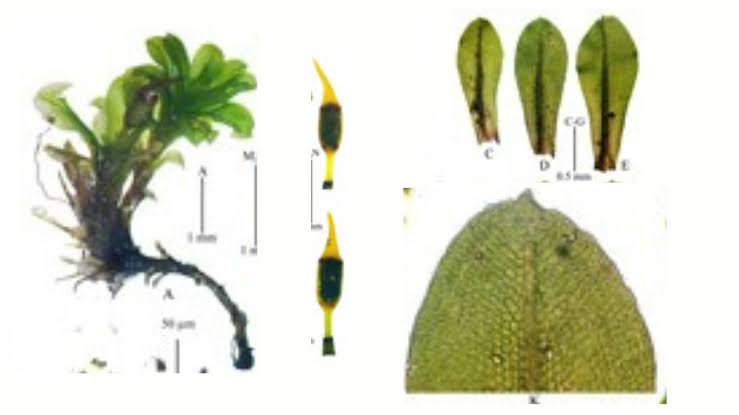
An international team of botanists has discovered a new moss species, Macromitrium nelliampathyanum, in the Nelliampathy Hills of Kerala’s Western Ghats, highlighting the region’s rich plant biodiversity.
About the Species
- Location: Discovered at Hill Top Mount, Nelliampathy Hills in Palakkad, Kerala (part of the Western Ghats), at around 1,400 metres altitude.
- Classification: A newly discovered moss species belonging to the genus Macromitrium, commonly found in tropical regions.
- Habitat: Grows in humid environments, typically on tree trunks, branches (epiphytic), and rocks.
- Naming: Named after its discovery site, the Nelliampathy Hills.
Key Features
- Leaves: Narrow leaves that curl and twist along the central vein (midrib) when dry.
- Spore Capsule: Small, nearly round (spherical) capsule holding reproductive spores.
- Calyptra: A pleated, hood-like protective cap covering the spore capsule, with a few hairs near its tip.
- True Anisospory: Produces two distinct sizes of spores within a single capsule.
About Mosses (Bryophytes)
- Nature: Small, non-vascular plants that lack water- and food-conducting tissues (xylem and phloem).
- Reproduction: Reproduce via spores instead of seeds or flowers, and generally require water for sexual reproduction.
- Ecological Role: Support moisture retention, nutrient cycling, and microhabitats in forest ecosystems.
FAQs
Q1. Where was Macromitrium nelliampathyanum discovered?
Ans. Nelliampathy Hills, Palakkad, Kerala, at approximately 1,400 metres altitude.
Q2. What is anisospory?
Ans. Production of two distinct size classes of spores, sometimes within a single spore capsule.
Q3. What is an epiphyte?
Ans. A plant that grows on another plant for physical support without being parasitic.