Context
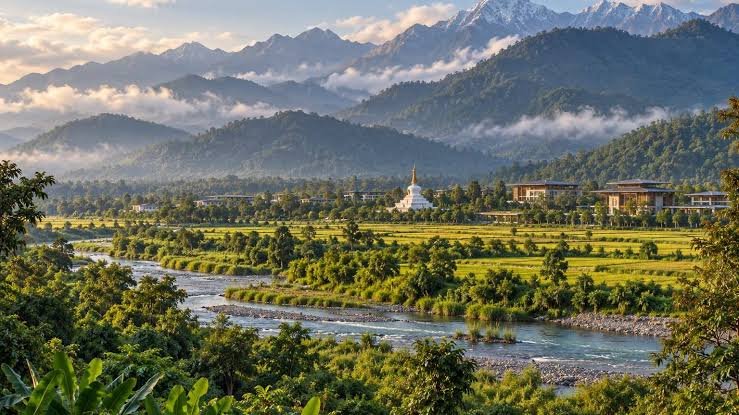
Bhutan is constructing 108 Jangchub Chortens (stupas of enlightenment) along a 12-km stretch of the Mau River in Gelephu, enshrining Buddhist relics of Indian origin. One stupa, built in nine hours, was dedicated to PM Narendra Modi in recognition of India’s support for the Gelephu Mindfulness City (GMC) project.
Jangchub Chorten: Meaning and Symbolism
- Etimology & Meaning: Jangchub means enlightenment, while Chorten is the Bhutanese term for a stupa, representing the mind and awakened state of the Buddha.
- Significance of 108: Represents a sacred number across Buddhism and Hinduism; aligns with the 108 beads in a mala, the 108 principal Upanishads in the Muktika canon, and astronomical ratios (Sun-Earth distance to Sun’s diameter).
- Consecration Practices: Stupas are consecrated with sacred relics, mantras, and dharanis (protective sacred verses), drawing on the Vajrayana tradition introduced from India by Padmasambhava (Guru Rinpoche).
- Vajrayana Buddhism: Commonly known as Tantric Buddhism, practiced across Bhutan, Tibet, and the Himalayan region; notably associated with Thangka scroll paintings.
Origin, Evolution, & Key Stupa Architecture
- Pre-Buddhist & Vedic Roots: Derived from pre-Buddhist burial mounds mentioned in Vedic literature; elevated into a central Buddhist institutional shrine after the Buddha’s death.
- The Eight Relic Stupas: Following the Mahaparinirvana (death) of Buddha at Kushinagar (c. 483 BCE), his corporeal relics were divided into eight parts, each enshrined under a dedicated stupa.
- Ashokan Expansion: According to the text Ashokavadana, Emperor Ashoka redistributed these relics across 84,000 stupas to propagate Buddhism nationwide.
- Architectural Evolution: Transformed from simple earth mounds into ornate structures during the Shunga and Satavahana periods, adding stone vedikas (railings), gateways, and Jataka tale carvings (e.g., Sanchi’s toranas).
- Core Architectural Components:
- Anda: Hemispherical earthen/stone dome.
- Harmika: Square railed balcony above the dome.
- Chhatra: Triple umbrella structure symbolizing three jewels of Buddhism.
- Vedika: Circumambulatory stone boundary railing.
- Torana: Monumental carved ceremonial entrance gateways.
- Major Pan-India Stupa Sites: Sanchi (Madhya Pradesh), Bharhut (MP), Amaravati & Nagarjunakonda (Andhra Pradesh), Piprahwa (Uttar Pradesh), and Sarnath (UP).
- Key Sarnath Stupas:
- Chaukhandi Stupa: Site where the Buddha reunited with his first five disciples.
- Dhamek Stupa: Commemorates the Dhammacakkappavattana Sutta (first sermon); built over Ashokan foundations during the Gupta period.
Background: Life and Teachings of the Buddha
- Shramana tradition: Emerged in 6th century BCE alongside Jains and Ajivikas; rejected Vedic animal sacrifices and caste hierarchies. The Brahmajala Sutta (Digha Nikaya) records 62 competing philosophical schools.
- Birth: Born as Siddhartha to the Shakya clan in Lumbini (Nepal); sage Asita prophesied his path to spiritual enlightenment.
- Ashokan Inscription: The Rummindei Pillar Inscription validates Lumbini, recording tax relief (bali exempted, bhaga reduced from 1/6 to 1/8).
- Mahabhinishkramana (Great Renunciation): Left palace life at 29 after seeing the Four Sights (old man, sick man, corpse, ascetic) with charioteer Channa and horse Kanthaka.
- Enlightenment: After about six years of wandering, he attained enlightenment under a pipal tree at Bodh Gaya (ancient Uruvela), on the banks of the Niranjana (Falgu) river.
- Four Noble Truths (Arya Satya):
- Dukkha: World is full of suffering.
- Samudaya: Desire and ignorance cause suffering.
- Nirodha: Suffering can be eliminated (Samsara cycle broken).
- Magga: Path to liberation via the Eightfold Path (Ashtangika Marga).
7. Dhammachakkappavattana (First Sermon): Delivered at Sarnath (Deer Park) to five disciples: Kondanna, Bhaddiya, Vappa, Mahanama and Assaji.
8. Tripitaka & Buddhist Councils:
- Sutta Pitaka: Buddha’s core discourses; compiled at First Council (Rajagriha) under Ajatashatru.
- Vinaya Pitaka: Monastic discipline rules; also compiled at the First Council.
- Abhidhamma Pitaka: Philosophical doctrines; compiled at Third Council (Pataliputra) under Ashoka.
9. Mahaparinirvana: Death at Kushinagar (c. 483 BCE); led to his corporeal relics being split into eight parts.
About Gelephu Mindfulness City (GMC)
- Vision & Concept: A planned city in southern Bhutan driven by King Jigme Khesar Namgyel Wangchuck, focusing on well-being, sustainability, and cultural preservation.
- Geographical Location: Situated at Gelephu, right along India’s Assam border.
- Legal Status: Created via Royal Charter (February 2024) as a highly autonomous SAR (Special Administrative Region) with direct executive, legislative, and judicial powers.
- Governance: Functions under the King’s guidance, adopting global best practices and international standards.
- Total Footprint: Spans a designated region of around 2,500 sq km.
- Urban Design: Features low- to mid-rise buildings designed around inhabitable bridges that house civic, educational, and transit infrastructure.
- Key Infrastructure: Planned facilities include an international airport, university, integrated medicine hospital, hydroponic greenhouses, and a hydroelectric dam.
- River Layout: Organized into 11 ribbon-like neighborhoods across 35 rivers and streams, using mandala-inspired urban designs.
- Eco-Flood Control: Uses terraced riverbank paddy fields to absorb floodwaters while preserving ecological corridors.
- Protected Areas: Encloses one national park and one wildlife sanctuary within its green boundary.
Significance of Gelephu Mindfulness City (GMC)
- Cultural Diplomacy: Exchanging Indian Buddhist relics reinforces India–Bhutan soft power ties and boosts Buddhist diplomacy.
- Strategic Value: Bordering Assam near the Siliguri Corridor (Chicken’s Neck), it enhances economic cooperation in the Eastern Himalayas.
- Development Model: Demonstrates a GNH (Gross National Happiness) model balancing growth and well-being through an autonomous SAR (Special Administrative Region).
- India’s Role: Backed by Indian infrastructure, including the approved Kokrajhar–Gelephu cross-border railway line.
FAQs
Q1. What are Jangchub Chortens?
Ans. Bhutanese stupas of enlightenment symbolising the Buddha’s awakened state; 108 are being built along the Mau River at Gelephu.
Q2. Why is the number 108 considered sacred?
Ans. It represents the beads in a prayer mala and the principal Upanishads; it also approximates the Sun–Earth distance in solar diameters.
Q3. Who introduced Vajrayana Buddhism in Bhutan?
Ans. Padmasambhava (Guru Rinpoche), an 8th-century Buddhist master from the Indian subcontinent.
Q4. Which stupa marks the site of the Buddha’s first sermon?
Ans. Dhamek Stupa at Sarnath.
Q5. What is the legal status of Gelephu Mindfulness City?
Ans. A highly autonomous Special Administrative Region (SAR) established by Royal Charter in February 2024, with executive, legislative and judicial powers.