Context
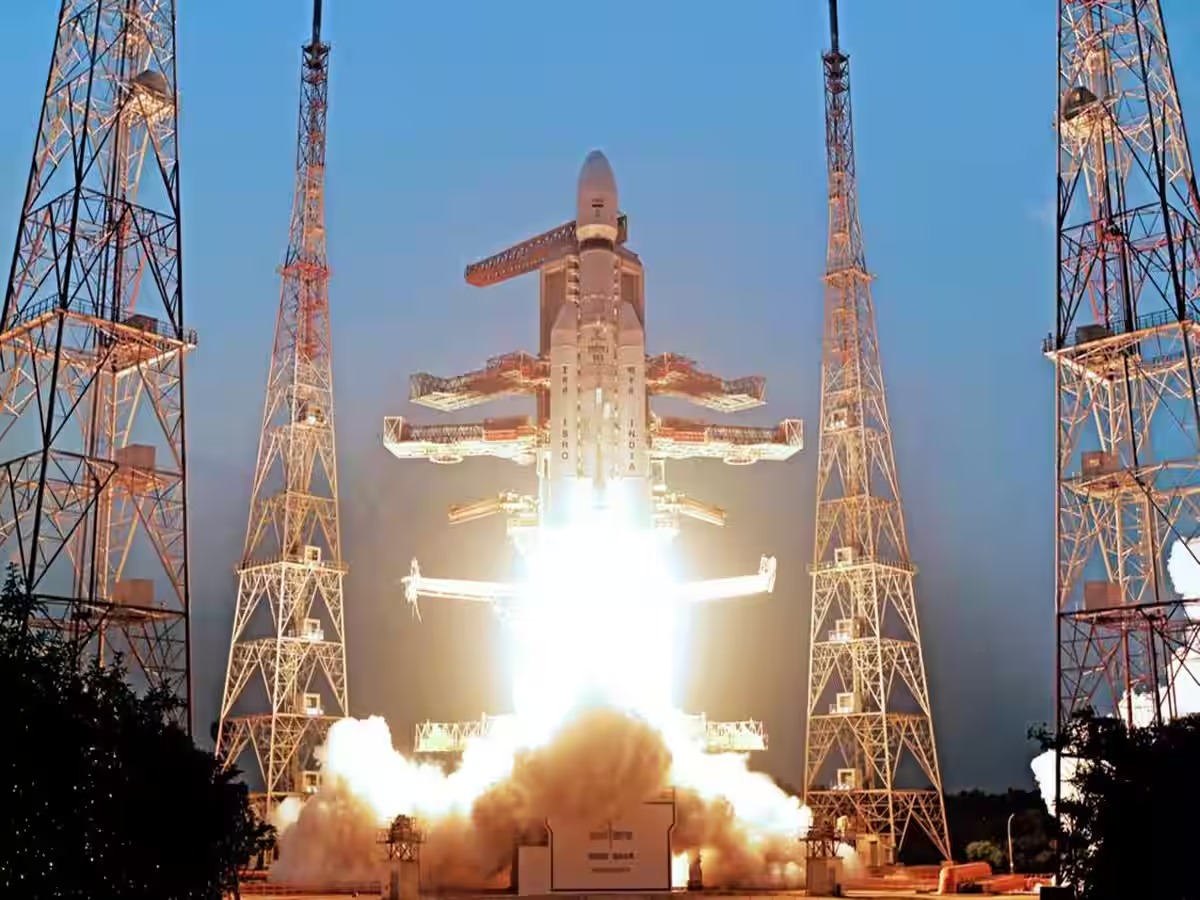
In November 2025, the Indian Space Research Organisation (ISRO) successfully launched the Indian Navy’s communication satellite GSAT-7R (CMS-03) from the Satish Dhawan Space Centre, Sriharikota.
About the GSAT-7R Satellite
- It is India’s heaviest communication satellite (Weight: approximately 4400 kg), which is designed and developed indigenously.
- A communication satellite is a type of satellite placed in space to help transmit signals for communication purposes (like phone calls, TV broadcasts, internet, and military communication).
- It receives signals from one place on Earth, amplifies them, and sends them to another place, often far away.
What are the other types of satellites?1. Weather Satellites: Monitor clouds, storms, and climate patterns to help forecast weather and track natural disasters. 2. Navigation Satellites: Provide GPS services for maps, travel, aviation, shipping, and military operations. 3. Earth Observation Satellites: Take pictures and collect data about Earth’s surface, used in agriculture, environment, urban planning, and disaster management. 4. Scientific Satellites: Used for space research, studying stars, planets, black holes, and cosmic radiation. 5. Military Satellites: Support defense operations with surveillance, communication, missile tracking, and secure data transmission. 6. Astronomical Satellites: Observe space beyond Earth’s atmosphere, like the Hubble Space Telescope, to study galaxies, stars, and cosmic events. 7. Biosatellites: Carry living organisms to study the effects of space on biology, used in experiments with plants, animals, and microbes. |
About LVM 3 Launch Vehicle
- GSAT-7R was launched via LVM 3.
- LVM 3 is the most powerful rocket developed by ISRO to carry heavy satellites into space.
- Payload Capacity
- To Low Earth Orbit (LEO): Up to 10,000 kg
- To Geosynchronous Transfer Orbit (GTO): Up to 4,300 kg
- To Trans-Lunar Injection (TLI): Around 3,000 kg
- It has 3 stages:
- First Stage: Two large solid boosters (S200) for initial thrust.
- Second Stage: Liquid core stage (L110) for sustained lift.
- Third Stage: Cryogenic upper stage (C25) for final orbital insertion.
About Geosynchronous Transfer Orbit (GTO)
- Geosynchronous Transfer Orbit (GTO) is an elliptical orbit used to move satellites from low Earth orbit to geostationary orbit.
- It acts as a transitional path; the satellite is first placed in GTO by the launch vehicle, and then uses its own propulsion to reach its final circular geostationary orbit.
- GSAT-7R , due to its high mass, was successfully placed in GTO so that it can raise and circularise its orbit using its onboard propulsion systems.
Importance of this Success
- Enhanced Naval Communication
- GSAT-7R provides secure and robust telecommunication coverage across the Indian Ocean Region.
- Supports voice, data, and video links for seamless connectivity between ships, submarines, aircraft, and Maritime Operations Centres.
- Boost to Indigenous Capabilities: The satellite is equipped with advanced indigenous components, showcasing India’s growing self-reliance in space and defense technology.
- Support for National Security
- Strengthens the Indian Navy’s operational readiness and situational awareness in complex maritime environments.
- Reinforces India’s commitment to safeguarding maritime interests.
- Aatmanirbhar Bharat in Action: Demonstrates India’s ability to develop and deploy high-tech defense assets independently, aligning with the vision of self-reliance.
- Strengthening Heavy Satellite Launch Capability: Validates LVM3’s capacity to launch satellites over 4 tonnes into GTO, reducing dependence on foreign launchers.
- Preparation for Gaganyaan Mission: The successful launch supports ISRO’s readiness for the Gaganyaan human spaceflight programme, which will use an evolved version of LVM3.
Conclusion
The successful launch of GSAT-7R marks a major leap in India’s space-based defense communication and reinforces the nation’s goal of self-reliance, security, and technological advancement in maritime operations.
| Ensure IAS Mains Question
Q. The launch of GSAT-7R marks a significant milestone in India’s quest for self-reliance and maritime security.” Discuss how the GSAT-7R enhances India’s defense communication network and contributes to national security. (250 words) |
| Ensure IAS Prelims Question
Q. With reference to the GSAT-7R satellite recently launched by ISRO, consider the following statements: 1. It will enhance India’s maritime communication by providing secure links among naval assets across the Indian Ocean Region. 2. It was launched using India’s most powerful operational rocket, LVM-3. 3. It has been directly placed into a geostationary orbit to ensure continuous coverage over the equatorial region. Which of the statements given above is/are correct? a) 1 and 2 only b) 2 and 3 only c) 1 only d) 1, 2 and 3 Answer: a) 1 and 2 only Explanation: Statement 1 is correct: GSAT-7R enhances Indian Navy’s communication and maritime domain awareness in the Indian Ocean Region. Statement 2 is correct: It was launched using LVM-3, ISRO’s heaviest operational launcher. Statement 3 is incorrect: The satellite was first placed in a Geosynchronous Transfer Orbit (GTO), not directly into Geostationary Orbit (GEO). It will use onboard propulsion to circularise its orbit later. |